Few films loom as large in Hollywood mythology as “Sunset Boulevard,” Billy Wilder’s 1950 portrait of fame, vanity, and the industry’s brutal disregard for aging stars.
At its haunted center stood Norma Desmond, a delusional silent film queen brought chillingly to life by Gloria Swanson in one of cinema’s most indelible performances. Draped in faded glamour and desperate for one more close-up, Swanson’s Norma became both a cultural archetype and a cautionary emblem of Hollywood self-destruction.
Yet before Swanson immortalized the role, Wilder reportedly envisioned another legendary diva: Mae West.
Ronnie Larsen’s new play, “Mae West in Sunset Boulevard,” imagines the conversations—and collisions of ego, wit, and artistic instinct—that might have unfolded had the famously sharp-tongued West stepped into the spotlight of one of Hollywood’s greatest masterpieces.
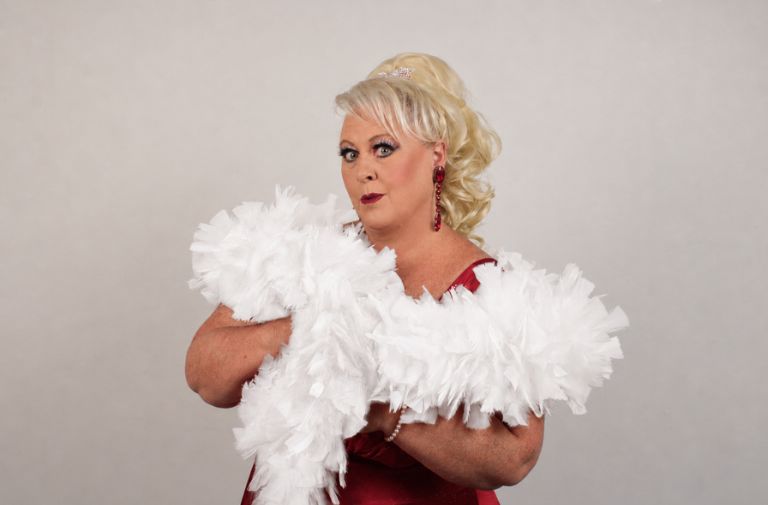
Jennifer McClain, a longtime star on South Florida cabaret stages and karaoke venues, is the blonde bombshell who will resurrect West and bring new light to perhaps the biggest “what if?” in Hollywood history.
McClain has frequently collaborated with Larsen, the award-winning playwright, director and producer at the Foundry in Wilton Manors. She showcased her acting skills there in “This Is Me,” a critically acclaimed 2020 autobiographical production that was among the first local shows staged after the pandemic shutdown, followed by other staged cabaret productions.
“Ronnie and I had talked for a long time about doing something different, a play. There was a Broadway play about Mae West, ‘Dirty Blonde,’ that we looked at, but it just wasn’t quite right,” recalled McClain. “But we kept coming back to Mae West and that’s when Ronnie sat down and wrote me a play.”
Even before she died in 1980 at the age of 87, West’s onscreen persona had become iconic, as comedians, female impersonators and drag queens asked audiences, “Why don’t you come up and see me sometime?”
Larsen began researching West’s life and discovered that Wilder had written Norma Desmond with West in mind. Accounts suggest she was open to the idea—until she read the script—but the negotiations were never documented. Within just a few days of nonstop writing, Larsen had a full-length play.
“There was an onscreen Mae West and the offscreen Mae West, yet they were very much the same person. She was complicated and that’s what made writing this play so interesting to me,” Larsen said. “Mae West became an icon, but imagine if she had taken that role!”
It’s easier for McClain to imagine West’s feelings.
“There are a lot of similarities,” McClain explained, “especially in the context of this play. Mae West is in her fifties and I’m in my 50s. We’ve both had long careers and had to work constantly to reinvent ourselves, to engage new audiences.”
Like McClain, she was also an ally to the LGBTQ community.
“She once wrote a play that included drag queens and homosexuals, at a time when—wink, wink—you couldn’t talk about those things,” McClain pointed out. “I didn’t know a lot about her before this show, but there are so many layers in this story that mirror her life, that mirror ‘Sunset Boulevard,’ that mirror me.”
While “Mae West in Sunset Boulevard” is a dramatic comedy, McClain’s cabaret fans can also look forward to a few musical numbers that West popularized in her films.
“It’s not a cabaret, it’s not a musical, but the music is such an integral part of revealing who Mae West was ... and is,” she concluded.
Jennifer McClain stars in the world premiere of “Mae West in Sunset Boulevard,” opening Wednesday, May 27, at the Foundry, 2306 N. Dixie Hwy. in Wilton Manors. Tickets start at $37.50, including the online booking fee, at RonnieLarsen.com.