

Ten years of pain. Ten years of grief. Ten years of mourning. Pain, grief, and mourning never go away. They shift, certainly. They morph into different expressions. Some days they are dull, other days they are as sharp as when they first appeared.
But they never go away.
To mark the 10-year anniversary of the Pulse Nightclub massacre, the Gay Men’s Chorus of South Florida (GMCSF) will perform a commissioned work to honor the 49 who died and the 53 who were wounded. Amor Eterno: A Requiem for Pulse was written by Saunder Choi, a Los Angeles-based composer.
It will debut at their Pride concert, Invincible, on June 19 at the Broward Center.
He talked with OutSFL about the difficulty of creating a piece that not only remembers the victims but also speaks to the survivors, the families and friends who have spent a decade in the shadow of pain, grief, and mourning.
A requiem is traditionally focused on prayers for the dead to quickly pass through purgatory and get to heaven. But Choi looked to Brahms for inspiration and the different tact taken by the master.
“Brahms focused on the living. Instead of ‘eternal rest grant to them, oh Lord,’ which is typically how requiems start, he started with ‘blessed are those who mourn. It’s focused on the living and takes on a very humanist perspective.”
Originally from the Philippines, Choi was living in LA when Pulse happened. He had been here about four years and the news reshaped how he saw America.
“When that happened, it kind of broke some sort of glass. It kind of broke that version of a free America a little bit for me as an immigrant.”
It also inspired him to write about the litany of tragedies inextricably linked to gun violence.
“At that time I wrote a piece titled American Breakfast. The text likened gun shooting because it was happening so often it was like Breakfast in America.”
While Brahms’ requiem serves as the skeleton, the beating heart of Amor Eterno is the group of people who carry the pain and grief. Choi met with some of them and watched interviews they gave in the immediate aftermath and then interviewed them again for this work.
“You could really see that the grief didn’t go away, but it definitely transformed. I feel that’s a universal aspect to loss and grief. It never really goes away, it transforms.”
Choi collaborated with four poets to create and work through Amor Eterno’s seven movements, giving them notes on universal themes from Brahms.
“For example, the second movement [titled] For All Flesh Is As Grass, has a lot of Earth themes. But it also has the funeral march. Amor Eterno’s is called Who Has Planted Their Flesh In the Ground. It’s very much a funeral march as well.”
Amor Eterno will comprise the entire first half of the concert. After intermission the chorus will perform more upbeat, celebratory songs of queer culture.
For tickets, visit GMCSF.org.
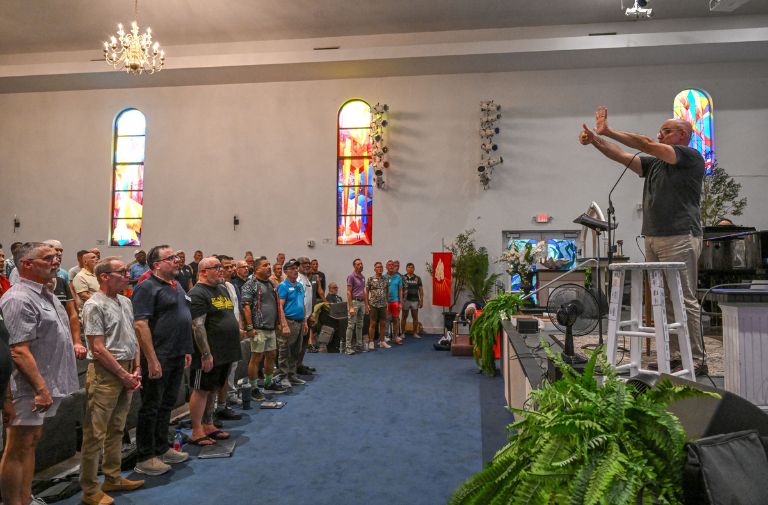
Gay Men’s Chorus of South Florida rehearsal. Photo by Carina Mask.