
The flag went up anyway. On Tuesday, under a cloudy sky and steady rain, the Progress Pride Flag was raised at Miami Beach City Hall – its colors catching the wind just enough to suggest motion, if not defiance.
It marked the opening of the 18th annual Miami Beach Pride, an 11-day celebration unfolding in a moment when celebration itself has become, again, a political act.
Across Florida, new legislation aimed at dismantling diversity, equity and inclusion programs is poised to take effect. The language is bureaucratic. The impact is not. In cities like Miami Beach, where LGBTQ life has long been both visible and economically vital, the question is no longer abstract: how to maintain that visibility under increasing constraint from Tallahassee.
Local officials are testing the boundaries of what remains possible.
“This may be one of the first real tests,” said organizers, privately, of how municipalities navigate a landscape where cultural expression is being legislated from afar.
Publicly, the tone is more measured – but no less resolute.
Bruce Horwich, chairman of the board for Miami Beach Pride, framed this year’s event not as a retreat, but as continuity under pressure.
“It reminds us that the right for equality has never been easy,” Horwich said. “But our community has always found ways to move forward together.”
Elsewhere in the city, that forward motion is taking physical form.
The rainbow crosswalk – removed abruptly last October by the Florida Department of Transportation, under the cover of darkness – is being restored. For many residents, the removal felt less like a policy decision than an erasure. Commissioner Tanya K. Bhatt called it “a real slap in the face,” a phrase that lingered in the weeks that followed, passed between residents as both complaint and recognition.
The response has not only come from within the LGBTQ community.
“Our allies understood what was at stake,” said Alex J. Fernandez, the only openly gay member of the city commission.
The crosswalk, Fernandez said, carries a history – the stigma of HIV/AIDS, the injustice of military exclusion, discrimination in housing and work and the long fight for the right to build a life, a family…a future.
That history now sits, visibly, at the center of a contemporary struggle — one that is much about presence as it is about policy.
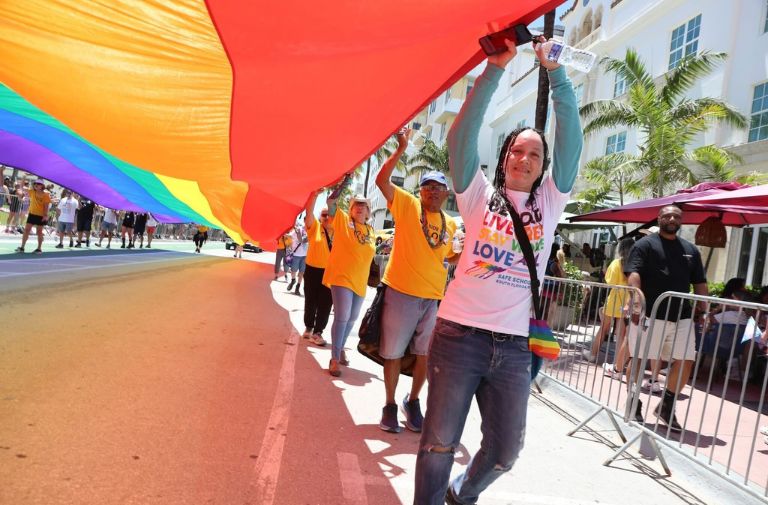
The festival itself proceeds as planned – free of charge. Lummus Park will be filled this weekend starting at noon on Saturday and Sunday. Drag queen Latrice Royal marshals Sunday’s parade on Ocean Drive, that familiar corridor of spectacle and performance. The theme this year – “Pride Is Infinite” – reads, at first, like branding. But in context, it carries a quieter insistence: that identity cannot be legislated out of existence.
“Pride cannot be contained by prejudice or politics,” Horwich said. “It lives in every story, every act of visibility.”
For decades, Miami Beach has occupied a particular position in the American imagination – a tropical enclave within a conservative state, where difference was not only tolerated, but in many ways, central to its identity. Today, greater Miami draws more than 1.65 million LGBTQ visitors annually, generating $1.7 billion in revenue that accounts for 22% of overall visitors.
Those numbers remain unchanged. What has shifted is the atmosphere around them.
The flag still rises. The parade will still move forward. But the meaning of both – once assumed, almost ambient – now feels newly contested, newly visible.
And perhaps that is the point.
RELATED