

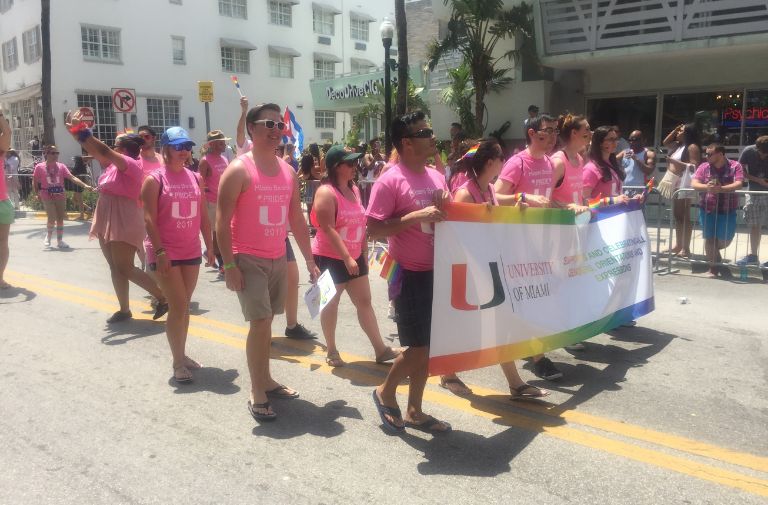
Miami Beach Pride — one of South Florida’s largest LGBTQ celebrations — faces significant changes after Florida lawmakers approved legislation that would prohibit local governments from funding diversity, equity and inclusion programs.
Organizers say the law, passed by the Florida House on a 77-37 vote March 10, will dramatically alter how the annual festival operates.
In emails obtained by OutSFL, Pride President Bruce Horwich warned local officials that without government support the event could be forced to scale back substantially.
“Basically, it would cycle downwards to the point where it might be local businesses setting up tents in a park,” Horwich wrote in response to inquiries about the potential impact of HB 1001.
The legislation, dubbed the “Anti-diversity” bill, prohibits counties and municipalities from funding, promoting or taking official action related to diversity, equity, and inclusion programs, potentially affecting Pride celebrations and other cultural events that rely on city partnerships.
Government support for Miami Beach Pride helps cover the infrastructure required for a festival that draws tens of thousands of visitors each year. Those dollars, Horwich said, fund police, security, fire rescue services, barricades, sanitation and street cleaning.
City records show Miami Beach has provided both direct funding and in-kind services to the festival for more than a decade. Since 2009, the city has allocated roughly $250,000 annually to support the event.
Even before the legislation passed, Pride organizers say this year’s event — scheduled for April 11–12 — has already seen its budget reduced by approximately $300,000.
State Rep. Fabian Basabe, whose district includes Miami Beach, voted for the bill. He said the legislation does not prevent Pride or other cultural celebrations from taking place.
“Nothing in this legislation stops people from celebrating Pride or any other cultural event,” Basabe said. “Private organizations remain free to organize festivals, parades, and community celebrations. If an event receives public support, it should operate as a community celebration open to all and supportive of local businesses.”
Basabe said the bill focuses on how public funds are used, not on restricting events themselves.
“Pride has become an important cultural event for Miami Beach and for visitors from around the world,” Basabe said. “That should continue.”
Basabe, a two-term Republican who defeated Equality Florida activist Joe Saunders in the 2024 election, suggested the debate surrounding the legislation could encourage a broader conversation about how large festivals evolve.
“Pride began as a protest and grew into a global cultural celebration,” Basabe said. “Events like this should belong to the entire community and be strong enough to stand the test of time.”
Basabe added that he recently offered to serve in an advisory capacity to help Pride organizers strengthen the festival and rebuild partnerships with businesses and sponsors.
Critics of the legislation say its intent is clear.
Last week a similar bill passed the Florida Senate on a 25–11 vote. During debate, Sen. Shevrin Jones, the state’s first openly gay Senate Democratic leader, said many Floridians understand the message behind the measure.
“You might not say it’s anti-LGBTQ,” Jones said on the Senate floor, “but the underlying tone is that it actually is.”
Basabe disputes that characterization and maintains that Pride celebrations will continue regardless of state policy.
“The community built Pride,” Basabe said. “The community will continue to celebrate it.”
But for organizers, the debate now extends beyond one festival. It raises a broader question about how Pride — once a protest against government power — will navigate a moment when that same power may determine whether cities can support it at all.