
Quick Answer
THCA flower and THC flower are the same plant, with the same molecule captured at two stages. THCA is the raw, non-intoxicating acid the living plant produces. Heat converts it into intoxicating Delta-9 THC, which is why smoking, vaping, or baking flips one into the other.
THCA flower is simply cannabis that tested below the 0.3% Delta-9 legal limit before heating, so it qualifies as federal hemp and hasn't been decarboxylated yet. Light it, and that same flower becomes THC flower and delivers the same high.
Key Takeaways
- Same plant, same molecule. THCA is THC before heat, through a reaction called decarboxylation.
- The difference is legal, built on a delta-9 testing line, and it isn't a biological one.
- "30% THCA" and "30% THC" describe different things. The conversion costs about 12% of the molecule's mass, and combustion costs far more.
- On November 12, 2026, a new federal total-THC standard changes what counts as legal THCA flower.
THCA Flower vs THC Flower at a Glance
Both THCA flower and THC flower come from the same species and behave identically once you apply heat. Everything in the psychoactive column comes down to one variable, and that variable is temperature.
|
Feature |
THCA Flower (hemp) |
THC Flower (marijuana) |
|---|---|---|
|
Main molecule on the shelf |
THCA (acidic precursor) |
THCA, with more free Delta-9 |
|
Intoxicating when raw? |
No |
Barely, until heated |
|
Needs heat to get you high? |
Yes |
Yes |
|
Federal legal status (through Nov 11, 2026) |
Legal hemp |
Federally illegal |
|
Delta-9 limit at testing |
≤ 0.3% by dry weight |
No limit |
|
Where it sells |
Online and hemp shops, ships nationally |
Licensed dispensaries only |
|
Typical price (eighth) |
~$40-$60 |
~$30-$60 |
|
Shows on a drug test? |
Yes |
Yes |
|
Effect once smoked |
Full Delta-9 high |
Full Delta-9 high |
What Is THCA Flower?
THCA flower is cannabis buds that are rich in tetrahydrocannabinolic acid, the raw acidic compound the plant builds inside its trichomes. In this form, it will not get you high, because the extra carboxyl group (COOH) on the molecule is too bulky to slot into your CB1 receptors. You can see the molecule and its structure on PubChem, the NIH chemical database, where it is listed as tetrahydrocannabinolic acid.
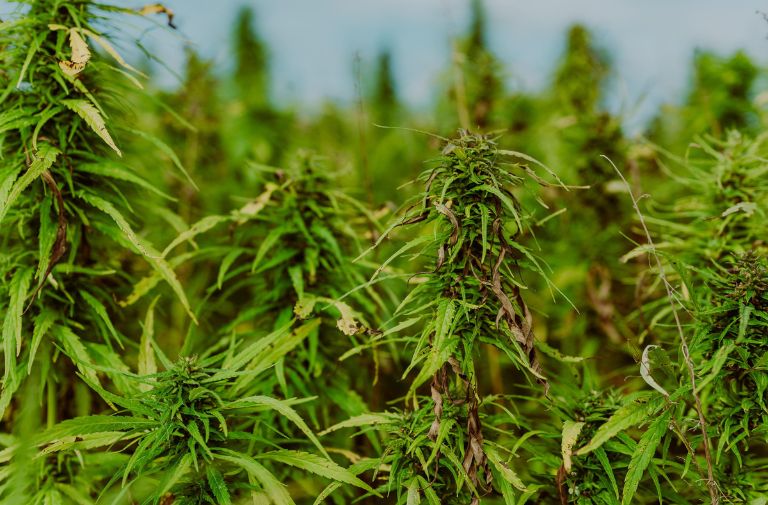
The plant is grown as hemp and tested below 0.3% Delta-9 THC by dry weight, so on paper it clears the federal bar. Visually and by smell, it grows, cures, and looks the same as any premium marijuana bud. The genetics are often identical to dispensary strains.
THCA flower shows up in a few common formats, and a lab report should travel with each one:
- Loose flower and pre-rolls, the everyday formats most people buy.
- Moonrocks and infused "snow caps" for higher potency.
- A batch-specific certificate of analysis (COA) for every harvest, published by reputable sellers.
Because the raw Delta-9 reading stays tiny before heat, the flower ships to many states where recreational cannabis is still restricted. That single lab detail is the reason it reaches your mailbox at all.
What Is THC Flower?
THC flower is the everyday name for marijuana, the cannabis you buy at a licensed dispensary for its labeled THC content. Growers and rec-market labs report it as "THC," and consumers shop by that percentage on the menu. It carries no 0.3% cap because it lives inside state-legal recreational and medical channels.
Here is the part that surprises people. Even dispensary "THC flower" stores most of its potency as THCA while it sits on the shelf. The living, freshly cured plant retains its cannabinoids in acidic form, so both products are chemically identical until a flame or an oven changes them.
The honest distinction lies in legal classification and in how each product is tested and marketed. One is sold as hemp with a sub-0.3% Delta-9 lab result. The other is sold as marijuana with a headline THC number. The plant in your hand is Cannabis sativa in both cases.
The Core Difference: Decarboxylation Turns One Into the Other
Decarboxylation is the reaction that separates the two products, and it takes about six minutes at high heat. Applying heat through smoking, vaping, or baking strips the carboxyl group off THCA, releasing it as carbon dioxide. What's left is delta-9 THC, which fits the CB1 receptor and produces the high.
The path runs in one direction:
- Raw bud, cannabinoids sitting in acid form as THCA
- Heat applied, whether from a lighter, a vape coil, or an oven
- Carboxyl group breaks off and leaves as CO2
- Delta-9 THC forms
- THC binds CB1 receptors in the brain, and effects begin
Researchers have timed this precisely. Mei Wang and colleagues at the University of Mississippi's National Center for Natural Products Research published decarboxylation kinetics in 2016 showing that THCA concentration dropped to zero in 30 minutes at 110°C, 9 minutes at 130°C, and 6 minutes at 145°C. Below 100°C, the reaction failed to finish within an hour.
The sub-100°C result explains a lot. Aging and a slow cure convert some THCA on their own, which is why old flower often tests with a little more delta-9 than fresh flower. It also explains why eating raw THCA flower does nothing at all. The conversion needs heat, and cold digestion never supplies it.
THCA Flower vs THC Flower: The Chemical and Scientific Difference
Chemically, THCA and delta-9 THC differ by a single carboxyl group, and that one group changes everything about how the molecule behaves in your body. Both share the same carbon skeleton. One chemical reaction stands between them.
- THCA: the acid form, larger and heavier, with poor fit at cannabinoid receptors
- Delta-9 THC: the neutral form, smaller, binds CB1 and produces euphoria
- The bridge: heat, which removes one carboxyl group as carbon dioxide
The receptor science is settled. John McPartland and colleagues tested THCA directly against both cannabinoid receptor types and concluded in Cannabis and Cannabinoid Research that THCA has little affinity or efficacy at CB1 or CB2.
Their honesty is the interesting part: they suspected some of their own binding signal was an artifact, caused by THCA decarboxylating into THC during the experiment itself. The acid is so eager to convert that measuring it cleanly is genuinely hard.
Is 30% THCA the Same as 30% THC? The Potency Math
No, a 30% THCA reading does not equal 30% active THC, and the reason is pure chemistry. When THCA decarboxylates, it releases a CO₂ molecule weighing 44 g/mol, which is about 12.3% of the original mass. What burns off is weight you paid for on the label but never inhale as THC.
That mass loss gives you the well-known 0.877 conversion factor. Usable Delta-9 THC is roughly the THCA percentage multiplied by 0.877. So a bud that tests at 30% THCA delivers about 26.3% active THC once you light it (30 × 0.877 = 26.31).
Regulators use the same arithmetic to define "total THC," written as Total THC = Delta-9 + (0.877 × THCA). This exact formula appears in the USDA hemp rule at 7 CFR Part 990 and is the basis for the upcoming federal change. It is also why a hemp menu "THCA %" reads higher than a dispensary "THC %."
The Label-to-Lungs Ladder
Run a 30% THCA eighth down the whole chain:
|
Rung |
What it measures |
3.5g at 30% THCA |
|
1. Label |
THCA by dry weight |
1,050 mg THCA |
|
2. Paper conversion |
THCA × 0.877 |
~920 mg potential THC |
|
3. Real decarb |
Conversion is incomplete |
Below 920 mg |
|
4. Combustion |
Pyrolysis and sidestream losses |
20% to 37% in mainstream smoke |
|
5. Bloodstream |
Systemic absorption |
~25% maximum |
The 0.877 conversion also answers a question that trips up almost every first-time buyer: why do hemp menus advertise numbers that look higher than dispensary menus?
A hemp menu quotes raw THCA, which is the pre-decarb figure. Most dispensary menus quote total THC, which already has the 0.877 conversion baked in. A 30% THCA listing and a 26% THC listing can describe the identical jar.
The practical takeaway: a 30% THCA eighth performs like a strong 26% dispensary eighth, because dispensary labels run the same 0.877 math on their own acid content. You're comparing like with like. Everything below rung two on the ladder applies to both products equally, which is why nobody actually absorbs anywhere near the number printed on either jar.
Do THCA Flower and THC Flower Feel Different?
Once heated, the high is the same, because the same Delta-9 THC reaches the same CB1 receptors in your brain. Potency-matched buds produce the same onset, intensity, and duration. Blind, most seasoned users cannot tell a well-grown THCA eighth from dispensary flower.
What people actually notice comes down to freshness, cure, and terpene profile rather than the "type" of flower. A clean cure smokes smoother and tastes brighter, and a rich terpene load shapes whether the effect feels heady or relaxing. These variables live in the growing and drying, and they apply equally to hemp and marijuana.
The timing is the same too, because the pharmacology is the same. Smoked or vaped, either flower follows the same curve:
- Onset within seconds to a few minutes.
- Peak near the 10- to 30-minute mark.
- Wearing off over one to three hours.
Higher-terpene batches can feel like they come on faster, though the underlying Delta-9 curve does not change.
The one real exception is eating it raw. Raw THCA flower will not intoxicate you without heat, so edibles must be made with decarbed material. For smoking and vaping, treat the two as interchangeable at equal potency.
Legal Difference: Why THCA Flower Is (For Now) Legal to Buy Online
The 2018 Farm Bill defines hemp as cannabis containing 0.3% or less Delta-9 THC by dry weight, and it measures Delta-9 only. Raw THCA flower passes because its free Delta-9 stays tiny before decarboxylation, even when total potential THC is high. You can read the federal hemp framework through the USDA at ams.usda.gov/rules-regulations/hemp.
This is what the industry calls the "THCA loophole." On the shelf, the flower is legal hemp, and in your lungs it becomes THC. The gap exists because the law tested for a specific molecule at a specific moment, before any heat was applied.
That single definition is why THCA flower ships to states where recreational cannabis is banned or limited. State law still varies widely, though:
- Around a dozen states restrict or ban THCA-heavy hemp outright, with Idaho among the strictest.
- Reputable brands block those states at checkout, so a seller that ships anywhere is a warning sign.
- State rules move faster than federal ones, so your delivery address can decide legality as much as the statute does.
The distinction here is a legal-definition gap, and the chemistry underneath is the same plant.
What the November 12, 2026 Law Changes
The biggest 2026 development is a federal rewrite of the hemp definition that no comparison guide should skip. Section 781 of P.L. 119-37, the 2025 Continuing Appropriations law, shifts hemp's legal line from Delta-9 alone to a total-THC standard, capped at 0.3% by dry weight and effective November 12, 2026. You can confirm this through the Congressional Research Service at crsreports.congress.gov (reports IF13136 and LSB11381) and the primary law at congress.gov.
"The chemistry never changed. What changes on November 12 is the ruler. Once the federal test measures total THC instead of Delta-9 alone, most flower that reads as legal hemp today no longer clears the line."
- Christina Jacobs, reviewer
Total THC uses the same 0.877 arithmetic covered above, so it counts the THCA that heat would later activate. Under that measure, a flower testing 22-31% THCA sits far over the 0.3% total-THC cap. Most high-THCA hemp flower on the market today would no longer meet the federal definition after that date.
The scale of the shift is large. The U.S. Hemp Roundtable estimates the redefinition would eliminate roughly 95% of existing hemp-derived cannabinoid products, according to a Troutman Pepper analysis. Law firms tracking the change, including Arnold & Porter, read it as aligning the federal test with what a lab measures after heating.
The window through November 11, 2026 is the current legal status quo, and sellers are watching the deadline closely. Analysts expect three shifts once the standard flips:
- Enforcement and compliance questions at both the federal and state level.
- Wider state-by-state divergence as local rules fill the gap.
- A pivot toward compliant, lower-total-THC products.
This page reflects the law as it stands in August 2026 and flags the date that changes the answer to "is THCA flower still legal?"
THCA Flower vs Dispensary Weed: Is There Really a Difference?
Chemically, THCA flower and dispensary marijuana are close to identical, and communities like r/trees and r/CannabisExtracts land on the same conclusion in thread after thread. The genetics overlap, the cannabinoids overlap, and the smoking experience overlaps at matched potency. The real separation is the legal channel, the testing standard, and sometimes the grow quality.
A common claim online is that THCA flower is just reground or low-grade weed. Some cheap product does exist, and some THCA flower is premium indoor bud grown by serious cultivators. The COA is the definitive evidence, since it shows potency, cannabinoid profile, and a clean contaminant panel for that exact batch.
Three real differences remain, and none of them is the plant itself:
- Legal channel: hemp sold online versus marijuana sold inside a licensed dispensary.
- Testing standard: a brand's own third-party COAs versus state-mandated lab rules.
- Oversight: seed-to-sale tracking on the dispensary side that hemp does not carry.
Buying from transparent sellers with published COAs closes most of that gap. Judge the bag, not the label.
Does THCA Flower Taste or Smoke Worse Than THC Flower?
Taste and smoothness come down to cure, humidity, storage, and freshness rather than the THCA-versus-THC question. A rushed dry or a bag left open too long makes any flower smoke harsh and taste like hay. That happens to hemp and marijuana alike.
Well-grown, properly cured THCA flower is hard to distinguish from top dispensary bud. Look for sticky trichomes, a strong terpene aroma, and a spring-back squeeze that signals correct moisture. Store it in a sealed jar away from light and heat to keep it that way.
Insider tip: drop a two-way humidity pack in the jar to maintain a relative humidity near 58 to 62%. That single habit fixes most of the harsh-smoke complaints people blame on the flower "type," and it works the same for hemp and dispensary bud.
THCA Flower vs CBD Flower
CBD flower and THCA flower answer two different goals, and the divide is whether heat unlocks a high. CBD flower stays non-intoxicating even after you burn it, because CBD is not psychoactive at any temperature. It suits daytime relaxation, calm, and focus without impairment.
THCA flower is non-intoxicating in its raw form and becomes a full Delta-9 high once heated. Choose CBD flower when you want the plant without the buzz, and choose THCA flower when you want the buzz through the hemp channel. A quick way to decide is to ask whether you want to feel high at all.
Is THCA Flower Safe? Drug Tests and Precautions
THCA flower will fail a drug test once you smoke or vape it, so treat it exactly like marijuana for screening. The moment it decarboxylates, your body metabolizes real Delta-9 THC into 11-nor-9-carboxy-THC (THC-COOH), the same metabolite standard urine panels detect. Federal testing guidelines from SAMHSA target that metabolite.
Detection depends on how often you use it. Occasional smokers may clear a urine test in a few days, while daily users can test positive for several weeks after the last session. There is no "hemp exemption" on a drug test, because the lab reads the metabolite and not the legal label on the bag.
Safety starts with the COA, so it helps to have a quick routine for reading one. Our 3-Check COA Rule keeps it simple:
- Confirm the potency on the report matches the number on the label.
- Confirm pesticides and heavy metals read non-detect (ND).
- Confirm the batch or lot number on the report matches the jar in your hand.
Beyond the lab work, the basics still apply. Skip any sprayed or unverified product, keep it away from anyone under 21, start low if you are new, and store it out of reach of children and pets.
Where to Buy Legal, Lab-Tested THCA Flower
Buy indoor-grown flower with batch-specific COAs from a brand that ships to your state. The lot number on the jar should match the number on the published report, and the report should be recent.
Exhale Wellness grows all its THCA flower indoors, publishes a COA for every batch, ships within 24 hours, and offers free shipping over $80.
Start with our THCA flower collection for whole buds, browse the full THCA range for vapes and edibles, or grab THCA pre-rolls if you'd rather skip the grinder. With the federal deadline approaching, buying from a compliant, transparent brand matters more than it did last year.
Frequently Asked Questions
Is THCA the same high as THC?
Yes. Once heated, THCA converts to Delta-9 THC and produces the same high, because it becomes the same active molecule.
Will THCA flower get you stoned?
Yes, when you smoke, vape, or bake it. Heat decarboxylates the THCA into Delta-9 THC, and raw THCA flower eaten cold will not intoxicate you.
Which gets you higher, THC or THCA?
Neither, at matched potency after decarb. Heated THCA flower and dispensary THC flower deliver the same effect gram for gram of active THC.
Is 30% THCA the same as 30% THC?
No. After the 0.877 conversion, 30% THCA yields about 26.3% active THC, so the menu THCA number always reads higher than the post-heat THC number.
Is THCA flower the same as marijuana?
Chemically, it is nearly identical, often derived from the same genetics. The difference is legal and testing-based, since THCA flower is sold as sub-0.3% Delta-9 hemp.
The Bottom Line
Same plant, same molecule, and heat is the only thing standing between THCA flower and THC flower. The differences that count are legal, and the November 12, 2026 total-THC law is about to redraw them. Buy lab-tested flower, confirm your state, and remember that "30% THCA" performs like about 26% THC the second you light it.
Disclaimer
This article is educational only and is not medical or legal advice. THCA flower is non-intoxicating raw and becomes intoxicating when heated, and it will cause a failed drug test. Products are for adults 21 and older. Federal hemp status is changing under the November 12, 2026 total-THC standard, so confirm current legality in your state before buying or using.
The views, opinions, and recommendations expressed in this article are solely those of the author and are provided for informational and editorial purposes only. They do not constitute professional advice and should not be relied upon as such. OutSFL makes no representations or warranties regarding the accuracy, completeness, or applicability of the content and assumes no liability for any actions taken based on it. The views expressed do not necessarily reflect those of OutSFL.