

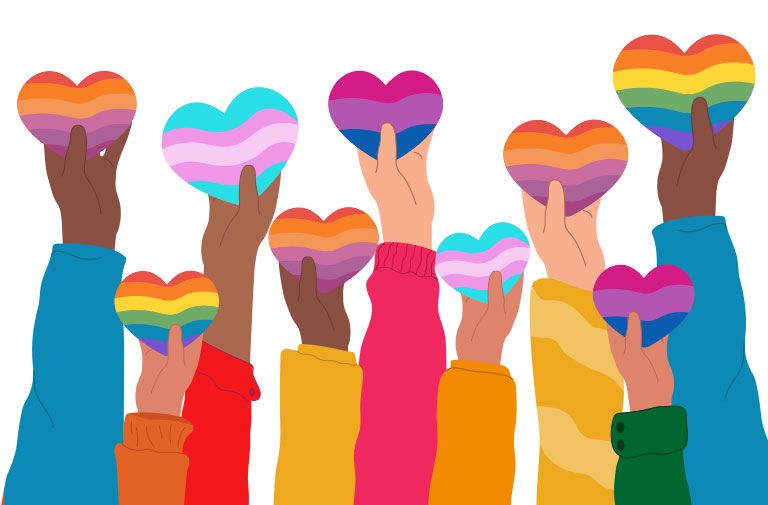
Love is love — but none of us experiences it the same way. Between movies, dating apps, and Valentine’s Day marketing, we’re often handed one script: find “the one,” settle down, and call it complete. But queer love has always been bigger than that, messier than that, and more honest than that.
These two personal essays offer just a glimpse into the endless ways people build connection, community, and commitment. Different journeys, different truths — same reminder: you get to define love for yourself.
Fall in Love Again and Again | By Cheyenne E. Boddie
I’ve always been a romantic. I love romcoms. I love wedding shows. I love love. I began planning my future wedding when I was 8. In all my imaginings of this big wedding and princess-cut gowns, there was always a placeholder waiting at the altar for me — a nameless, faceless figure who I knew would be a man, because that was the only thing ever modeled for me.
As I got older, I realized that an idealized wedding was all wrong for me. I hate dresses — I hated them before I ever dreamed of a Cinderella-style gown. They’ve always felt uncomfortable and wrong on me, no matter how well they fit. I always felt uncomfortable and wrong, especially when it came to envisioning myself in a relationship. I didn’t start dating until well into high school, and even then, I never showed up as myself. I was scared to talk to my crushes about my identity after one told me he could “fix me.”
When I began to fully embrace all parts of my identity, I started to find real love. I met my future wife, “CM”, the summer before our junior year of college, and I knew almost immediately I’d spend the rest of my life with her.
I wasn’t even looking for another partner when I met “RJ” in an online chat room, but we clicked. We bonded fast, became friends, and before I knew it, we were telling each other “I love you.” A few months later, RJ met “IS” at a speed dating / friendship event — he wasn’t looking for a partner either, just hoping to make friends — but they kept talking after it ended. When they began dating, he introduced the two of us, and almost immediately, IS and I started mutually crushing. Within a year and a half of meeting RJ, IS and I were partners too.
I’ve known I was open to polyamory since I first entered the dating space, but going from someone who barely dated to being in three committed relationships at once was a trajectory I never expected. Still, I can truly say queer love saved me. My partners see me, hold me, and lift me up in ways I never knew existed. To be loved by them, and to love them, has been one of the greatest, most fulfilling journeys of my life. Being able to be my full self with partners who are as nonbinary, as bi/pan, or ace as me has been incredible.
Queer Love As Liberation | By I. Roque
As a Philosophy major, a lot of my work centers around the nature of man. The intricacies of identity — and the frameworks we’ve carved out for men and women, respectively, in Western civilization — are often on my mind. Aristotle speaks of two instances of natural subordination: that of the master over the slave and that of the man over the woman, which is quite funny to me. Plato, in his Symposium, tells us a Greek myth where, sometime long ago, “humans were originally created with four arms, four legs, and a head with two faces. Fearing their power, Zeus split them into two separate parts, condemning them to spend their lives in search of their other halves.”
This myth — two halves doomed to search for missing limbs — prevails through the ages, with imagery and metaphors that seep into even the most modern cultural conventions. Pastel conversation hearts with soft-spoken pleas like “be mine” and “soulmate” are passed around by school children. Artificial Intelligence applications advertise everywhere that they have the expertise to find you a true “match.”
This, however, is a clever Western notion that stems from a deep dissatisfaction with one's material reality. For millennia, nonbinary people were considered sages — individuals who embodied the spirit of multiple genders and held some esoteric truth about wholeness. The Muxe of the Zapotec culture are artisans, masons, and craftspeople. The Hijra of South Asia, led by a guru, were prominent members of society before the terror of the British Raj.
It is my true belief that love exists universally, and that queer love is not only a rebellion against the norms of society, but against the very idea of natural subordination itself. When one rids themselves of the dependency that comes with assuming any one gender, then one is free to pursue a better world for all. For some, that means taking on multiple partners. For others, it is breaking free from the heteronormativity that continues to silence us even today.
However you love this Valentine’s Day, do it knowing that you’re free to — and that love always wins.
Sign up to receive the OutFAU newsletter here