
It’s just after dawn and I’m knee-deep in the swamp water of the Everglades, pulling soil samples, while the airboat I drove out here cools down behind me. I’m a long way from the Florida school where I once stood up in a red cocktail dress and pearls to teach my own lesson on the Stonewall uprising because no one else would. I am the same person — I just finally have time to care about more than surviving high school.
For most of high school, I didn’t have that room. I was openly queer in a place that treated it as a provocation. People followed me home and threatened me, threw things at me, chased me, and the school seemed more worried about protecting its image and my bullies than protecting me. At 16, I faced discrimination from students and school administration alike. I documented what I experienced and I organized out of self-defense.
I spoke to other students about their experiences and realized they were dealing with the same harassment I was, and worse. I had parents who would have walked into that school and defended me, but many other students didn't. Some couldn't even report the harassment because the school's first step was to call home. To a closeted teenager, that's much worse than bullies at school.
So my friend and I started a Queer Student Union (QSU). Other kids began coming to me with things they were too afraid to report themselves. I’d write down what they told me and bring it to administrators anonymously, because for some of them, having their parents find out wasn’t safe. I wasn’t trying to become an activist. I was trying to make the windowless, grey-walled school building we all had to go to every day a little less dangerous.
I started attending school board meetings and bringing forward my concerns. I learned my school board was banning books that tell LGBTQ+ stories and began to understand that this problem was bigger than just my high school. I organized field trips to the school board for QSU to get more students to defend our right to access queer stories.
Then Florida passed the “Don’t Say Gay” law and my small fight became part of a national one. I went to the state capitol to testify in opposition, organized a massive school walkout, and I even became a plaintiff challenging the law. I was just seventeen and had already watched a government that claimed to love freedom take it away from our community. I couldn’t understand how we studied American history with the queer parts left out.
What I couldn’t see then, because I had no room to, is that this was never the only fight I cared about. The environment was always on my mind, even in high school. Every time I drove to the school board, I’d pass a lush forest being clear-cut and think, that’s what I should be defending. Unfortunately, I was too busy defending my own rights to defend the land we all rely on. Now I'm not. I study Sustainability and the Environment at Florida International University. Last year I worked as a guide in the Everglades, caring for alligators and running airboat tours; now I test the water and soil there for the world's largest ecosystem restoration project.
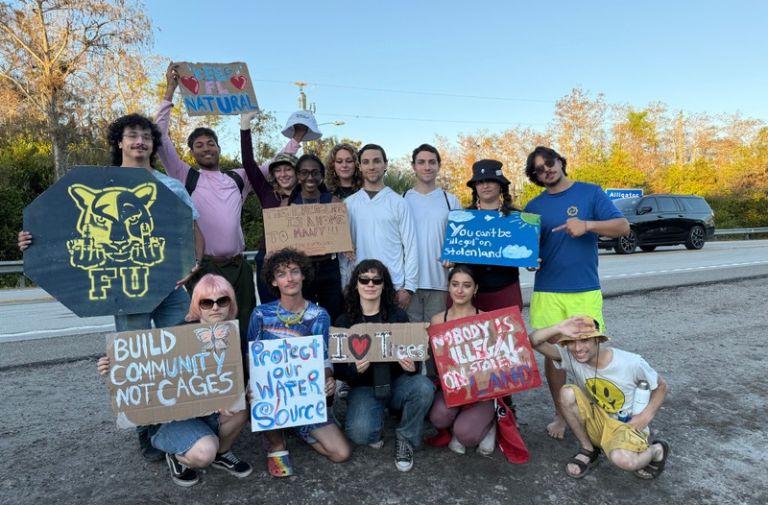
I use the skills I learned organizing in Orlando to create free Everglades field trips for students. I bring students on a "slough slog," walking into the swamp water, watch them fall in love, teach them about the land, what is being done to it, and then mobilize them to government meetings to defend and protect the Everglades back in the city.
Out here, the work has introduced me to people I never expected to know: environmental scientists, Miccosukee tribal members, families who have fished this water for generations. The deeper I get into this work, the clearer it becomes that it was all one fight the whole time. The same forces that are trying to erase queer history from classrooms have spent the past century demonizing the land so it could be exploited.
This September, Miami-Dade County commissioners approved a company’s plan to build more than 140 acres of concrete on protected wetland, past the boundary that’s supposed to protect the Everglades. It was one of at least eleven proposals now trying to cross the Urban Development Boundary.
The Miccosukee reservation is just down the street. They are the original land defenders and have lived in Florida longer than anyone. It is inaccurate to teach Florida history without teaching Indigenous history, yet the Florida public school history curriculum has denied that truth since the beginning. Erasure is erasure. We talk about book bans as if silencing history were something new. It isn’t, and it never was. They do not teach us about the Everglades because you can’t protect what you were never allowed to know was there.
That’s why Lambda Legal’s LGBTQ+ Bill of Rights means something to me. It refuses to let us spend our whole lives braced for the next attack, fighting against it in court and calling that enough. Instead, it names what we’re owed on the other side: an education that tells the truth, a family that won’t turn on you, health care and a real shot at a life, a democracy that counts you, a place to belong. I spent high school fighting so queer kids wouldn’t be erased. The Bill of Rights is about something bigger: making sure queer students are safe at school.
Speaking out got me this far. But something I have learned outside of any classroom is that you must bring people to the place you're asking them to fight for. When I take students who’ve never set foot in the Everglades and guide them through walks in the clear, filtered swamp water, they feel their whole nervous system go quiet for the first time. Then they learn that someone wants to pave it, and something clicks that no lecture on climate change ever could. That is from a personal connection to the land.
So do the unglamorous thing. Learn where you live. Really learn it. Whose land is it? Why is there a canal where a river once ran, and what died when they rerouted the water? The answers often aren’t at the city museum. You have to go to a Native reservation, talk to the local scientists, dig up the history that the government wants buried. Once you see how erasure worked in your own backyard, you start to see it everywhere and find your role in the fight.
I won’t pretend I’m full of hope. I have a lot less than I did at seventeen. We are up against a lot, and many people my age have given up fighting. Many won’t even vote. I understand the exhaustion. I’ve felt it. But checking out doesn’t make the consequences go away. Every single one of us has a role to play in building the world we want to live in. Collective action can make it happen.
That’s a fight I’m ready for.
Will Larkins (any/all) is a student at Florida International University and an environmental and LGBTQ+ organizer. While in high school in Winter Park, Florida, he was a Lambda Legal plaintiff in the lawsuit Cousins et al. v. The School Board of Orange County et al., a challenge to the state’s “Don't Say Gay” law.