

Ocean Drive has always known how to perform.
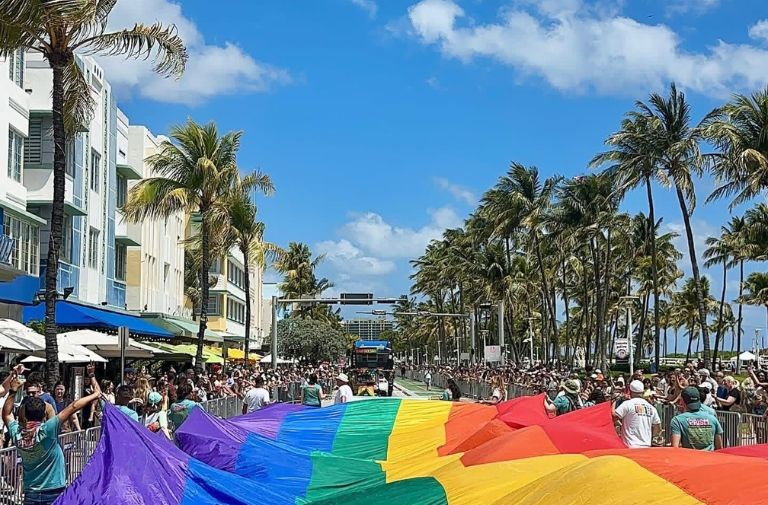
On Sunday, beneath a wind-whipped sky, it became something else — a corridor of spectacle, memory and quiet resistance. Floats moved slowly past the palms, music bleeding into the sound of the ocean as thousands gathered not simply to watch, but to be seen.
Now in its 18th year, Miami Beach Pride has grown into one of the largest Pride events in the Southeast, drawing more than 150,000 people across its 11-day schedule. What began as a local assertion of presence has evolved into a defining ritual for the city — part festival, part reunion, part reckoning.
This year, that reckoning felt closer.
The parade unfolded as expected — fire trucks and civic vehicles leading, performers and dancers following, but the mood carried a different weight. In a state increasingly defined by efforts to limit LGBTQ visibility, the act of gathering openly felt less like tradition and more like resolve.
“Pride could not have been more successful,” declared Board Chairman Bruce Horwich. “The community came out in full force.”
And it did, but the story was not only the spectacle.
There were drag queens, luminous and central to Pride’s lineage. But there were also older couples, walking hand in hand, their presence shaped by decades when such gestures carried risk. Parents with children, offering them a world that once refused them. Young people moving in clusters, tentative and electric — testing who they might become.
There were teachers, service workers, small business owners — lives that rarely headline Pride coverage, but form the quiet architecture of the community itself.
If the parade shimmered, it was because of them.
“There’s something different about being in it versus watching it,” said Jonathan Welsh, a local author who walked with his team at Care Resource. “You feel the energy, the conversations happen in real time, it brings the work back to its simplest form — connection.”
Still, the tensions were unmistakable.
Florida’s ongoing restrictions on diversity, equity and inclusion initiatives — and broader efforts to constrain LGBTQ expression — hovered just beyond the celebration. Echoes of the late orange juice saleswoman Anita Bryant, revived by minions from the governor’s office.
What once read as purely festive now carried the undertone of something more contested.
State representative Fabian Basabe, who appeared in the parade, offered reassurance.
“Pride is not going anywhere,” he said, while emphasizing the point of keeping the event community focused, family friendly and non-political.
But Pride has never been entirely separate from politics.
It emerged from protest — most notably the Stonewall Uprising — and has always carried a tension between celebration and resistance. To gather publicly, to claim space without apology, is itself a form of defiance whether named or not.
That tension surfaced in more subtle ways over the weekend.
Some participants voiced concerns about limited opportunities for local vendors and a narrowing of cultural expression distanced from its grassroots origins. Others lamented the focus on crosswalks and bathrooms when funds for HIV services were being cut, endangering the lives of thousands.
And yet, the city held.
At Twist, Miami Beach’s most enduring gay bar, the line to enter stretched around the block on Saturday night. Inside, the atmosphere was less curated and more immediate — something closer to the raw, communal energy that first defined Pride.
Outside, various renditions of the rainbow flag were lifted in the wind. Strangers met each other’s eyes with brief, unguarded recognition. For a few hours, the usual distances — of fear, of history, of law — loosened.
What happens next remains uncertain.
Pride in Miami Beach continues to evolve, shaped by politics, commerce and the shifting needs of the community it gathers. Whether it leans further into spectacle or returns to something more openly defiant may not be entirely its choice.
But for now the image remains:
A long stretch of sunlight pavement.
A crowd that refuses invisibility.
And a celebration that, even at its most polished, still carries the unmistakable outline of protest.
RELATED