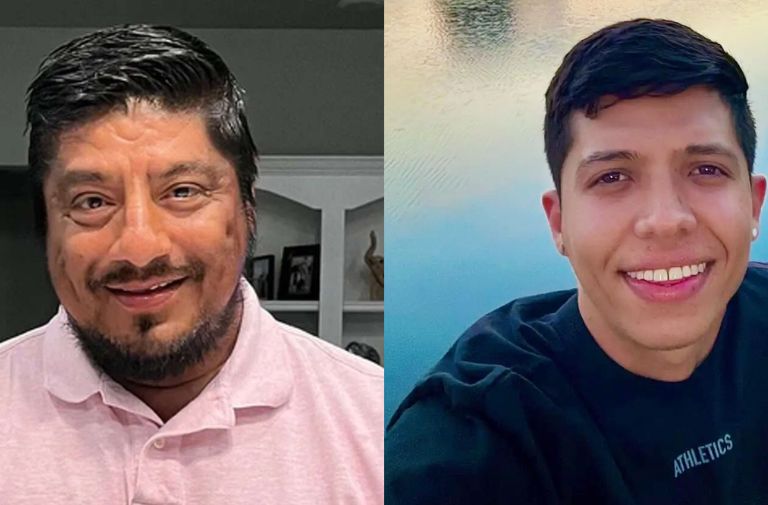
ICE agents just shot and killed two more innocent people, a man in Texas and another in Maine. Both men were legally authorized to work in the United States; both were shot in the early morning while driving to work.
Neither victim was ICE’s intended target, meaning each man died because federal agents pursued him in error.
Anyone who’s ever been chased — even if just in a nightmare — can imagine the terror of being followed by a masked and armed aggressor in hot pursuit. But instead of waking up from the dream right when he catches you, the masked man chasing you is actually real. He’s not floating at the foot of your bed, he’s at your car door with a loaded gun. He really does pull the trigger, you really do die, and your family really does have to grieve your absence for the rest of their lives.
An American horror story
On July 7, 2026, in Houston, Texas, ICE fatally shot Lorenzo Salgado Araujo, a 52-year-old Mexican national who had lived and worked in the U.S. for over 30 years, recently reaching his goal of owning his own construction company. According to preliminary reports, ICE agents in unmarked vehicles pursued Araujo while he was driving his construction crew to the morning’s job site.
Although agents admit that Araujo was not even their intended target, DHS is claiming Araujo “tried to run over an officer” with his vehicle. The three workers in the van with Araujo said no one was in front of his vehicle. They said that Araujo, a life-long construction worker with expensive tools in his work van, thought the masked men chasing them in two unidentified, unmarked black vans wanted to steal his equipment.
Six days later, similar story. In the early morning of July 13, 2026, an ICE agent shot and killed 26-year-old Johan Sebastian Guerrero in Biddeford, Maine. Guerrero was from Colombia, was authorized to work in the U.S., and was also on his way to work when he was killed. Although Guerrero was not the federal agents’ intended target either, ICE claims that Guerrero also “tried to use his vehicle as a weapon” against officers, similar to ICE allegations against Araujo and Renee Good in Minnesota. A witness saw Guerrero “bleeding profusely from the head. He was talking. (Guerrero) said: ‘I tried to stop’” before taking his last breath.
The only definitive proof of what happened in either encounter would be video footage. Authorities have not released any such video, and the agents were not wearing body cams, but rest assured some doctored recording will soon surface on Fox News, cropped and manipulated to blame the victims.
Federal agents are not immune from state prosecution and never have been
Not only can ICE agents be prosecuted, tried by jury, and sent to prison (or worse) for murder, but Trump can’t pardon them. Anyone convicted of murder under a state’s criminal code is stuck with state justice as they languish in that state’s penitentiary.
Under state and federal law, a federal agent acting outside the scope of his duties is not immune from state prosecution for murder, manslaughter, or any other crime under state law. Since 1890, the Supreme Court has held federal officers immune from state prosecution only if 1. they were acting within the scope of their official federal duties, and 2. their actions were objectively reasonable.
If an ICE agent is prosecuted in state court, he does have the right to remove his case to federal court, but a case removed to federal court is still prosecuted under state law. Federal procedural law applies, but so what? The state’s substantive law still governs whether or not it was murdered.
Federal courts apply this strict two-pronged test to determine whether Supremacy Clause Immunity exists in each case, given all the facts in evidence. It is never automatic and there is no complete federal immunity as Stephen Miller falsely claims; there never has been, since 1890.
This week, masked men in two unmarked vans aggressively chased the wrong targets. They sped, cut them off, then got out of unmarked vans and ran toward them, guns drawn. When the terrorized victims got confused or scared or both and pulled away, officers ran after their vehicles, on foot. When they got closer, in a testosterone-spiked rage, they shot two innocent men, in two separate states, to death. Whether those actions were reasonable, necessary and proper, and within the officer’s official duties, won’t be up to Stephen Miller to determine. It will be up to a jury.
Sabrina Haake is a political analyst and 25+ year federal trial attorney specializing in 1st and 14th A defense. She writes the free Substack, The Haake Take.