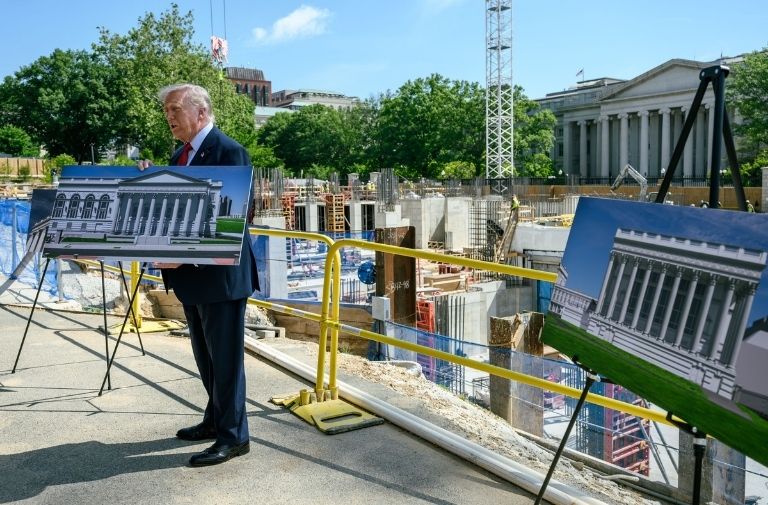
Last week, on an emergency basis, Trump asked the Supreme Court to rescue the centerpiece of his “capital improvement campaign.” Trump now calls his ballroom — a 90,000 ft.2 gilded party palace where donors in haute couture can eat wagyu beef and dance the night away — an “urgent matter of national security.” On Friday, the Court let Trump have his way.
Trump’s legal team was responding to a lower court’s stop-work order on the ballroom. An appellate panel ruled that presidents do not own the nation’s capital, or the White House, but rather are entrusted as temporary custodians. As such, they lack the unilateral authority to destroy, raze or replace core national structures without explicit approval from Congress. “The White House is the People’s House,” the majority wrote, “and under the Constitution’s Property Clause, Congress exercises plenary control over the building and its surrounding land.” Astute readers will note that “Congress” is not “the president.”
Trump, selling merch and teasing an unconstitutional third run in hopes of evading legal accountabilityforever, has made clear that he does not respect national discourse, protests, or stewardship, and he does not see his role as temporary. Worse, his obsession with building a nuclear bunker to save himself as he threatens the world with tactical nukes is ominous.
How a party palace became a matter of “national security”
Trump has been yammering for a golden ballroom for over a decade, always framing it as a matter of dignity, aesthetics and design. “It will be a great legacy project, and I think it will be special,” he announced last July. “I think it will be really beautiful.” When he demolished the East Wing to make room for it in October, he again described the ballroom solely in terms of taste. He said then, and on many other occasions, that it was “unbefitting” for a nation of the U.S.’s stature to “have to erect temporary tents for large events;” national security never came up.
Even after major legal challenges arose in mid-December, Trump’s early legal pleadings still brayed about aesthetics and Trump’s need to entertain foreign palm greasers in style. As the “sole organ of American foreign policy,” Trump’s legal team argued, a president “must be able to receive ambassadors and other public ministers in an appropriate setting.”
But as federal courts began in earnest to question his authority to build it, Trump started re-marketing his ballroom by finding a new purpose for it. As presented in the WSJ, Trump began in January to shift his marketing strategy from aesthetics to national security. By March, Trump was all in on the ballroom’s “security upgrades,” which he now claims were “requested” by “the military.” Trump’s ballroom is no longer about space, dignity and taste. It’s all about national security, an afterthought Trump routinely trots out to defend his many sins.
Another disaster of Trump’s own making
The two-story East Wing of the White House previously held drawing rooms and offices for first ladies and their staffs. In early October of last year, without Congressional approval, without so much as a permit, Trump destroyed it. It only took Trump three days to turn 120 years of U.S. history into rubble, to make way for a party room twice the size of the entire White House.
Trump’s Supreme Court petition pushed his national security angle, disingenuously re-casting and re-marketing the whole project. U.S. Solicitor General D. John Sauer told the high court the ballroom is an “integrated military complex” which is “vitally required by national security.” He argued that halting construction now, to comply with the lower court’s order, would “leave an incomplete structure exposed to the elements, creating a ‘disaster’ and posing safety risks.” Sauer urged that stopping the project would “put the security of the president and his family at risk and override the advice of the nation's top military, intelligence and law enforcement officials” because the project has moved “beyond the point of no return.”
So Trump’s PR strategy for selling his ballroom became his legal strategy, never mind that the “nation's top military, intelligence and law enforcement officials” never asked for a ballroom. Rather, as the National Trust for Historic Preservation counters, Trump intentionally rushed both demolition and construction as a deliberate strategy meant to outrun judicial oversight. Trump only recently concocted his ‘national security’ angle to help promote it.
On Friday, the Supreme Court let Trump get away with it, ruling that construction could continue while it “fully considers” the appeal, without imposing any kind of end date. It was an obvious punt, and a major victory for Trump, because by the time they rule, the ballroom will be too far along to stop. No doubt the 6 republicans will attend Trump’s first ball.
Sabrina Haake is a 25+ year federal trial attorney specializing in 1st and 14th A defense. Her columns are published in Alternet, Chicago Tribune, MSN, Out South Florida, Raw Story, Salon, Smart News and Windy City Times. Her Substack, The Haake Take, is free.