

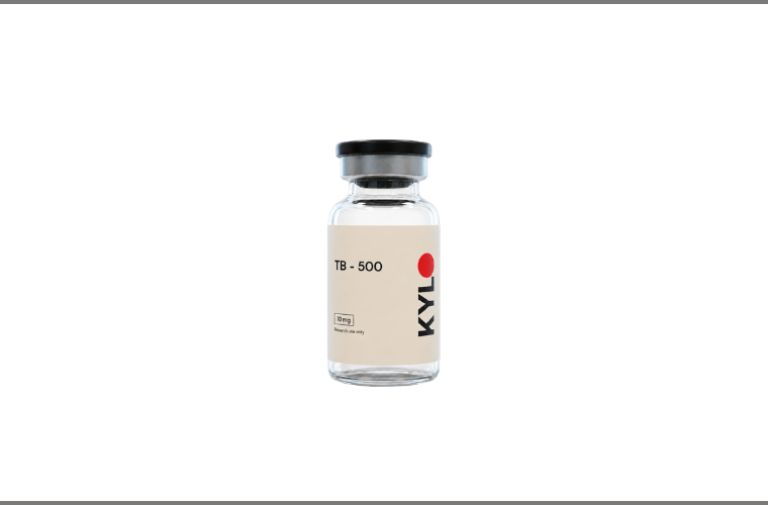
You can buy research-grade TB-500 online from vendors like Kylo Peptides, which sells a 10 mg lyophilized vial for $69.95. Kylo identifies its TB-500 as the seven-amino-acid fragment Ac-LKKTETQ, and its latest certificate from Optiq Health Labs reports 99.2% purity, with identity confirmed by LC-MS. At $7.00 per mg, it also costs less per milligram than the other two options.
American Peptides ($100 per 10 mg) and PS Peptides (from $44.99 per 5 mg) also sell TB-500 with lot certificates. Their documents describe a different molecule, though. American Peptides' certificate mass and PS Peptides' CAS number both match full-length thymosin beta-4, a 43-amino-acid peptide. Because sellers use the name "TB-500" for both, check the sequence and molecular weight before you compare prices.
We compared each supplier's public pages and certificates. All three sell TB-500 for laboratory research use only.
Quick Comparison Table
|
Supplier |
TB-500 format |
Listed purity |
Testing/COA |
Product size |
Research-use positioning |
|---|---|---|---|---|---|
|
Lyophilized |
≥99% (lot: 99.2%) |
Optiq COA, LC-MS identity |
10 mg |
Yes |
|
|
American Peptides |
Lyophilized |
99.9% (lot: 99.68%) |
Bioviridian COA, LC-MS/MS |
10 mg |
Yes |
|
PS Peptides |
Lyophilized |
≥99% (lots: 99.90-99.93%) |
North American Diagnostics COA + 4 panels |
5 mg, 10 mg |
Yes |
What Is TB-500?
TB-500 is a synthetic seven-amino-acid peptide, Ac-LKKTETQ, copied from positions 17 to 23 of thymosin beta-4 with an acetyl cap on the front end. Researchers who buy TB-500 peptides want to study how that short actin-binding stretch behaves on its own. Think of it as one sentence lifted out of a long paragraph.
TB-500 and Thymosin Beta-4
Thymosin beta-4 (Tβ4) is a 43-amino-acid protein of about 5 kDa and the main G-actin-sequestering peptide in cells, according to a 2003 FASEB study. TB-500 keeps only its LKKTETQ motif. Doping-control chemists describe TB-500's key ingredient as LKKTETQ with an acetylated N-terminus (Ho et al., 2012).
So the fragment and the full protein share a name family and one short stretch of sequence. That shared stretch is why supplier wording needs care.
TB-500 in Laboratory Research
- Cytoskeletal research: how actin filaments assemble and break down
- Actin-related assays: G-actin binding by the LKKTETQ motif
- Cell migration: endothelial and keratinocyte movement in culture
- Cellular signaling: pathways that follow actin remodeling
- Protein interaction studies: which binding partners the fragment retains
- Preclinical work: animal models, many of them run with full-length Tβ4
Why the Name Matters When You Buy TB-500
The label "TB-500" spans quite different materials, from a seven-residue fragment to a 43-residue protein. Buying on the name alone can put the wrong molecule in your freezer, so the paperwork behind the name deserves a slow read.
TB-500 vs Thymosin Beta-4
Thymosin beta-4 and the TB-500 fragment are two different molecules that often share one product title. The fragment weighs about 889 daltons, and the full protein weighs about 4,963. The FDA's 2026 briefing document states they "are not the same substance," so settling which one a listing sells comes first.
Structural Difference
|
Feature |
TB-500 fragment |
Full-length thymosin beta-4 |
|---|---|---|
|
Length |
7 amino acids |
43 amino acids |
|
Sequence |
Ac-LKKTETQ, Tβ4 (17-23) |
Complete Tβ4 chain |
|
Formula |
C38H68N10O14 |
C212H350N56O78S |
|
Molecular weight |
889.0 |
4,963 |
|
CAS number |
885340-08-9 |
77591-33-4 |
|
PubChem record |
CID 16132341 |
Commercial pages swap the two terms because the fragment was derived from the protein. "Thymosin beta-4 fragment" also sounds a lot like "thymosin beta-4" on a product card.
Why Researchers Should Check the Exact Product
Read past the product title to five data points: the product name, the written sequence, the molecular weight, the identity line on the COA, and the mass-spectrometry result. Mass is the most objective of the five, since it separates the two molecules at a glance. If any detail drifts from the others, email support before you order.
What This Means When Comparing Suppliers
Compare the documents behind each product title. Kylo's listed sequence, CAS number, and 889.02 weight all point to the fragment. American Peptides' COA reports a molecular weight of 4,964.2, and PS Peptides lists CAS 77591-33-4, both of which match full-length Tβ4.
Either molecule can suit a study. It just has to be the one your protocol calls for.
What Should You Check Before Buying TB-500 Peptide?
Before you buy TB-500 peptide from any vendor, run the listing through one six-point screen: compound identity, purity, identity testing, a lot-specific COA, product quantity, and supplier transparency. We call it the 6-Point TB-500 Buyer Screen. A source that clears all six gives you a vial you can trace from order to bench.
1. Compound Identity
- Name: TB-500, ideally with "Ac-LKKTETQ" or "Tβ4 (17-23)" beside it
- Sequence written out in full
- CAS number where provided (885340-08-9 for the fragment)
- Molecular weight near 889 g/mol
- Synonyms that fit the fragment
- A description that stays consistent from top to bottom
If the page and the certificate disagree on any of these, the rest of the screen can wait until support explains why.
2. Purity
A stated purity like "≥99%" means the target peptide made up at least that share of what the HPLC detector recorded. The figure earns trust once a certificate from a named lab backs it. Look for the actual lot result, such as 99.68%, printed next to the spec.
A range like "≥99%" on its own is a target the supplier sets for itself.
3. Identity Testing
Purity and identity answer different questions. HPLC tells you how clean the sample is, and LC-MS tells you what the main peak actually is. A strong listing promises both, and its COA reports both.
4. Lot-Specific COA
Check that the certificate shows:
- Lot or batch number
- Test date
- Testing laboratory
- Product name
- Purity result
- Identity result
5. Product Quantity
- 5 mg vs 10 mg, and which size the certificate covers
- Whether the measured content lines up with the labeled amount
- Whether the supplier publishes net content at all (all three here do)
A TB-500 10mg vial measured at 9.75 mg and one measured at 10.23 mg are both normal results, and that 0.48 mg difference only shows up when you read the content line.
6. Supplier Transparency
- Company details and a physical address
- Research-use labeling
- Published testing information
- Downloadable product documents
- Clear shipping terms
- A reachable support channel
A third-party tested label becomes checkable once the page names the lab, the test date, and the lot number.
TB-500 Purity, HPLC, and Mass Spectrometry
TB-500 purity testing relies on HPLC to measure how much of the sample is the target peptide. Mass spectrometry then weighs the molecule to confirm its identity. You need both numbers, since a 99.9% pure vial of an unexpected molecule still misses the brief for a fragment study.
What HPLC Shows
High-performance liquid chromatography pushes the sample through a column and draws each component as a peak. Purity is the target peak's area as a share of all peaks, usually read at a UV wavelength such as 214 nm. Labs default to it for peptides because it separates close impurities like truncated or deleted sequences.
What Mass Spectrometry Adds
Mass spectrometry reports a molecule's mass, and MS/MS fragmentation can confirm its sequence, as USP and MHRA authors explain. Bigger peptides pick up several protons, so the spectrum shows a ladder of charge states. Multiply a peak by its charge and subtract the protons: a 710.2 peak at 7+ works out to about 4,964 Da.
Why Both Matter
Read the two results together, and check that the identity line names the same molecule the listing sells. A matching mass on the COA is the fastest way to confirm it.
TB-500 COA: What Does a Researcher Need to See?
A TB-500 COA should connect one vial to one tested sample and let you read the results without guesswork. Walk through six fields in order, from the product name down to any supporting panels. When a field is blank or vague, a short email to support usually clears it up before you order.
Product Name
Does it say TB-500, and does the molecular weight on the page agree with that name?
Lot Number
Can you match it to your vial? Kylo's lot SD-260726-1 and American Peptides' lot TB10-0803 both appear on their certificates.
Testing Date
Is it recent enough to cover the batch you'll receive? The most recent published TB-500 certificates from all three suppliers date from August 2026.
Testing Laboratory
Who ran the analysis? All three suppliers name a lab: Optiq Health Labs, Bioviridian, and North American Diagnostics.
Analytical Results
Which methods actually ran? Expect RP-HPLC purity, LC-MS identity, and an HPLC content figure in milligrams.
Supporting Panels
Some suppliers add endotoxin, sterility, heavy metals, or residual solvent reports. When a lot has none, ask support what was run.
Kylo Peptides, American Peptides, and PS Peptides all publish TB-500 certificates with a named lab, a lot, and a date. Their profiles start with the supplier whose listing names the fragment most directly.
Top Suppliers For TB-500 Peptide
#1. Kylo Peptides
Fragment-listed TB-500 with a lot COA. Kylo Peptides sells the one TB-500 of the three whose listed sequence, CAS number, and molecular weight all describe the seven-residue fragment. We read its Optiq PDF line by line: the certificate names TB-500 and confirms identity by LC-MS. For a buyer who wants the Ac-LKKTETQ fragment, that listing gives you the most to check against.
Product Details
- Compound: TB-500, thymosin beta-4 fragment, Ac-LKKTETQ, Tβ4 (17-23)
- CAS / molecular weight: 885340-08-9 / 889.02 g/mol
- Format: lyophilized powder, one 10 mg vial
- Price: $69.95 per vial, with 5% off two vials and 10% off three
- Storage: −20 °C, sealed, dry, and out of light
- Positioning: sold for laboratory research use only, to qualified researchers
Testing
- Lab: Optiq Health Labs, one of four independent labs in Kylo's COA library, alongside Janoshik, Freedom Diagnostics, and Vanguard
- Lot: SD-260726-1, reported August 10, 2026
- Purity: 99.2% by RP-HPLC, against a ≥98.0% specification
- Identity: LC-MS
- Measured content: 9.88 mg
- Extra panel: endotoxin, USP 71 sterility, yeast and mold, residual solvents, and heavy metals, each marked as pass.
What Makes Kylo's Listing Easy to Evaluate
Everything a buyer needs sits one click apart. The product page lists the sequence, CAS, and weight, and the certificate also opens in Optiq's portal so that you can check it at the source.
Dispatch runs within 24 hours, with free shipping over $150 and a 30-day money-back policy. Kylo says each certificate matches the lot ID printed on the vial, so the check on arrival is quick.
Who Should Consider Kylo's TB-500?
- Labs whose protocol calls for the Ac-LKKTETQ fragment specifically
- Buyers who want a lot record and a measured mg figure before ordering
- Researchers who compare documentation first and price second
If your protocol calls for the fragment, check the latest lot on Kylo's TB-500 page.
#2. American Peptides
Known for a code-searchable TB-500 COA. American Peptides prints Bioviridian web code COA7595 on its TB-500 certificate. Type that code into the lab's search page, and the lot record comes up on the lab's own site. At $100 per 10 mg, it is the highest-priced single vial of the three.
American Peptides Product Details
- Listing: TB-500, 10 mg (SKU TB-500-10MG)
- Price: $100.00
- Format: lyophilized white powder, stored at −20 °C
- Stated purity: a 99.9% badge, plus ≥99% by HPLC and mass spec in the spec block
- Positioning: in vitro laboratory research only
Testing
We pulled the lot TB10-0803 certificate and read the results:
- Bioviridian; sample received August 11, report issued August 17, 2026
- 99.68% purity by RP-HPLC at 214 nm
- 10.23 mg measured content
- LC-MS/MS identity, endotoxin below 0.05 EU/mL, heavy metals below 0.01 ppm
Worth double-checking: the certificate lists a molecular weight of 4,964.2, and its mass peaks add up to about 4,964 Da. That matches full-length thymosin beta-4, and the page's spec block shows both a 4,963.4 figure and the 889.02 fragment figure. If your work needs the seven-residue fragment, ask support which molecule this lot contains.
Pricing and Ordering
Volume pricing brings the vial to $93 at three units, $89 at five, and $84 at ten, and a subscription saves up to 15%. Orders placed before 12 pm CT usually ship the same business day from its U.S. facility, with free shipping over $300. The $130 total in its "frequently bought together" box includes a $30 reconstitution solution.
Compare lot TB10-0803 on American Peptides' TB-500 page.
#3. PS Peptides
An option for a smaller 5 mg TB-500 vial. PS Peptides is the only one of the three selling TB-500 in a 5 mg size, currently $44.99, with a 10 mg vial at $79.99. Both are flash-sale prices, 13% below the regular $51.99 and $91.99. A TB-500 5mg vial suits a pilot run where a full 10 mg would sit in the freezer.
Product Details
- Sizes: 5 mg and 10 mg, both in stock on 29 September
- Price: $44.99 / $79.99 on sale; $51.99 / $91.99 regular
- Format: lyophilized powder
- Storage: −20 °C long-term, 4 °C short-term
- Labeling: laboratory and research use only, sold to qualified researchers
Testing
We opened both current certificates from North American Diagnostics, an Austin, Texas lab. The 10 mg report shows 99.93% purity and 9.75 mg measured. The 5 mg report shows 99.90% purity and 5.10 mg.
Each size also carries four extra reports: heavy metals (lead, arsenic, cadmium, and mercury not detected), endotoxin (under 5 EU per vial), USP 71 sterility with no growth, and a fentanyl screen. One detail to confirm, though. The page calls TB-500 a 43-amino-acid peptide and lists CAS 77591-33-4, the registry number for full-length Tβ4, while the COA names the product without printing a molecular weight.
Ordering Information
Two vials take 3% off, and three or more take 5% off. Current reports sit on the product page by size, with an archive of older batches underneath. Its published policy lists free UPS 2nd Day Air over $200 and same-day dispatch for orders before 2 PM EST.
TB-500 Price Comparison
TB-500 prices from these three suppliers run from $44.99 for 5 mg to $100 for 10 mg. Per milligram, the spread narrows to roughly $7 to $10. The fairer cut divides by the milligrams each lab actually measured, since vials rarely hold exactly their label amount.
|
Supplier |
Size |
Listed price |
Approx. price/mg |
Purity listed |
COA |
|---|---|---|---|---|---|
|
Kylo Peptides |
10 mg |
$69.95 |
$7.00 |
≥99% |
Yes |
|
American Peptides |
10 mg |
$100.00 |
$10.00 |
99.9% |
Yes |
|
PS Peptides |
5 mg / 10 mg |
$44.99 / $79.99 (sale) |
$9.00 / $8.00 |
≥99% |
Yes |
Using each certificate's measured content, the per-mg price shifts a little. Kylo comes to about $7.08 (9.88 mg), PS Peptides to $8.20 for the 10 mg vial (9.75 mg) and $8.82 for the 5 mg vial (5.10 mg), and American Peptides to $9.78 (10.23 mg).
Price is one input among several. Weigh it alongside:
- The quantity your work actually needs
- Which molecule the identity data describes
- How many tests the lot went through
- Free-shipping thresholds: $150 at Kylo, $200 at PS Peptides, $300 at American Peptides
- Format and storage specifications
A cheaper vial of the wrong molecule costs more in repeat work than it saves at checkout. Membership and bulk discounts can move these figures, so compare standard single-vial prices first.
Size changes the maths too. PS Peptides' 5 mg vial costs less at checkout but about 60 cents more per measured milligram than its 10 mg vial.
TB-500 Supplier Comparison
Side by side, all three places to buy TB-500 peptide clear the basics: a research-only listing, HPLC purity, mass-spec identity, and a lot-matched COA. The differences sit in size options, the depth of extra panels, and which molecule each supplier's identity data describes.
|
Criteria |
Kylo Peptides |
American Peptides |
PS Peptides |
|---|---|---|---|
|
TB-500 listed |
✓ |
✓ |
✓ |
|
Research-only positioning |
✓ |
✓ |
✓ |
|
HPLC testing |
✓ |
✓ |
✓ |
|
Mass-spec/identity testing |
✓ LC-MS |
✓ LC-MS/MS |
✓ HPLC-MS |
|
Lot-specific COA |
✓ |
✓ |
✓ |
|
Product quantity |
10 mg |
10 mg |
5 mg / 10 mg |
|
Additional testing |
Endotoxin / sterility / metals / solvents / yeast and mold |
Endotoxin / heavy metals |
Heavy metals/endotoxin/sterility/fentanyl |
|
U.S. fulfillment |
✓ |
✓ |
✓ |
|
Public documentation |
✓ |
✓ |
✓ |
- Kylo Peptides suits the documentation-first approach. Its listed sequence, CAS number, and molecular weight all describe the Ac-LKKTETQ fragment, and its lot carries the broadest extra panel.
- American Peptides stands out for its stated 99.9% purity, a 10 mg format, and a lot-matched COA you can look up by typing code COA7595 into Bioviridian's search page.
- PS Peptides offers two vial sizes and publishes four extra screening reports per size next to each COA.
TB-500 Storage and Handling
After you buy a TB-500 peptide, keep the freeze-dried powder frozen, dry, and dark. All three suppliers list −20 °C for the powder, and PS Peptides adds 4 °C for short holding. Follow your supplier's storage instructions first, because they reflect how that particular lot was prepared and packed.
- Store sealed vials at −20 °C, away from light and moisture
- Avoid repeated freeze-thaw cycles
- On arrival, check the seal, the powder cake, and the glass
- File the lot number with its COA the same day
- Log the date received and where each vial sits in storage
A tidy record here saves hours later when someone asks which lot fed which experiment.
If a vial arrives warm, cracked, or with a collapsed cake, photograph it before opening the box further. All three suppliers list a support channel, and a clear photo plus the lot number makes any replacement request quick.
TB-500 Research and What the Evidence Actually Shows
Research on TB-500 mostly comes from lab and animal work on actin, cell movement, and tissue remodeling. Studies of its parent protein show actin binding and cell migration, and chemists have mapped how TB-500 breaks down in animals. The FDA found no clinical studies of TB-500 itself.
Areas Studied in TB-500 Research
- Actin binding and G-actin sequestration, the job of the LKKTETQ motif
- Cell migration and new vessel growth in endothelial models
- Cytoskeletal remodeling
- Signaling that follows actin changes
- Preclinical models, including drug-testing work that tracks TB-500 metabolites in horses
A 2012 review in Expert Opinion on Biological Therapy ties much of this to full-length Tβ4, which binds actin and promotes cell migration. Separately, doping labs in Hong Kong and Ghent built detection methods for TB-500 and its breakdown products, which is how researchers mapped its metabolism.
What Researchers Should Not Assume
- Preclinical results stay preclinical. Cell and animal findings do not establish effects in people.
- Tβ4 findings belong to Tβ4. A 2024 doping-control study notes that the biological effects of TB-500 "have not been documented."
- Plausibility is a starting point. The FDA's briefing document found no clinical studies or human exposure data for TB-500.
TB-500 Research-Only Status
TB-500 peptide is sold as a research-use-only material for laboratory and analytical work. Suppliers classify it outside the drug, supplement, and cosmetic categories, and none of the three labels it for people or animals. Its regulatory status is still moving, so research findings belong within their experimental context.
- FDA review: On July 23, 2026, the FDA's compounding advisory committee weighed TB-500 for the 503A bulks list. Reuters reported an 8-6 vote in favor with one abstention, after FDA staff had recommended against listing.
- Next step: the vote is nonbinding, and the FDA must still decide whether to act on it. We found no final action as of 29 September 2026.
- Labeling: each supplier states it sells only to qualified researchers, and each prints its research-only line on the product page.
- Sport: WADA's 2026 Prohibited List names TB-500 as a thymosin-β4 derivative banned at all times.
How to Check TB-500 When Your Order Arrives
When lyophilized TB-500 arrives, spend five minutes matching the vial to its paperwork before it goes into the freezer. Three quick checks, covering the label, the documents, and your own records, build a traceability file you can show anyone who asks where the material came from.
Check the Label
- Product name reads TB-500
- Quantity matches what you ordered
- Lot number is printed and legible
Check the Documentation
- COA lot number matches the vial
- Testing laboratory is named
- Purity and identity results are both present
Check the Product Record
Keep these together in one folder:
- Order confirmation
- A saved copy of the product page
- The COA PDF
- The lot number
- The date received
Save the product page as a PDF on the day you order. Listings change, and your copy shows exactly what the supplier described when you paid.
TB-500 Buying Checklist
Use this checklist as a last pass before you buy TB-500 peptide and again when the box lands. It condenses the six-point screen, the COA walkthrough, and the receiving steps into fourteen ticks, so nothing slips between ordering and storage. Print it, or keep it next to the order confirmation.
Before ordering
- ☐ Exact TB-500 identity confirmed
- ☐ Product format confirmed
- ☐ Quantity confirmed
- ☐ Purity documentation available
- ☐ Identity testing available
- ☐ Lot-specific COA available
- ☐ Testing laboratory identified
- ☐ Storage information available
- ☐ Supplier information verified
- ☐ Shipping terms reviewed
After receiving
- ☐ Lot number matches COA
- ☐ Product label matches order
- ☐ Documentation saved
- ☐ Storage conditions followed
The last four boxes are the easiest to skip. The vial goes straight into the freezer, and the paperwork stays in an inbox where nobody links it to the lot.
FAQs
What does the TB-500 sequence tell a researcher?
Which molecule you have. Ac-LKKTETQ is seven residues from thymosin beta-4's actin-binding site, capped with an acetyl group. A listing that prints this sequence alongside the matching molecular weight is describing the seven-residue fragment.
Why can TB-500 listings use different names for the same research material?
History and habit. The fragment came from thymosin beta-4, so sellers use "Tβ4 fragment," "Tβ4 (17-23)," "TB500," and "Tβ4 acetate" loosely. The CAS number and molecular weight cut through the naming.
Does a TB-500 COA need to show the lot number?
Yes. Without one, a certificate proves only that some sample passed a test somewhere. The lot number links that result to the vial in your hand, and it is the first thing to quote if you ever query a result with the supplier.
Why might a supplier publish multiple COAs for TB-500?
Different sizes and batches. PS Peptides posts separate 5 mg and 10 mg reports plus an archive of older lots. Each batch is its own test, so match the report to the lot on your vial.
What is the difference between a product COA and a supplier-wide testing claim?
Specificity. A banner saying every batch is tested states a policy. A product COA names the compound, lot, lab, date, and results, which you can check one by one against the vial and, where offered, the lab's own portal.
Why should the product description and COA be checked together?
They can disagree. A page may describe one molecule while the certificate's mass data describes another. Reading both side by side catches the mismatch before the vial reaches your bench.
Final Thoughts on Buying TB-500 Peptide
Buying TB-500 peptides comes down to one question: can you prove which molecule is in the vial, how pure it is, and which lot it came from? All three suppliers publish real, lot-level certificates. The right pick depends on the molecule and size your research calls for, so knowing where to buy TB-500 starts with your protocol.
- Seven-residue fragment with a lot-tested certificate: Kylo Peptides
- Code-verifiable COA on a 10 mg vial: American Peptides
- A 5 mg size with extra screening reports: PS Peptides
Whichever source you choose, read the certificate before adding to your cart. Visit Kylo Peptides first to read its current TB-500 lot record, then order once the numbers fit your protocol.
Disclaimers
- Affiliate disclosure: this page contains sponsored content and affiliate links. We may earn a commission if you buy through them, at no extra cost to you. Kylo Peptides is a commercial partner.
- Research use only: TB-500 is sold for laboratory research. Nothing here is medical advice, and no product mentioned is approved for human or veterinary use.
- Accuracy: prices, stock, and certificates were checked on 29 September 2026 and may change. Confirm current details on each supplier's site before ordering.
The views, opinions, and recommendations expressed in this article are solely those of the author and are provided for informational and editorial purposes only. They do not constitute professional advice and should not be relied upon as such. OutSFL makes no representations or warranties regarding the accuracy, completeness, or applicability of the content and assumes no liability for any actions taken based on it. The views expressed do not necessarily reflect those of OutSFL.