

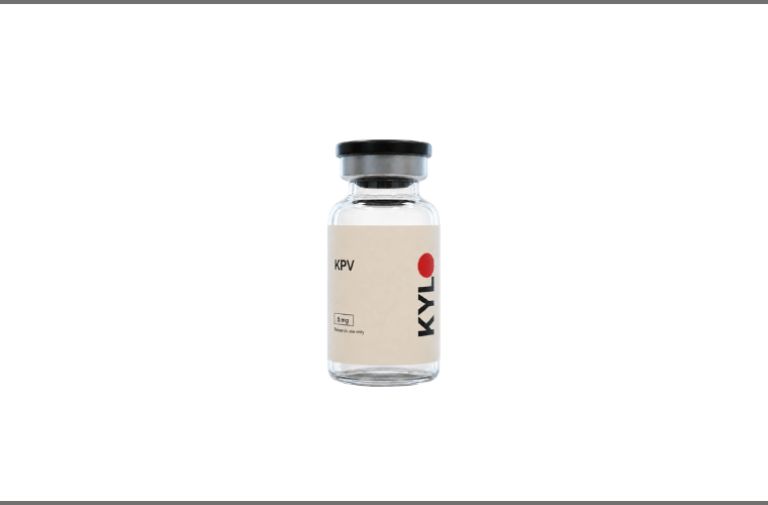
Buying KPV peptides for research? KPV is commonly supplied as a lyophilized (freeze-dried) powder intended for laboratory and in-vitro research, with suppliers such as Kylo Peptides offering research-grade material. Pricing can vary by supplier, vial size, and quantity, with individual vials commonly falling in the $20–$70 range. Price alone won't tell you whether the material matches the label, but you can vet a trustworthy KPV source yourself in about ten minutes. All you need to do is check the paperwork.
We reviewed 20+ top-ranking KPV vendors online, and only one reported a COA for each batch, testing across 7 assays, including purity, identity, net content, endotoxins, heavy metals, and more. US searches for "KPV peptide" rose from about 1,000 a month in early 2023 to over 52,000 a month in September 2026, indicating growing demand and a more careful approach to selecting a supplier.
KPV Peptide at a Glance
|
Category |
Details |
|
Peptide type |
Tripeptide |
|
Sequence |
Lys-Pro-Val (K-P-V) |
|
Parent molecule |
Alpha-MSH, residues 11 to 13 |
|
Molecular weight |
342.43 g/mol |
|
Formula / CAS |
C16H30N4O4 / 67727-97-3 |
|
Salt forms |
Free base and acetate |
|
Typical research format |
Lyophilized powder in 5mg or 10mg vials |
|
Research focus |
Inflammatory signaling |
|
Evidence |
Primarily preclinical (cell and animal models) |
|
Human clinical evidence |
None established |
|
FDA-approved treatment |
No |
|
Research-use status |
Sold by research suppliers for laboratory use |
What Is KPV Peptide?
KPV is a tiny peptide with a famous parent, Alpha-MSH.
KPV and Its Relationship to Alpha-MSH
KPV is made from three amino acids: lysine (K), proline (P), and valine (V), in that exact order. It's the tail end of alpha-melanocyte-stimulating hormone (alpha-MSH), at positions 11-13. Researchers study it for its potential anti-inflammatory properties, carried over from the parent.
Why KPV Is of Interest in Research
Short peptides are easier to synthesize and test precisely, so KPV is a handy research tool. Most work so far focuses on how it interacts with cellular signaling, especially inflammatory pathways, in cell and animal models. KPV also shows up in blend research, especially as the only ingredient that differentiates KLOW from GLOW. All the data around it is preclinical.
KPV Peptide Mechanism of Action
Here's how researchers propose KPV works in lab models.
Alpha-MSH and the KPV Sequence
Alpha-MSH signals through melanocortin receptors. KPV is a fragment, and scientists are studying how much of that signaling it retains.
NF-κB Signaling
NF-κB is a protein switch that turns on many inflammatory genes. A 2008 study in Gastroenterology reported that nanomolar KPV concentrations inhibited NF-κB and MAP kinase signaling in human intestinal cell lines.
Cytokine Signaling
Cytokines are the messenger proteins cells use during inflammation. In the same 2008 study, researchers treated human intestinal cell lines with KPV and reported lower pro-inflammatory cytokine levels. They saw a similar drop in two KPV-treated mouse colitis models, DSS and TNBS.
PepT1-Mediated Uptake
PepT1 is a transporter that carries two- and three-amino-acid peptides like KPV into cells. The 2008 study discussed above showed KPV rides PepT1 into intestinal cells, paving the way for research on the peptide in gut models.
Why Mechanistic Research Is Not the Same as Clinical Evidence
A preclinical pathway result shows what a molecule does in a controlled lab model. Since the FDA has found no human exposure data on KPV by any route, every mechanism explored so far is research-led.
Where to Buy KPV Peptide for Research
For research-grade KPV, there’s one supplier whose paperwork holds up when you check it.
Kylo Peptides
Kylo Peptides sells KPV as a research reagent labeled "For Research Use Only · Not for human or veterinary use." Kylo describes it as a characterized reagent for in vitro laboratory research. It comes as lyophilized (freeze-dried) powder in two sizes: 5mg for $44.95 and 10mg for $59.95. Members get 50% off both sizes.
Buy two vials and save 5%; buy three and save 10%. Kylo also lists the CAS number (67727-97-3) and molecular weight (342.43 g/mol) on the website, which makes identity checks easy.
The purity spec is ≥99% by HPLC. Every lot is third-party tested, and each certificate of analysis (COA) is published and matched to the lot ID on your vial. The testing panel covers LC-MS identity, net peptide content, sterility, endotoxin, and heavy metals.
For storage, it lists -20 °C for lyophilized powder, kept dry and away from light. Orders are dispatched within 24 hours on business days, and orders over $150 ship free.
Why Consider Kylo Peptides?
Kylo runs seven assays on every batch. Sterility follows USP <71> with a 14-day culture, and endotoxin follows USP <85> using LAL screening. Purity runs on HPLC-UV, identity on LC-MS, and heavy metals (lead, arsenic, cadmium, and mercury) on ICP-MS. Kylo also weighs net content, so a 10mg vial is confirmed to hold 10mg. It also tests several samples per run for batch consistency.
Testing is completed at three independent labs: Janoshik Analytical, Freedom Diagnostics, and Vanguard Laboratory. Freedom and Vanguard hold ISO/IEC 17025:2017 accreditation under A2LA certificate 6377.01. Every result goes on the lot-matched COA.
What to Consider When Choosing a KPV Peptide Source
Choosing a KPV source comes down to eight checks.
1. Peptide Identity
Can the supplier prove the powder is KPV? Look for LC-MS data showing a mass matching KPV's 342.43 g/mol. HPLC tells you how pure the compound is. Mass spec tells you what the compound is.
2. Purity
A purity number needs an HPLC test to back it up. Look for a result that shows the actual HPLC percentage for your lot, ideally ≥99%. A rounded "99%+" with no chromatogram is a claim without proof.
3. Third-Party Testing
Check who ran the test. Prefer independent labs because they don’t have any stake in the sale. A transparent supplier will name the lab and also share its accreditation, preferably ISO/IEC 17025.
4. Lot-Specific COA
The certificate should match the exact batch you're holding. Look for the same lot ID on the COA and the vial label. If the two differ, you're reading another batch's report.
5. Testing Methods
Good labs name their test methods on COAs: HPLC-UV for purity, LC-MS for identity, ICP-MS for heavy metals. If a result has no method next to it, ask the vendor which test produced it.
6. Contaminant and Microbiological Testing
HPLC and LC-MS don't check for bacterial toxins, live microbes, or metals. Endotoxin, sterility, and heavy-metal tests cover that. For cell-based work, check those three closely.
7. Batch Traceability
You should be able to trace a vial to a lot and a lab report. Vendors ensure this in plenty of ways. Some, like Kylo, make lot-specific COAs easily searchable in the site’s COA library, while others ship the vial with a scannable QR code that links directly to the COA. Such checks matter even more when the buyer is dealing with a multi-peptide stack like the KLOW stack.
8. Research-Use Labeling
The product should be clearly labeled for research use. It’s the bare minimum. You should know that the label alone doesn't settle compliance. In a 2024 FDA warning letter, the agency said website claims showed products were "intended to be drugs for human use" despite "RESEARCH USE ONLY" labels. Careful suppliers use the same RUO framing across labels and website.
How to Read a KPV Peptide COA
A COA looks intimidating, but it's just a receipt with lab results attached. Here’s how you can decode it like a pro.
What Should a KPV COA Include?
- Product name: KPV or Lys-Pro-Val, ideally with the salt form (free base or acetate).
- Lot number: a unique ID that matches the label on your vial.
- Purity: the lot's actual HPLC percentage. Kylo's published format reads like "99.62% HPLC-UV purity, BPC-157 lot 2604060200."
- Identity: an LC-MS or mass spec result that matches KPV's 342.43 g/mol.
- Testing method: the method named next to each result.
- Laboratory: the lab's name, plus a report ID you can look up.
- Test date: recent enough to match the batch you're buying.
- Relevant quality assays: net content, endotoxin, sterility, and heavy metals.
Insider tip: Most peptide-testing labs run public lookup pages. Janoshik asks for a task number and unique key, and Freedom Diagnostics uses an accession-based search code. If your COA carries those codes, confirm the report on the lab's own site in under a minute.
How to Verify a Lot-Matched COA
Verifying a COA requires you to connect these 5 chains:
- Product: note the product name and size on your vial.
- Lot number: copy the lot ID printed on the label.
- COA: find the certificate carrying that exact lot ID.
- Laboratory: check the lab name, then look up the report on the lab's public portal.
- Results: confirm the purity, identity, and contaminant results meet spec.
If any of them are untraceable, pause and ask the vendor. Legit suppliers answer these questions honestly, even though it’s explicitly through support. The most transparent ones, however, mention these details on the COA itself.
Generic COA vs. Lot-Specific COA
Peptide batches can drift in purity and content from run to run, and their certificates need not match. An undated or lot-free certificate is only a good starting point for your questions about the product, not the specific batch you bought. Kylo published batch-specific certificates for every KPV lot it produces.
KPV Peptide Quality: Why Purity Isn't the Whole Story
A 99% purity number is one marker of the overall peptide quality. Other crucial ones include:
Purity vs. Identity
Purity measures how much of the sample is one compound. Identity confirms which compound. As FDA official Russell Wesdyk told NPR in July 2026, "We can't create quality standards until we actually know what it is."
Why Peptide Characterization Matters
Characterization pins down sequence, mass, and salt form. KPV acetate and free base carry different amounts of peptide per milligram of powder, so your COA should name the form.
Impurities and Byproducts
Synthesis leaves byproducts like truncated or deleted sequences, and FDA reviewers assess peptide-related impurities from 0.1% upward. A clean chromatogram is your best way to check these.
Aggregation
Peptides can clump into aggregates during storage and handling, which changes how they behave in an assay. Cold, dry, dark storage helps.
Microbial Quality
Endotoxin switches on NF-κB. So, if your KPV vial is contaminated with it, the NF-κB signal you're reading for KPV studies may get muddy. The same logic applies to blends like the GLOW stack.
Batch-to-Batch Consistency
Consistency testing compares several samples against one reference to flag a batch that doesn't meet quality parameters during a run.
KPV Peptide Regulatory Status in 2026
As of September 2026, KPV is not FDA-approved. FDA staff proposed keeping it off the 503A bulks list. An advisory committee then voted 8 to 6, with 1 abstention, to recommend adding it to the same list. However, the vote is advisory, and FDA hasn't made a final decision.
Is KPV FDA Approved?
No. There's no FDA-approved KPV drug. Research suppliers sell KPV for laboratory use only.
KPV and the 503A Bulks List
The 503A list sets which bulk ingredients compounding pharmacies can use. KPV previously sat in FDA's Category 2 until the agency withdrew its nomination. FDA's safety-risk page still states that the agency "lacks important information regarding any safety issues raised by KPV."
What the 2026 Advisory Committee Recommendation Means
On July 23, 2026, FDA's Pharmacy Compounding Advisory Committee voted 8 yes, 6 no, and 1 abstention on KPV. Going in, FDA's briefing document stated: "FDA is proposing that KPV (free base) NOT be included on the 503A Bulks List." One panelist, Dr. Elizabeth Rebello of MD Anderson, told NPR she worried about "responding to market-induced demand rather than a decision based in solid science."
Recommendation vs. Final FDA Decision
FDA describes the committee's votes as non-binding recommendations. It still has to complete rulemaking for adding anything to the list. The vote left existing restrictions in place for now.
Research-Use-Only Products vs. FDA-Approved Drugs
Research-grade KPV is sold as a lab reagent. It hasn't gone through FDA review for safety, effectiveness, or drug manufacturing.
How to Evaluate KPV Research Yourself
KPV papers get quoted a lot online, and summaries tend to stretch with every retelling. Run any claim through this 8-question evidence check before trusting it:
- Study type: Cell, animal, observational, or clinical? Nearly everything published on KPV so far is cell or animal work.
- Sample size: How many cells, animals, or people were involved? Small mouse groups can give early signals that still need to be repeated in larger models.
- Model used: Which cell line, species, or disease model? The 2008 Gastroenterology study used Caco2-BBE, HT29-Cl.19A, and Jurkat cells, plus DSS and TNBS mouse colitis.
- Research conditions: What formulation, concentration, and delivery method? For instance, some KPV studies packed the peptide into engineered nanoparticles. Their results may not match those from a lyophilized powder.
- Endpoint measured: Did the study track a biomarker, like a cytokine level, or an outcome you'd see outside the lab? Marker changes translate into early hypotheses about the compound.
- Publication quality: Is it original peer-reviewed research or a secondary summary? Go to the primary paper whenever you can, and read the methods before the abstract.
- Replication: Have independent teams reproduced the finding? One lab's result is a starting point. Two or three labs landing on the same answer can be filed as potential evidence.
- Human relevance: Can the findings reasonably translate to people? With FDA reporting no human exposure data, it’s only safe to say nobody knows yet.
US searches for KPV grew about 12x between January 2025 and September 2026, per Ahrefs data. Demand tells you people are curious. However, the FDA still reports no human exposure data on the compound, so the evidence hasn't caught up. So, keep your research plans anchored to what's being published. Use the checklist, save the papers, and let the data set your expectations.
Why Choose Kylo Peptides for KPV Research?
If you've ever lost weeks to a reagent that didn't give the desired results, bad paperwork could be the reason. Here's how Kylo takes that stress off your plate.
Transparent Documentation
Kylo publishes each lot's certificate on the product page. You can read the results before you order.
Lot-Specific COA
Every KPV certificate matches the lot ID on your vial. You always know which batch the numbers belong to.
Independent Testing
Each lot goes through three independent labs, two of which also hold ISO/IEC 17025:2017 accreditation.
Peptide Identity Verification
LC-MS checks the molecule against the Lys-Pro-Val sequence on the label. A near-miss compound shows up as the wrong mass.
Purity Testing
HPLC-UV purity is tested against a ≥99% target. Kylo reports each lot's actual HPLC % without rounding it up.
Batch Traceability
The vial, lot, certificate, and lab report should all connect, and the vendor should make traceability easy.
Research-Use Positioning
Kylo labels KPV "For Research Use Only · Not for human or veterinary use." It describes itself as a chemical supplier, outside the scope of 503A and 503B compounding pharmacy rules.
Ready to compare the paperwork yourself? Check out Kylo's KPV and pull up the lot-matched COA.
KPV Peptide FAQs
Does KPV peptide come with a COA?
It should. Kylo publishes a lot-matched COA for KPV on the product page before each batch goes on sale. Skip any listing that can't show one.
What should a KPV COA include?
Product name, lot number, HPLC purity, LC-MS identity, testing methods, lab name, test date, and contaminant results like endotoxin, sterility, and heavy metals.
How do I verify a KPV COA?
Match the lot ID on your vial to the certificate, then look up the report on the testing lab's public portal using the codes printed on it.
Why is lot-specific testing important?
Peptide batches can vary from run to run. A lot-specific COA shows results for the exact vial you have.
Is KPV peptide FDA approved?
No. FDA has not approved any KPV drug. Research-grade KPV is sold for laboratory use only.
What is KPV's current regulatory status?
As of September 2026, an FDA advisory committee voted 8-6-1 to recommend adding KPV to the 503A bulks list. FDA hasn't made a final decision.
Does KPV have human clinical evidence?
Not yet. FDA says it has found no human exposure data on KPV by any route. Published work is cell and animal research.
What is the relationship between KPV and alpha-MSH?
KPV is the last three amino acids of alpha-MSH (positions 11 to 13). Researchers study the fragment on its own.
Why does KPV research focus on PepT1?
PepT1 carries small peptides into intestinal cells. A 2008 study showed KPV enters cells through PepT1, so gut models dominate the research.
How should I evaluate KPV research studies?
Check study type, sample size, model, conditions, endpoint, publication quality, replication, and human relevance. Most KPV evidence is preclinical.
Is Kylo Peptides' KPV intended for research use?
Yes. Kylo supplies KPV for in vitro laboratory research only. It is not for human or veterinary use.
Final Thoughts
Buying KPV gets a lot less stressful once you check the paperwork yourself. The science is early. The regulatory picture is still evolving. The only thing you can control is verifying your source's paperwork.
A KPV listing earns your money when it shows a lot-matched COA, LC-MS identity at 342.43 g/mol, a real HPLC number, and endotoxin, sterility, and heavy-metal results from a lab you can look up. If a vendor can show all of that, it’s good to go. If the paperwork has gaps, resolve your queries before you order.
Kylo is the best pick for research-grade KPV. You can pull the COA, check all the details, and let the results do the talking. And keep an eye on FDA's next move on the 503A list, because 2026 isn't done with KPV yet.
Research-use notice: KPV is sold for laboratory research only. The FDA has not approved it for human or veterinary use. This article is for informational purposes and is not medical advice.
The views, opinions, and recommendations expressed in this article are solely those of the author and are provided for informational and editorial purposes only. They do not constitute professional advice and should not be relied upon as such. OutSFL makes no representations or warranties regarding the accuracy, completeness, or applicability of the content and assumes no liability for any actions taken based on it. The views expressed do not necessarily reflect those of OutSFL.