

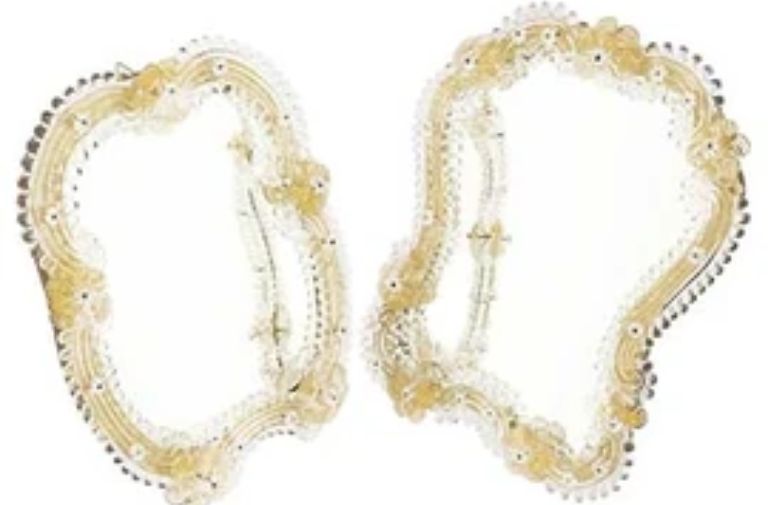
What are Venetian Glass Mirrors: Mirrors are such an important and integral part of our lives that we rarely even think about where they came from or what we would do without them. Every home has functional mirrors, often in the closets, sometimes by the entryways, wherever we need to assess how we look. Many homes also have decorative mirrors, which add volume and an interesting accent to a space. But do you know who made the first real glass mirrors like the ones we use today? Perhaps not so surprisingly, it was Venetian glass masters.
Venetian glass mirrors are stunning and have a long history going back to the fifteenth century. They have extraordinary clarity and exquisitely handcrafted glass frames. And amazingly, they are still being made today, as they maintain a reputation as some of the most opulent and bespoke home decor items. In this article, you will find five interesting facts that you might not know about Venetian glass mirrors.
Glassmaker Angelo Barovier Invented The First Glass Mirror
The Venetians first attempted to produce mirrors in the 14th century on the island of Murano. However, they had limited success, creating mirrors by metalizing glass with tin or lead. It was not until the mid-15th century that the perfect mirror glass was produced. Angelo Barovier, a member of the famous Barovier family, which had been producing glass since the 13th century, invented Cristallo, a transparent and colorless glass resembling rock crystal.
Cristallo was produced by mixing quartz sand with plant ashes as well as manganese oxide to neutralize iron oxide and create an almost clear glass, which was lightweight and fragile. The only downside was that it could corrode over time because of the low lime content.
In 1455, Barovier was given the exclusive right to produce Cristallo Veneziano by the Republic of Venice. New techniques were then created to embellish Venetian mirrors, such as engraving, enameling, and gilding.
In 1540, Venetian glassmaker Vincent Redor patented a leveling and shining procedure that created a perfectly flat mirror surface.
Venetian mirrors reached a peak in the 17th century. At this time, Venice held a monopoly on large-scale mirrors. Gold or bronze was often added to the glass to enhance reflection, and the frames were decorated with beveled pieces of glass.
However, in the 18th century, Venice faced competition from French and English glassmakers, and its monopoly disappeared. Despite this, Venetian glass mirrors were revived in the 20th Century by glass companies such as Fratelli Tosi and AAV Barbini Srl, and it is still possible to purchase beautiful mirrors from the island of Murano.
Venetian Mirrors Were Once More Valuable Than Gold
Murano Glass production flourished during the 15th to 17th centuries. Venetian glass mirrors were all the rage during that period, setting Murano Glassmakers above the rest. Their highly reflective and beautiful mirrors were were very expensive and popular with European royalty, including King Henry VIII of England and King Francis I of France. This was because they were high-quality, rare, and made using secret techniques known only to the glassmakers of Murano.
To maintain this monopoly, the Venetian government put up various legal and physical barriers to prevent the Venetian glassmakers from sharing their secrets with glassmakers from other countries. They could not leave the island of Murano. If they shared the secrets or, worse, left their community, the punishment could be brutal and swift.
Owning a Murano glass mirror at this time was a sign of social status and wealth. They adorned palaces, intensifying light and producing stunning visual effects. Just one mirror could cost as much as a naval ship or a painting by one of the masters of the Italian Renaissance.
Although other countries eventually caught up with Venice in mirror production, Venetian glass mirrors were amongst the most desired luxury items in the world until the late 17th century. Interestingly, they have again become one of the top-demand luxury items for sophisticated homes in the twentieth century. Both vintage and new Venetian mirrors are available in the market, with the more elaborate and better-preserved vintage models being the most expensive. Even when new, large and opulent Venetian mirrors require an incredible amount of work by many people, and thus command high prices, in tens of thousands of dollars.
Venetian Glass Mirrors are Masterpieces of Glass Art
Venetian mirrors are considered to be masterpieces of artistry, and it isn't hard to see why. They portray a centuries-old tradition of unparalleled craftsmanship that combines function with intricate handmade decoration.
Rather than plain glass, many mirrors crafted in Venice by Murano artisans are hand-engraved with different motifs such as flowers, leaves, and vines. These are usually created with a sandstone wheel and add texture and depth to the mirrors. Sometimes gold leaf is embedded in the glass to create a luxurious and highly reflective effect.
It is not only the mirror that is composed of glass, but the frames are often made of small hand-blown pieces of glass that have been assembled on a wooden base. They can be made of dainty Filigrana glass or have floral elements. These are attached with glass-headed nails.
The edges of the mirrors are usually beveled by hand, creating approximately a 2 cm. (0.78 in) edge which catches the light and sparkles.
All these factors add up to Venetian mirrors earning the status as the height of sophistication, artistry, and luxury.
The Mirror Gallery in Versailles Features 357 Venetian Glass Mirrors
In 1665, a few Venetian glassmakers were enticed to move to France by Minister Jean-Baptiste Colbert to teach local French glass masters to produce mirrors for the court of the Sun King, Louis XIV. Among them were brothers Gerolamo, Marco, and Domenego Barbini of the famous glassmaker family. It was a dangerous project as the Venetian government ordered that glass artisans fleeing Murano for France should be assassinated. Because of this, the Hall of Mirrors is sometimes called The Bloody Mirrors.
The Mirror Gallery was constructed between 1678 and 1684 and was designed by Jules Hardouin-Mansart. It is 73 meters (239.5 feet) long, and it connects the apartments of the King and Queen. On one side, there are 357 mirrors, and on the other, 17 arched windows. The mirrors are decorated with gilded bronze and feature the sun and the fleur-de-lis, an emblem with petals that represents French royalty, nobility, and the Virgin Mary. There are also crystal chandeliers in the gallery, reflecting light. The luxurious and elaborate design showcased the artistic, political, and economic power of France and the King.
Using mirrors for decoration as well as functionality at this time in history was exciting and different. The Mirror Gallery looks bigger than it actually is, as the mirrors give an illusion of space. They capture and magnify the light from the windows and the chandeliers, resulting in a brilliant and gleaming effect. The King wanted the Gallery to be a metaphor for his reign, which he considered to be a time of enlightenment, understanding, and knowledge.
Venetian Mirrors are Still Made Today Using Traditional Methods with Modern Vibes
Venetian glass mirrors are still being made by hand today. Traditional methods are being used with up-to-date twists. Cristallo is the main technique used with quartz pebbles being heated, cooled quickly, and then ground into a powder. Manganese oxide and plant ash are added, and the mixture is heated at a high temperature to produce molten glass. This is cut and shaped into a mirror. Different shapes are created these days, not just oval.
The mirrors may then be etched or engraved, beveled edges are created to reflect light, and designs are etched onto the glass frames. These can be floral, as in previous centuries, or more modern geometric designs.
The back of the mirror is then coated with a reflective layer of silver. Mercury was also used in the past, but it is highly toxic, so it is now avoided.
Finally, the glass is polished and finished to give the mirror strength, power, and clarity.
Although Venetian mirrors are still considered a luxury item, they are now more affordable and grace not only palaces but also everyday homes.
The views, opinions, and recommendations expressed in this article are solely those of the author and are provided for informational and editorial purposes only. They do not constitute professional advice and should not be relied upon as such. OutSFL makes no representations or warranties regarding the accuracy, completeness, or applicability of the content and assumes no liability for any actions taken based on it. The views expressed do not necessarily reflect those of OutSFL.