

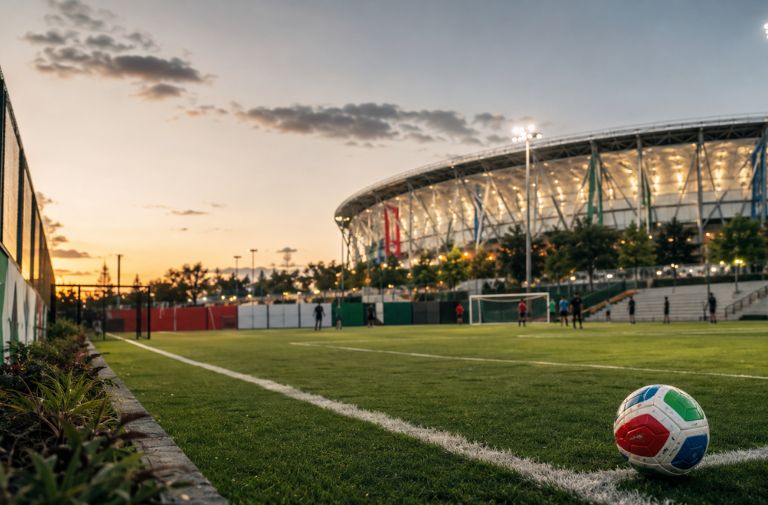
The 2026 World Cup left behind a harder set of numbers than most tournaments ever manage: 48 teams, 104 matches, 308 goals, and a record 6,810,966 spectators. Spain finished the job on July 19 at New York New Jersey Stadium, beating Argentina 1-0 after extra time when Ferran Torres scored in the 106th minute. Just over five weeks later, the immediate legacy is visible in community-football projects, expanded training networks, a larger competitive field and a new benchmark for how a three-country tournament can operate. The longer economic and social effects will take years to measure.
Forty-Eight Teams Did Not Break the Football
The expanded format was the experiment everyone had to judge in real time. Across 104 matches, the 48 teams produced 308 goals, an average of 2.96 per game; FIFA says that was the highest World Cup scoring rate since the 1970 tournament. The extra knockout round also gave more national teams meaningful tournament minutes, while Spain, Argentina, France and England were still playing on the final weekend. The scale held.
Three Countries Learned to Share One Tournament
Canada, Mexico and the United States spread the competition across 16 host cities, from Vancouver and Mexico City to Miami and New York New Jersey. FIFA also assigned the 48 teams to 48 base-camp training sites, with 25 communities outside the host-city list receiving national teams during the group stage. That widened the tournament footprint to places such as Austin, Tampa, Tijuana and Santa Barbara without adding match venues there. Mexico also became the first country to stage the men’s World Cup for a third time, after hosting in 1970 and 1986.
More Matches Changed the Betting Board
The new format has created a deeper live data set than the traditional one used in Qatar in 2022, especially once the Round of 32 introduced another knockout layer. Analysts could compare group-stage shot volume, goals per match, substitutions and extra-time patterns across more teams rather than leaning too heavily on reputation. For fans, football betting (Arabic: مراهنات كرة القدم) gained a wider statistical base for moneylines, totals, player props and in-play prices as unfamiliar matchups forced markets to adjust quickly. A fixed bankroll still mattered because a larger schedule created more decisions, not greater certainty.
Mexico City Put a Number on Legacy
Some of the clearest evidence of the tournament’s longer-term impact is appearing at street level. Mexico City is using the World Cup to help renovate 500 football pitches, from natural- and artificial-turf fields to seven-a-side courts and full-size grounds. Separately, FIFA, the Inter-American Development Bank, and the Mexican Football Federation plan to build eight community mini-pitches across Mexico by the end of 2026. The first opened in La Paz in June. Unlike projections for tourism or GDP, these are tangible projects: named facilities, defined targets, and work that residents can see taking shape.
The Knockout Stage Has Already Produced Tight Margins
The expanded tournament has delivered several matches decided by a single goal, with late moments and narrow scorelines shaping the route through the knockout bracket. That has made team news, confirmed lineups, substitutions, live odds, totals, and match-state data especially important for viewers assessing how a game is changing. A side that dominates possession may still struggle to create clear chances, while one tactical adjustment or injury can quickly alter the balance. The most useful analysis separates those measurable changes from the emotion of the occasion and keeps any stake proportionate to the evidence.
The New Benchmark Is Mostly Numerical
Spain’s second world title will remain the sporting headline, but the operational benchmark may travel further. Morocco, Portugal and Spain will stage 101 matches at the 2030 World Cup, while Argentina, Paraguay and Uruguay will each host one centenary celebration match. By 2027, the stronger measure of 2026 may be whether Mexico City’s 500-pitch program and the new community facilities remain active rather than how many attendance records still sit in a FIFA graphic.
The views, opinions, and recommendations expressed in this article are solely those of the author and are provided for informational and editorial purposes only. They do not constitute professional advice and should not be relied upon as such. OutSFL makes no representations or warranties regarding the accuracy, completeness, or applicability of the content and assumes no liability for any actions taken based on it. The views expressed do not necessarily reflect those of OutSFL.