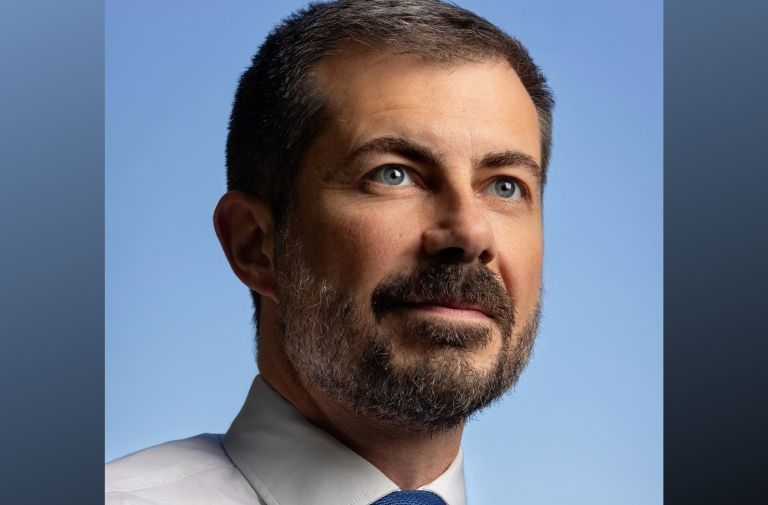
Former Secretary of Transportation Pete Buttigieg was separated from his 4-year-old twins for a day in late June by a false allegation of child abuse — a heinous act made more so because it echoes a long history of people trying to take children from LGBTQ parents. Many others have covered the incident in detail; here, I want to look at some of that history.
We should note first, though, that we don’t yet know the real reason for the accuser’s action. On his Substack (petebuttigieg.substack.com), Buttigieg called the incident “a cruel, politically motivated hoax that harmed our family.” That feels true — but was it purely political, based on Buttigieg’s policy stances and/or political actions, or was there anti-LGBTQ animus involved? Buttigieg is still one of the most visible LGBTQ parents in the media, making it possible — even likely — that the perpetrator had some level of anti-LGBTQ feelings. As Buttigieg himself acknowledged, “It’s not lost on me that this happened soon after we shared photos of our family on social media for Father’s Day. Or that this occurred during a month meant to make families like ours feel welcome and safe.”
Indeed, the incident hits on old biases and fears familiar to far too many LGBTQ parents. Starting in the 1960s, for example, when many LGBTQ parents began leaving heterosexual marriages, courts would often find against them in custody hearings because of groundless fears that “being raised with lesbians and gay men harmed children in some way, socially, emotionally, psychologically, or sexually,” as Daniel Winunwe Rivers explained in “Radical Relations,” his history of lesbian- and gay-headed families.
Queer parents were forcibly separated from their children at other times, too. In 1985, Massachusetts couple Don Babets and David Jean had their foster children removed from their care by the Department of Social Services (DSS) on the same day that the Boston Globe published a piece saying that some of their neighbors were opposed to the boys’ placement, WBUR reported. Mere weeks later, the state instituted a new policy under which it was almost impossible for gay and lesbian people to become foster parents. Babets and Jean sued with the help of GLAD Law, and although they never got the boys back, “in 1990 as a result of the case DSS returned to a ‘best interests of the child’ standard for foster care rather than focusing on the sexual orientation of the parents,” GLAD Law has noted (gladlaw.org).
In another headline case, the mother of Sharon Bottoms (later Sharon Mattes) in 1993 sued for custody of Bottoms’ child after Bottoms began a relationship with another woman. Much of the court hearing centered on what the women did in their bedroom, which the judge said was “illegal and immoral,” making Bottoms an unfit parent. The court granted custody to Bottoms’ mother, although Bottoms claimed she (Bottoms) had been molested by her mother’s live-in boyfriend when she was a teen. Bottoms appealed, but after three years, stopped the custody fight, wanting to spare her 5-year-old son more turmoil, per Carlos Ball’s history “The Right to be Parents.” She continued to challenge a restriction preventing her from visiting with her son if her partner was present, but in 1999, the Virginia Court of Appeals upheld that as well.
More recently, too, parents with trans and nonbinary children have faced allegations of abuse and been investigated by CPS (Child Protective Services) simply for affirming their children’s identities. This has been most prevalent in Texas, where Governor Greg Abbott (R) issued a directive in 2022 that medically necessary health care for gender dysphoria should be considered a form of child abuse. The ACLU has two cases, PFLAG v. Abbott and Doe v. Abbott, that are challenging that policy.
None of the situations above is identical to that of the Buttigiegs, but they show some of the context through which LGBTQ families may be viewing the family’s situation: we know how vulnerable our families have been to false accusations of improper conduct.
Things have gotten better for LGBTQ parents and our children over the years; courts now almost never deny custody explicitly because of a parent’s LGBTQ identity (though they may exhibit bias in more subtle ways), and even nongestational and nongenetic parents have access to a greater range of legal protections. But the United States overall is now moving in a more anti-LGBTQ direction, so it pays to be vigilant and to ensure one’s legal parentage is as secure as possible. (See lgbtqparentage.org for a brief guide from GLAD Law and me.)
We should remember, too, that the Buttigiegs were likely targeted because of their high profile. I do not believe that we LGBTQ parents as a whole should fear CPS knocking on our doors right now — although there is also an awful history of racism in CPS investigations, and a conflation of poverty and neglect, that mean some families may have more to worry about than others. Parents of trans and nonbinary children, too, particularly in Texas and other conservative states, have extra reasons to take precautions. Regardless of your situation, though, know that LGBTQ families are strong and resilient, and there are people and organizations who have your back.
I hope that whoever targeted the Buttigiegs is caught and faces justice. I wish the Buttigiegs safety and peace. And I hope we can all work towards a day when no LGBTQ parent or parent of an LGBTQ child has to fear that their children will be taken away because of anti-LGBTQ bias.
Dana Rudolph is the founder and publisher of Mombian (mombian.com), a two-time GLAAD Media Award-winning blog for LGBTQ parents, plus a searchable database of 2,000+ LGBTQ family books.