It was a stormy Tuesday evening 35 years ago when “the music of the night” thundered Broward County into the cultural big time.
With the Florida premiere of The Phantom of the Opera, the curtain rose for the first time at the Broward Center for the Performing Arts. That night, Feb. 26, 1991, the gleaming Fort Lauderdale venue announced itself as a major arts destination that would become one of the premier Broadway roadhouses in the country.
The Broadway blockbuster was such a runaway success that it ran for 12 weeks — for the first 10 of them selling out the elegant Au-Rene Theater’s 2,658 seats (at ticket prices topping out at $55!). Almost immediately, Broward County had cultural cred.
“Its 12-week run was unheard of at the time,” says Matt McNeil, the center’s chief programming officer. “It helped establish the touring Broadway model that audiences know and love today,”
And for the Broward residents among the 250,000 theater-goers who ultimately saw the show, there was icing on the cake: They would no longer need to schlep down to Miami to see a Broadway spectacular — or make do with the sadly lacking local alternatives, as bemoaned in this excerpt from the Sun Sentinel’s opening-night review:
“With 10 years of War Memorial Auditorium performances behind me, the sense of relief was nearly overwhelming as I walked through the doorway of the Broward Center alongside other first-nighters. (Folks who have been around here much longer than I may understandably faint from the shock of stepping into a genuine theater with a genuine lobby, genuine seats, genuine balconies, even genuine boxes, a genuine orchestra pit and a great big genuine stage.)”
“Existing venues such as War Memorial and Parker Playhouse were too small to host the larger productions and major touring shows,” says Jan Goodheart, the center’s vice president of external affairs. But, she says, the center did more than give the county a top-notch venue — it created a cultural anchor in the heart of the city.
“Fort Lauderdale’s downtown was expanding, and community leaders also viewed a state-of-the-art performing arts center as a tool to contribute to economic growth, help redefine the brand of Fort Lauderdale, attract tourists and support local businesses as part of a new Arts & Entertainment district.”
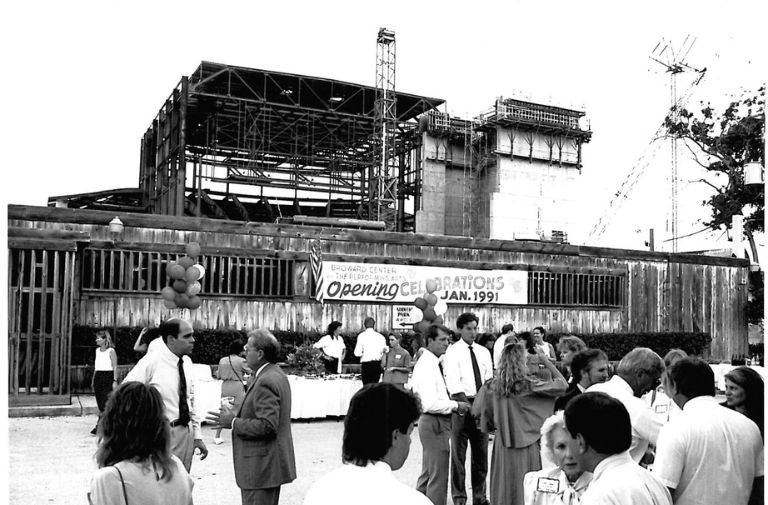
That vision has long become a reality — last year, the center’s annual economic impact exceeded $178 million — beginning with the center’s inception as a public-private partnership that led to the establishment of the Performing Arts Center Authority in 1984. Construction of the center began four years later. It was still finishing up as patrons filed in on opening night.
Since that record-setting premiere, the center has continued to draw rave reviews, having been ranked among Top 10 venues multiple times by Pollstar. Five years ago, the global industry authority named it as one of only 10 finalists for “Theatre of the Decade.” And in 2025, Billboard ranked both Broward Center and its affiliate, The Parker, No. 5 in respective categories.
“The Au-Rene Theater is consistently ranked next to venues like Radio City Music Hall,” Goodheart says, “because of our success in attracting audiences to world-class performances.”
“It really comes down to understanding what your community expects and what will resonate with them,” says McNeil, who’s been with the center since 2014. “Not every performing arts center is the same — we all deliver on our mission in different ways.”
For the Broward Center, that mission has been distinguished by one programming constant — even amid the evolving theater-going trends of the past three-plus decades.
“Touring Broadway has continued to appeal to the South Florida audience,” McNeil says. “We are proud to be one of the few venues in the country that hosts Broadway titles for two weeks at a time. Our loyal subscribers love the big marquee hits — shows like The Lion King, The Book of Mormon, and a landmark five-week run of Hamilton, all South Florida premieres — as well as fresh-from-Broadway productions like Death Becomes Her, &Juliet, Back to the Future, and the enduring Mamma Mia!”
Beyond the touring theatrical hits, a retrospective of the center’s credits would include a dazzling cast of superstars and span the spectrum of the performing arts, including several once-in-a-lifetime shows. McNeil mentions a recent example.
“Since 2023 we have been fortunate to welcome Bobby Weir & Wolf Bros for three separate visits totaling 10 shows. The final run in 2024 featured four nights at the Au-Rene Theater and two at The Parker, all sold out, drawing an enthusiastic fanbase to Fort Lauderdale from across the region.”
But the center’s regional impact extends beyond its tradition of bringing in world-class performances to its three main stages, and to those of the other venues under its umbrella — The Parker, The Rose and Alfred Miniaci Performing Arts Center and the Aventura Arts & Cultural Center.
“We see the arts as more than just entertainment,” says Goodheart. “It is reflected in our mission — we build community through the arts. We present arts experiences that resonate with and reflect our community.”
Goodheart speaks with authority — she’s been with the center for just over 20 years, overseeing its community engagement and education divisions, among others.
“The center has earned an international reputation for developing local and regional artists, serving an increasingly diverse audience base and delivering the largest free arts-in-education program in the country,” she says. “Through the Student Enrichment through the Arts program, more than 100,000 students a year from Broward County Public Schools experience live performing arts, free of charge, and many for the first time. And our education programs leverage talent from our stages to impact classroom learning.”
So far, the program has brought more than 3.8 million students grades K-12 to the center’s venues to see live performances directly connected to their school curriculum.
“This program is unique in the country and the envy of many of our peers,” Goodheart says.
Other community-based programs include a sensory-inclusive series for people with developmental disabilities; the Rose Miniaci Arts Education Center, offering year-round classes in performing arts for kids, teens and adults with opportunities to work with top arts professionals; and Amplify Arts, a recently launched program to help nurture local and emerging artists and arts organizations. The center also hosts productions by Slow Burn Theatre Company.
“We are incredibly proud to support the largest subscription base for this beloved regional theater company, born and raised right here in Broward County,” says McNeil.
Supporting the center itself is the Broward Performing Arts Foundation, which has raised more than $100 million for capital campaigns. Among them has been the opening of the theater’s club level in 2012 — a first for performing arts centers — and the $60 million ENCORE! renovation completed two years later, which added the Huizenga Pavilion and the Miniaci Center to the center’s campus.
Now, long after its opening-night sellout, the Broward Center presents 1,000 performances for more than 650,000 guests each year. Just seeing those guests is something that Goodheart finds heartening.
“I consistently enjoy the energy and the joy watching our audiences coming out of a performance — and the magic of watching a family enjoy a performance together,” she says. “There’s nothing quite like the excitement of a child watching their first Broadway show, or a couple seeing their favorite band on stage, or a parent seeing his child take a bow, knowing that we are helping create a moment that they will keep with them forever.”
This story was produced by Broward Arts Journalism Alliance (BAJA), an independent journalism program of the Broward County Cultural Division.