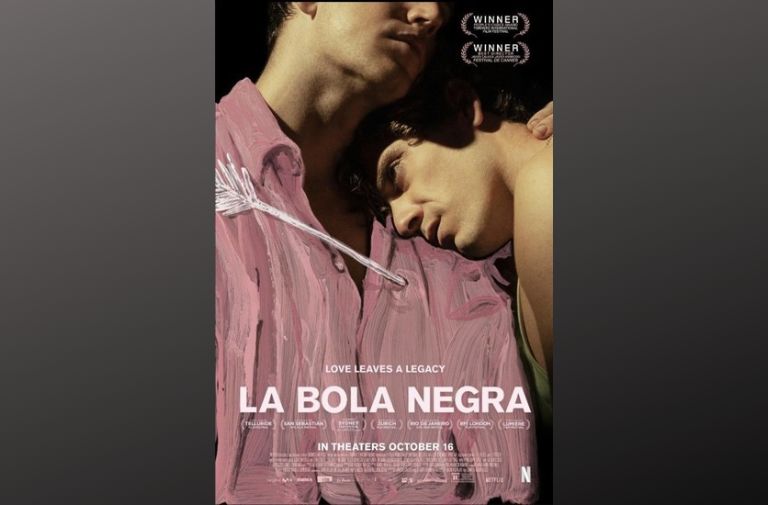
If you’ve been following the news about the acclaimed queer movie “La Bola Negra” (Netflix) since it began winning multiple awards at film festivals (including Cannes), then you might get the sense that the hype machinery is running at full speed. However, in this case, “La Bola Negra,” co-directed by queer filmmaking couple Javier Calvo and Javier Ambrossi (aka Los Javis), and co-written with gay playwright Alberto Conejero, lives up to the buildup.
Telling three stories simultaneously – one in 1937 (featuring Sebastián, played by gay actor Guitarricadelafuente), one in 1932 (featuring Carlos, played by queer actor Milo Quifes), and 2017 (featuring Alberto, played by queer actor Carlos González) – draws us in immediately. During the Spanish Civil War, a small village where Sebastián plays trumpet in a band is devastated by an unexpected attack by the Italian air force, resulting in multiple deaths, including Sebastián’s mother. After narrowly escaping, Sebastián switches his loyalty to the Nationalists. At a makeshift hospital, he is put in charge of guarding hot wounded “red” soldier Rafael (Miguel Bernardeau), and a closeness develops between the two.
In 2017, playwright-turned-historian Alberto shares an apartment in Madrid with his partner Juan Pablo (out actor/writer Julio Torres). Via an unexpected call from a lawyer’s office in Cantabria, Alberto learns that his difficult mother Teresa’s (Lola Dueñas) father (about whom he knew nothing) has passed, and that he has been left some things in the will and must meet with the lawyer. Among his inheritance is a love letter, as well as what appears to be an unfinished piece (“La Bola Negra”) by legendary gay writer Federico Garcia Lorca. How this manuscript ended up in his grandfather’s possession is at the very heart of the movie.
The section set in 1932 plays out like the story in the Lorca manuscript. Carlos, a young gay man from a respectable family, attempts to apply for membership to a restricted social club and casino. When the vote is taken by the committee, utilizing black and white balls to symbolize no or yes votes, Carlos is “blackballed” because of his reputation in the town for being queer. In many ways, including the finale of the sequence, it is the most fantastical of the three segments.
Additionally, there are other stories woven into the film’s exquisite fabric. There are scenes involving Lorca (Albert Cortés), presented as flashbacks in black and white. There is the introduction of Nené (Penelope Cruz), a risqué entertainer whose interaction with Sebastián has a long-lasting impact on him. And Alberto’s meeting with Isabelle (Glenn Close), an American Lorca scholar, adds another astonishing twist to the story.
Historical, homoerotic, brutal, intimate, revelatory, layered, political, and unapologetically queer, “La Bola Negra” overstays its welcome by 25 minutes. Nevertheless, it is not only one of the best movies of 2026, but it also deserves a place of honor in the pantheon of contemporary LGBTQ cinema.
Rating: A-