Bradley Cooper received a couple of Oscar nominations for the 2024 biopic “Maestro,” in which he starred as the late Leonard Bernstein, in addition to directing and co-writing the screenplay. “Maestro” didn’t avoid the subject of Bernstein’s queerness, but it felt like a secondary subject.
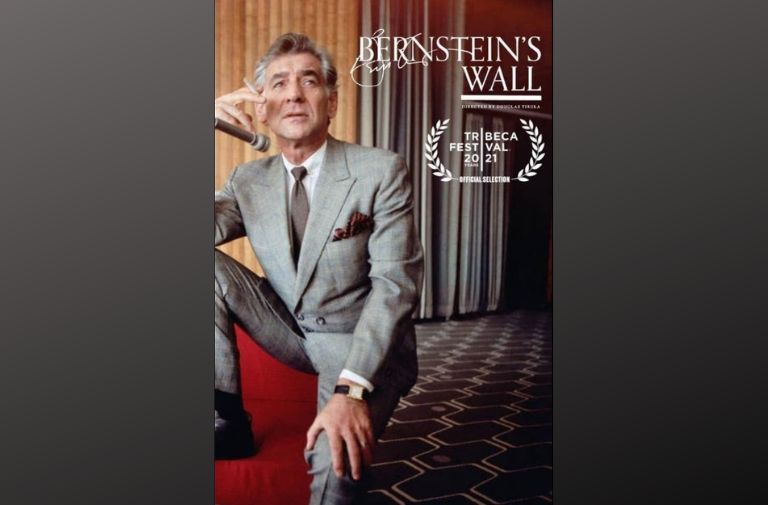
Douglas Tirola’s documentary, “Bernstein’s Wall” (Topic Studios), is another story altogether. Queer viewers who felt cheated that “Maestro” pushed Bernstein’s homosexuality to the side will likely find much to admire in Tirola’s doc.
Much of “Bernstein’s Wall” is in the lauded conductor and composer’s own words and voice. When Bernstein speaks of the “boundaries, barriers, walls dividing our lives on unrealistic maps,” he sounds as if he could be speaking about the current state of the world.
The doc gets the biographical facts out of the way early on. The aunt who moved away from Boston and left her upright piano behind. Young Bernstein’s interest in the instrument and the lessons that followed (although his Russian immigrant father opposed it).
Following graduation from Harvard at 20, realizing he didn’t want to work for his father, he studied conducting at the Curtis Institute in Philadelphia, and later at Tanglewood in the Berkshires, where he met instructor and fellow homosexual: composer Aaron Copland. Bernstein and Copland’s letters, in which the younger man wrote about queer sexual desire are worth the price of admission alone.
By 25, having moved to New York for “subsistence,” Bernstein experienced the kind of career breakthrough most people can only dream about. Throughout the 1940s and 1950s, Bernstein’s star continued to ascend, with success after success on the Broadway stage, in concert halls, in movies, and on TV.
Through it all, however, Bernstein’s struggle with and confusion about his sexual identity is at the heart of his emotional and physical well-being. Even after marrying, and then fathering three children, it’s obvious that it’s a dominant aspect of his personality. His wife, Felicia, even addresses the subject in a letter to Bernstein, writing “you are a homosexual and you may never change.”
Because the doc is in Bernstein’s own voice, it is not sentimental in the least. In fact, the various controversies in his life, including being on McCarthy’s radar during the Hollywood Blacklist era, as well as earning himself a spot on Nixon’s enemies list for the famous gathering he hosted for the Black Panthers (about which Tom Wolfe wrote in his book “Radical Chic & Mau-Mauing the Flak Catchers”), combined with his anti-war and civil rights activism, presents a stellar portrait of a man whose spirit and energy we could benefit from today.
Rating: B+