
There’s a saying among some of us who move abroad: you should run towards something, not away from something.
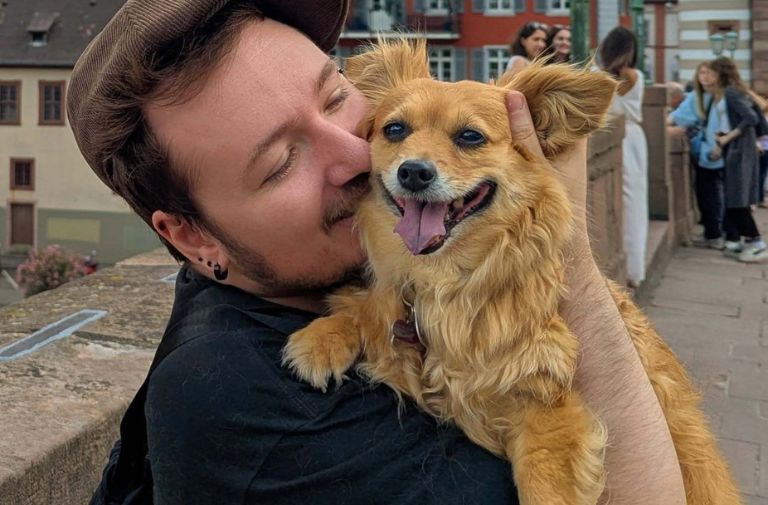
That’s why, around five years ago on a foggy November day, it was such a relief to watch Joe Biden declare victory on the old LED TV fastened to the wall in the hotel lobby. When the waiter arrived with a flammkucken for my dog and I, he seemed apathetic, but there was no point trying to explain how I felt.
There in Luxembourg, as a transgender immigrant from South Florida, I was safe – but so was the country I had just left behind. I could release the guilt of walking away from the fight, and instead focus on deciding which country in Europe I would settle down in.
But that comfort has long since perished.
In January 2025, as I bundled up in my German apartment while reading through Trump’s day one Executive Order against “Gender Ideology Extremism,” I could feel my hands shake. I felt effectively no longer welcome in my own homeland.
That feeling has expanded over the past year and a half:
- I watched online as the rainbow crosswalk I had posed on after my top surgery was painted over.
- I can no longer renew my U.S. passport without the gender marker being reverted (and was briefly unsure if I would even be allowed to renew it at all).
- I’ve watched friends go stealth or de-transition due to fear or lack of healthcare.
- And I’ve come to dread the possibility of ever needing to travel to the U.S. for family, due to the new risks and complications of whether I would be allowed to enter as a trans traveler.
I wish I could say I hadn’t seen this coming.
Even so, when I reclaimed Luxembourg citizenship and later moved abroad, I promised myself to live by that motto; not to run away, but towards whatever was out there calling my name.
The life I found waiting for me in Germany, right across the Luxembourg border, is now mine in a way that is painful to describe when compared to the U.S.’s ongoing decline of trans rights:
- My EU documents list one name, and one gender: Brendon Lies, male. I currently foresee no threat of this being taken away.
- I can contact my doctor or workplace about my transition at any time, and without fear of retaliation or disrespect.
- And only 10 minutes away, in front of the Rathaus (City Hall), multiple rainbow flags still wave for Pride Month.
To be honest, I’m haunted by all the baggage that managed to fit into my two suitcases. What did I do to deserve this, when my community back in the States is suffering like this? At the same time, part of me still feels like I’m on standby, waiting for fight or flight.
But all’s quiet on the Western Front.
Whether I’m shopping at Globus Baumarkt or sitting down at my desk at work, I stand out as the American… nothing more.
Make no mistake either; I’m very open here about my transition, but every time it comes up, I’m met with a level of indifference that feels alien.
A notable moment was during a sunny afternoon talking with my neighbors, when I happened to mention I was transgender. It hadn’t been very long since I had decided on Germany, and to be honest I felt a twist in my stomach as I waited to see how they would react. But they only asked me one question:
“Are you happy now?”
“… Yes, of course, very much so,” I had answered.
“Then that is what matters.” And just like that, they shifted to a different subject.
It took time to come to terms with how I felt from that conversation. Like, was that it? No acknowledgement of the fear or rejection, of the marches I had walked on with red and blue police lights rippling across the faces in the crowd…
Here in Germany, a place where the LGBT community was once sent to concentration camps, I now feel almost like an upside-down refugee, watching through the looking glass of my phone as America writhes from a similar illness that left the 81-year-old scars upon the oldest buildings of my street.
A few weeks ago, I curled up with my dog and a warm cup of Earl Grey to read “And They Thought They Were Free: The Germans 1933-45” by Milton Mayer, who followed the lives of several Germans post-WWII to understand the humans beneath the hatred. The descriptions of the rolling streets and wooden halls were easy to imagine; all I had to do was look out my window for a view of hills nested with German buildings that had been built centuries ago.
As for the people, though… they only reminded me of my fellow Americans back home, where the word “transgender” is starting to be used by politicians as an insult and a slur.
Here in Germany, the sirens of hatred have long since quieted. Of course not everything is perfect, and indifference can be a vulnerability – so I remain prepared to fight again if necessary. But for now, my world has become something that I couldn’t have imagined five years ago: a peaceful life as boring little Brendon, who speaks terrible Deutsch and prefers to walk his dog at precisely 8 p.m.
I’m no one special, and I no longer need to stay on yellow alert or brace for the next trauma.
The world I’ve found is the world I dream of for everyone in my community, including those who still live in the country that I used to – but might never again – call home.
The other night, I received an email alerting me that my U.S. Passport would be expiring soon.
I thought once again about both of my passports; about my Luxembourg passport that says “male”, and about how renewing my U.S. passport would automatically revert the gender marker back to “female”.
Then I spared a middle finger for my computer screen and deleted the email.
Brendon Lies is a 35-year-old trans man originally from Fargo, North Dakota, and the former Art Director of South Florida Gay News. He began his transition in 2013, and uses art in every form to share his life with others. He now lives in Saarland, Germany, where all he cares about is his little dog.