

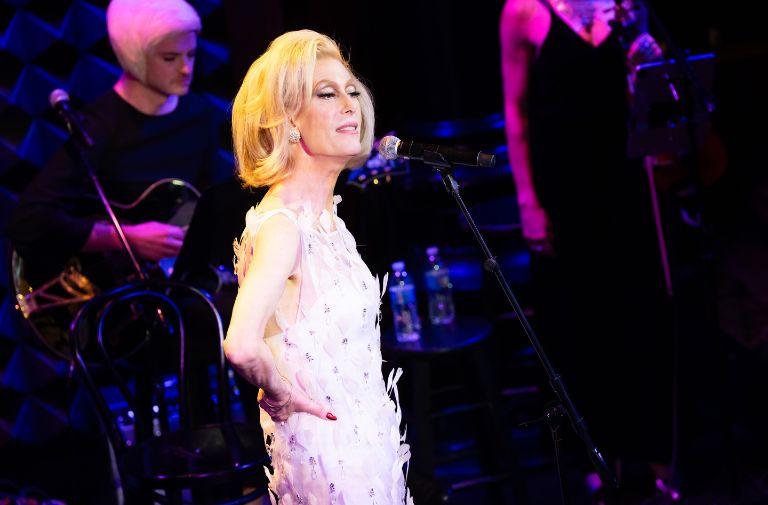
Recently, I had the opportunity to experience Complications in Sue, the groundbreaking modern opera produced by Opera Philadelphia with a libretto by Michael R. Jackson and staged at the historic Wilma Theater in Philadelphia. It featured ten composers documenting the life of one woman across ten decades. From the moment the lights dimmed, the production challenged every preconceived notion theater-goers have about what opera should be. But then, an effervescent figure sauntered onto the stage — instantly shifting the energy in the room.
They were magnetic. Vibrant. Unapologetically alive.
This was not the traditional boisterous opera diva audiences have come to expect. Instead, there was something far more compelling: a presence that felt fearless, intimate, and entirely original. Every movement, every word, every glance carried a kind of electric honesty that demanded attention. I found myself completely captivated, unable to look away and immediately needing to know more about the person behind Sue.
That person was none other than the incomparable Justin Vivian Bond.
What unfolded over the course of the performance was more than opera — it was art as liberation. Bond brought Sue to life with a layered humanity that blurred the lines between performance, storytelling, identity, and truth. They transformed the stage into a space where queerness, vulnerability, humor, and resistance could all exist simultaneously.
It was unlike anything I had ever witnessed on an opera stage.
And long after the curtain fell, I found myself still thinking about the power of that performance, and the artist bold enough to inhabit it so completely.
There are artists who perform, and then there are artists who redefine what it means to exist in the world. Justin Vivian Bond, known intimately as Viv, belongs to the latter. At 62, (soon to be 63) Bond does not present as someone who has “become” anything new. Instead, they embody something far more radical:
A life lived in unwavering alignment with who they have always been.
“I don’t think I’ve changed one iota,” Bond reflects. “I kind of knew who I was when I was little. Now I’m just allowed to be who I am.”
That distinction — between becoming and allowing, is the foundation of Bond’s artistry, activism, and enduring cultural impact.
Leaving, Surviving, Finding Language
Bond’s story begins in a small town in Western Maryland, a place they now describe not as conservative, but simply “backwards.” It was a space that offered little room for difference, and even less for a young, gender-nonconforming person trying to understand themselves without language, visibility, or community.
They left the day after high school graduation.
That departure was not just geographic — it was existential. It was the first of many acts of self-preservation that would define a life shaped by movement: Delaware, New York, D.C., San Francisco, London, Paris. Each place added something. Each place demanded something.
But it was San Francisco in the late 1980s, during the height of the AIDS crisis, that transformed everything.
Art as Survival, Art as Protest
By the time Bond arrived in San Francisco in 1988, queer communities were under siege — not just by disease, but by systemic neglect.
“It was very clear that they wanted us literally dead,” Bond says of the U.S. government’s response to the AIDS crisis.
In that climate, art was not indulgence — it was resistance.
Bond found their voice in queer performance spaces, cabaret, and political satire. These were not stages built for comfort. They were stages built for truth-telling, for confrontation, for survival.
“If I sang songs in bars and said whatever I wanted and charged a cover,” Bond explains, “I could make a living.”
It was a simple equation with profound implications: Art could sustain life. Art could sustain truth. And most importantly — Art could bypass systems that refused to support them.
Refusing the Binary, Creating the Language
Long before “nonbinary” entered mainstream vocabulary, Bond was already living beyond the confines of gender.
“There weren’t words for it,” they recall.
The options were rigid: transition fully or remain invisible within existing categories. Neither felt honest. So Bond did something revolutionary: they refused the premise altogether.
They occupied the in-between. The fluid. The undefined.
And in doing so, they did not just live differently, they helped create the language for others to do the same. One of the most tangible examples? The now widely used honorific “Mx.” (pronounced “mix”).
“I came up with it and popularized it,” Bond shares, almost casually.
Today, it appears on official forms, reservations, and institutional documents across the world. What began as a personal necessity became a global linguistic shift.
The Cost of Becoming Yourself
Authenticity, as Bond makes clear, is not a soft concept. It is not aesthetic. It is not performative. It is costly.
“You lose relationships in order to become yourself,” they say.
There is no romanticism in that statement — only truth. Becoming requires unlearning, confrontation, and often, separation. It demands that others see you differently, even when they resist. It demands that you insist anyway. But Bond is equally clear about the other side of that equation:
“You find your people as you become yourself.” Loss and belonging exist in tandem. Always.
The Stage as Sanctuary
For Bond, the stage is not simply a platform, it is a place of safety.
“I consider it a place where I can say or do anything I want,” they explain.
This is where the lines between persona and person blur, but not in the way audiences might assume. Bond’s stage presence is not a mask — it is an amplification. A heightened truth. A space where intimacy becomes collective, where discomfort becomes necessary, and where audiences are invited — not just to watch, but to feel, question, and reconsider.
“The audience has been my director for my entire career,” Bond says.
That relationship is reciprocal. It is alive. And it is rooted in something many artists strive for but rarely achieve:
Trust.
Truth, Discomfort, and Liberation
Bond does not claim to tell the truth in a literal sense.
“I wouldn’t say everything I say is truth,” they admit.
But everything they do serves an idea, one rooted in liberation. Their work challenges audiences not through certainty, but through disruption. Through humor. Through discomfort. Through the invitation to think differently.
“You have to go to places that make people uncomfortable in order to move on,” Bond says.
In a cultural moment increasingly defined by curated identities and polished narratives, Bond’s approach feels almost radical: Be honest. Even when it costs you. Be uncomfortable. Especially when it matters.
A Life Beyond Legacy
Perhaps the most surprising aspect of Bond’s perspective is their relationship to legacy. Or rather — their lack of interest in it.
“When people encounter my work years from now… I don’t care,” they say plainly.
Not out of indifference, but out of presence. Bond’s work is not about permanence. It is about experience. About the exchange between artist and audience in a singular moment.
“I care if they come,” they add.
There is something deeply freeing in that philosophy. In a world obsessed with documentation, virality, and longevity, Bond reminds us that art — at its core, is about connection in real time.
Manifestation, or Something More
When asked what they would tell their younger self, Bond’s answer is both simple and profound:
“I already believed my dreams would come true.”
And they did. Not because of luck. Not because of ease. But because of belief — paired with relentless authenticity.
“Manifestation is my superpower,” they say, almost with a shrug.
But what Bond demonstrates is something deeper than manifestation. It is conviction. The kind that does not waver in the face of rejection, invisibility, or systemic resistance. The kind that does not wait for permission.
The Continuing Revolution
Justin Vivian Bond is not simply an artist. They are a living archive of queer history, resistance, and evolution. They have stood in rooms where visibility was dangerous. They have created art when institutions refused to fund it. They have lived truth before language existed to describe it.
And today, they continue to do what they have always done: Exactly what they want. No more. No less.
“I like to do as little as possible,” they joke. “But if I’m doing something, it’s what I want to do.”
There is power in that simplicity. There is power in that refusal. And in a world still trying to define, limit, and categorize identity — Justin Vivian Bond remains something far more enduring: Uncontained. Uncompromised. And entirely their own.