
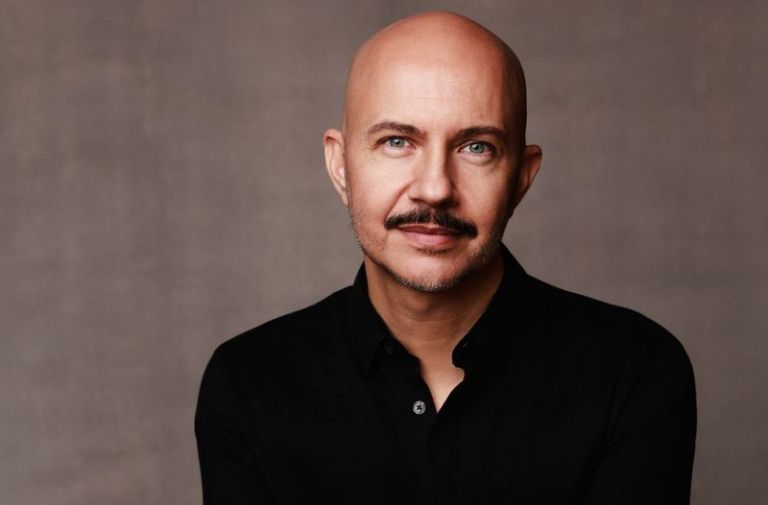
More than 45 years after the first newspaper article about AIDS appeared in the New York Times, gay poet Steven Reigns continues to write about it; a literary reminder that the health crisis is far from over. As with his previous collection, “A Quilt For David,” the subject is front and center in his new book, “Outliving Michael” (Moon Tide Press, 2025). A far more personal effort, “Outliving Michael” is a devastating poetic tribute to Reigns’ late friend Jon Michael Church, who passed away at the age of 42 in 2000.
Reigns was kind enough to make time for an interview in advance of his April 10 event at Stonewall National Museum and Archives in Fort Lauderdale.
In late March, shortly after this interview is taking place, you are leading a writer’s craft seminar, “Poetry As Memoir: Autobiographical Poetry Writing Workshop” at the Saints and Sinners LGBTQ literary festival in New Orleans. Have you conducted this kind of workshop before?
I started teaching LGBTQ writing workshops when I was 23 years old, a couple of years before my first book came out. Leading up to the book and its release, I started to hear how alienating literature and writing was to friends. Assigned books in school that don’t represent queer experiences, and queer personal writings aren’t always embraced by teachers or institutions. I realized the displeasure had more to do with what they were forced to read and the responses they received to their writings. I sought to change that and taught local workshops to a queer youth group. I wanted to connect them with the pleasure of writing, and also to expose them to literature that represented their lives and experiences. I loved those workshops and soon taught them around the country. I was then asked to teach workshops to HIV+ groups. Almost 20 years ago, I started teaching the My Life is Poetry autobiographical poetry writing workshop for LGBTQ seniors. This came about because I saw a bigger gap in elder representation.
Because of the memoir-quality details of the poems in your new book, “Outliving Michael,” I was wondering if you were a journal keeper or if you relied on memory for these poems.
I always thought that my on-again, off-again journal writing would be a goldmine when it came time to write a memoir. I didn’t consult them at all when writing this collection. Rereading about that time would have been painful, but also because what was important was what memories remain. What moments and comments haven’t left me all these years later. I was so young and impressionable. I knew so little of the world and was a sponge for information, especially hanging on Michael’s words and wisdom. My journal writing started at an early age. I first had sex at 16 with a guy, came home, and wrote it down. I read the entry to my friend Stephanie, who suggested I should be a writer. My introduction to gay sex and writing happened all in that time; it was a moment of spontaneous combustion.
The title of the book, “Outliving Michael,” comes from a line in one of the shortest poems in the book. Did you always know that this would be the title? Were there other book titles in contention?
The skilled poet David Trinidad gave me input on the collection. I was initially using a different title, which always fell short for me. David suggested “Outliving Michael,” and I immediately loved it. He has quite a bit of experience with titles, having published over two dozen books. I raved to him about what a great idea it was. After showering him with praise, he said, “You know I just took it from a line in your poem?” I had forgotten that, and we had a good laugh.
Most of the poems in the book are untitled, and some have proper titles. Why did you choose to employ that device?
You’re such an astute reader [laughs]! Titles seemed to stall the storytelling. There didn’t seem a need to have more of a pause or announcement than the page break. The titled poems I wanted to stand out and set a tone. All the poems in the collection can stand alone but these poems have a different feel than the others and still contribute to the collection’s focus.
How did you decide on the order of the poems?
I wanted the collection to have an arch, to have the story unfold in an interesting way. Some poems also did a better job of introducing dynamics or subjects, and I wanted those to come first. I laid out the printed poems and started shuffling to find an order that would meet these goals. The final poem always felt like the way I wanted to end the collection.
Were any of the poems written while Michael was alive?
My writings have always been a representation of what I’m grappling with at the time. Writing is how I make sense of things. None of these were written when Michael was alive. There’s a poem in the collection about an everyday moment in my life and remembering a story Michael told me. I did the math and realized I had lived longer than he had. He seemed so much more experienced and worldly than I that I didn’t think I’d surpass him in anything, including age. Grappling with his loss and reflecting on the lasting impact of his friendship is what prompted me to write this collection.
Do you know if either Andrew Holleran or Judge Judy Sheindlin are aware that they are in “Outliving Michael?”
Michael introduced me to Holleran’s work, and so I’ve always closely associated the two. I’ve had a nice acquaintanceship with him for years. We first met in Provincetown in 2001. I was a young writer and thrilled to have such an exchange with a literary luminary. I teared up walking back to my hotel, {because} Michael wasn’t around for me to call and tell him about it. Holleran is incredibly modest for someone so accomplished. I’ve never said anything to him, not wanting him to feel pressured to respond in any sort of way. I was honored that he gave a blurb for “A Quilt for David,” calling it “a searing recreation of that horrible chapter in the early stages of AIDS.” As a Floridian, he understands the culture and what it would have been like for David Acer, living at that time on the Treasure Coast. I didn’t fully understand Michael’s love of Judge Judy. Of course, he loved her sass and wit, but it always felt more substantial. When writing the book, I reflected on how she probably gave him a sense that there was order in the world. That there was justice and fairness. Dying of AIDS at that time, there was neither.
In a way, Florida is another character in the book. Florida also figures prominently in your previous book, “A Quilt for David.” Were the poems in “Outliving Michael: written before, after, or at the same time as the David book?
With “A Quilt for David,” I thought I was writing about what happened in a Florida dental office. What I was really writing about was America at that time. I deeply understood Florida culture because I moved to Naples in 1994 and later lived in Tampa until 2005. I have so many fond memories of Florida and the people I knew. Michael Church was one of those people.
“Outliving Michael” feels like the personal companion to “A Quilt for David.” In one book, I didn’t know the subject and in the other book, it felt as if I knew the subject better than anyone. I wrote the material separately. Researching Acer was all-consuming. I spent countless hours in libraries and archives, ran ads in the newspaper looking for past patients and associates, and traveled several times to Florida. For that time, it feels like all my focus was on David Acer and trying to get to the heart of what happened. Outliving Michael was much easier to write because it required no research, only sitting with my memories and memorializing a dear friend.
Would you say that these books are an attempt to give a voice to the voiceless?
“A Quilt for David” was very much my writing to vindicate. I never met David Acer and devoted over a decade to researching the situation. What happened to David could happen to any of us; someone points a finger, and our life and legacy get altered. It’s incredibly unfair. Poetry is the language of our emotions. With David Acer and Kimberly Bergalis, there was data that was ignored. Emotions biased perceptions at that time. I used poetry to do the labor of helping others see and feel another perspective. My book centers on David, where all media previously focused on Kimberly. Poetry is saying the unsaid and doing so with an economy of language. It’s my favorite kind of storytelling. In “Outliving Michael” I feel as if I was sharing Michael with more people. Though grief is one of the book’s subjects, it’s actually quite a funny collection. I repeat so many things Michael said. I love reading these poems at events and hearing how much people would have enjoyed him if he were still here.
Finally, you recently posted on social media about online harassment you continue to receive about “A Quilt For David.” Would you say that hateful attacks of this kind have increased due to the current political climate, and do you foresee a time when this kind of provocation will cease?
Those messages don’t even phase me. I’ve lived through so much that even the nastiest message has zero impact. I’m confident in the work I put out and its perspectives. We’re in a less tolerant country, and that trickles down from the top, but the uptick in attacking messages happens when “A Quilt for David” gets attention in mainstream publications. Many straight people grew up not questioning narratives, and that’s something embedded in the queer experience. Queer readers can imagine the media hysteria of the time, the favoring of heterosexual narratives, the gay scapegoating and witch-hunt, and the blaming of someone with less social standing. AIDS changed the course of history, especially queer history. In these two books, I’m telling small slices of these histories and changes. In both cases, it’s been an honor to devote so much time to these men who spent their last years in Florida.