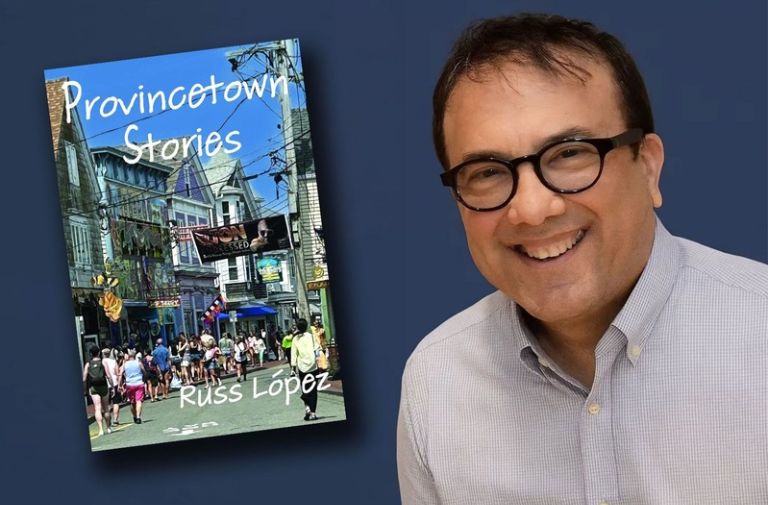
To say that Russ Lopez loves his hometown of Boston would be an understatement. He is the author of nonfiction books—including The Hub of the Gay Universe, Boston 1945-2015, and Boston's South End, exploring how competing visions of community, development, and identity reshaped one of the city’s most complex neighborhoods. His books explore the interplay of community, identity, and place, weaving together history, personal narrative, and cultural insight.
His latest book, this time short fiction, Provincetown Stories, captures the contradictions, beauty, and emotional intensity of Provincetown—where identity, desire, and community collide at the edge of Cape Cod. Full disclosure: I am also collaborating with Lopez for the next book in my series on LGBTQ Bars, Last Call Boston.
Provincetown Stories is a collection filled with diverse, eccentric, and often deeply human characters. What was your approach to character development for such a wide cast?
I thought it was extremely important to include the town’s broad range of people, and one thing they all have in common is that they want to be respected for who they are. So that was my starting point: how do they demonstrate their dignity, how do they want to present themselves to the world, and what do they value about themselves? Once I figured out what made a person tick, it was easy to build their world around them.
The town itself feels like a character in the book. How did you go about capturing Provincetown’s personality in your writing?
I believe that an author must immerse themselves in a time and place. Ptown is lovably independent and proudly off kilter. The challenge is to not get so entertained by the eccentricity splashing you in the face that you forget to observe and remember what is happening.
Some of your stories have mythic or surreal touches—like Luna, the immortal, or the Orpheus retelling. What draws you to blending realism with magical or mythical elements?
The blending of the surreal and real has a long history: think of the ghost of Hamlet’s father or the witches in Macbeth. Add to that my Mexican heritage. One of our traits is the belief that magic surrounds us. That sets the stage for interlaying the mythic with the concrete.
Were there any stories that were particularly difficult to write or that evolved significantly during the editing process?
The hardest story in the book to write was The Return, a story about a man who couldn’t go back to Ptown for decades because his grief for his partner, who died of AIDS, was too strong. As a gay man of a certain age who lost so many friends and loved ones in that horrible time, there are places I can’t visit to this day without shedding tears. As this story grew, my feelings of sadness increased, but I kept on writing the story out of respect for the departed. This was just one small way to honor those we lost.
Your work showcases a broad spectrum of queer, Latinx, and other underrepresented identities. How do you balance representation with storytelling without falling into tropes?
I hate being stereotyped, so I try not to fall into stereotyping myself. To capture Ptown, you have to write about everyone. I obviously don’t have firsthand experience with what many of my characters have faced. I let my characters live their reality. I just chase after them to write it all down.
The book has been described as a “love letter” to Provincetown. What would you say back if Ptown could write you a letter in return?
I don’t want Ptown to ever end. A thousand years from now, I want a place where people spontaneously make out with strangers on the benches in front of town hall. I want to be able to see overweight hairy men proudly strut down the street in tiny bathing suits and high heels. I want artists, drag queens, and fishermen’s wives to block the aisles of the supermarket as they complain to each other about the town going to hell because someone painted their house the wrong color. Change is inevitable, but I hope the town stays eccentric.
Provincetown is my home. It is my muse. If I stopped writing about it, I would feel like I was abandoning the love of my life. I vow to write more books on Ptown.
Russ Lopez will read from his book at Stonewall Museum on Monday, Nov. 16 at 6 p.m.