

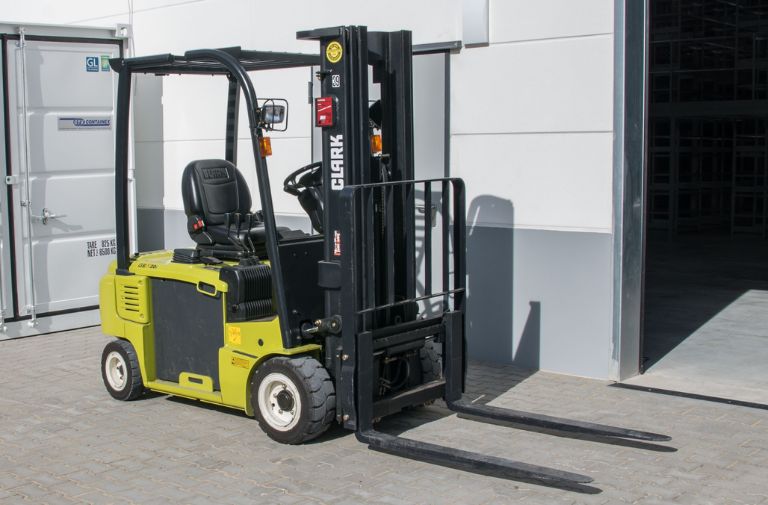
A forklift that stops working creates an immediate dilemma. Repair it and risk further downtime, or replace it and accept a substantial capital expense? For many businesses, the decision feels urgent, particularly when a machine fails during a busy production run, warehouse expansion or seasonal peak.
However, the cheapest decision in the moment is not always the most economical over the machine’s remaining life. A structured assessment can reveal whether repair offers genuine value or simply delays an inevitable replacement. The right choice depends on more than the age of the forklift: operating hours, maintenance history, safety, parts availability and the demands placed on the truck all matter.
Start with the condition, not the age
Age is a useful indicator, but it should not determine the decision by itself. A well-maintained forklift that has operated in a clean, controlled environment may remain dependable for years beyond the point at which another machine, exposed to heavy loading and poor conditions, becomes uneconomical.
Begin by assessing the forklift’s overall condition. Look for recurring faults rather than focusing only on the latest breakdown. A single failed hydraulic hose or worn battery component is usually a straightforward maintenance issue. A pattern of transmission problems, steering faults and electrical failures suggests a deeper reliability concern.
The quality of the repair also matters. Some faults can be corrected with relatively little disruption, while others require specialist labour, lengthy diagnostics or parts that are difficult to source. If the truck must be dismantled to access a major component, the labour bill can quickly exceed initial expectations.
A useful condition review should consider:
- The frequency and severity of breakdowns
- The cost and availability of replacement parts
- Safety-critical wear, including brakes, steering, forks and mast components
- Maintenance records and inspection results
- Whether the truck still meets current operational requirements
This information provides a more reliable basis for decision-making than a single repair quotation.
Calculate the true cost of repair
Repair costs extend beyond the invoice from an engineer. Downtime, lost productivity and disruption to other warehouse activities can have a greater financial impact than the replacement part itself.
Suppose a forklift costs £1,200 to repair but remains unavailable for five working days. If the business has to hire another truck, reassign employees or delay dispatches, the actual cost may be considerably higher. A repair that appears affordable in isolation may therefore be poor value when its operational consequences are included.
It is also important to distinguish between a one-off repair and a recurring cost. A major repair may be sensible if it restores the machine to reliable service. Repeated spending on the same forklift, however, can indicate that its useful working life is coming to an end.
Businesses should review repair costs over at least the previous 12 months, including servicing, emergency call-outs, replacement parts, hire equipment and downtime. This historical view helps identify whether maintenance expenditure is stable or steadily increasing.
To compare the costs of repair and replacement, assess both options over a realistic period rather than comparing one repair bill with the purchase price of a new truck. A replacement may have higher upfront costs but lower maintenance requirements, improved energy efficiency and stronger availability. Conversely, a repair may be the better option when the forklift has a solid service history and the work addresses an isolated fault.
Consider safety and compliance
Safety should never be treated as a secondary factor in the financial calculation. Forklifts operate around pedestrians, racking, vehicles and valuable stock. Defects affecting braking, steering, lifting performance or operator protection can create serious risks, even if the machine remains technically operational.
A forklift must be maintained and examined in line with applicable workplace safety requirements. Regular inspections can identify deterioration before it results in an accident, but a history of failed checks or recurring defects should prompt a wider review of the truck’s suitability.
Ask whether the proposed repair will restore the forklift to a safe and compliant standard, or merely keep it running temporarily. If a machine requires frequent intervention to remain operational, replacing it may reduce both risk and uncertainty.
Look beyond the purchase price
When replacement is being considered, compare the complete cost of ownership rather than focusing solely on the advertised price. Relevant factors include:
- Purchase, finance or lease costs
- Delivery and commissioning
- Operator training
- Servicing and warranty coverage
- Battery charging or fuel requirements
- Residual value at the end of the replacement period
Modern electric forklifts, for example, may offer lower operating emissions and reduced routine maintenance, although battery technology, charging infrastructure and duty cycles must be assessed carefully. A newer internal combustion truck may provide better performance for outdoor or heavy-duty work, but fuel use and ventilation requirements could affect the overall calculation.
Match the forklift to current operations
A machine can become unsuitable even when it remains mechanically sound. Changes in warehouse layout, load sizes, shift patterns or floor conditions may leave an older forklift struggling to meet demand.
Consider whether the truck has sufficient capacity, lift height, manoeuvrability and attachment compatibility for present requirements. If operators regularly work around its limitations, productivity and safety may both suffer. Replacing it with a better-matched model could improve performance more than repairing an increasingly unsuitable asset.
The opposite is also possible: a business may be tempted to replace a forklift when a targeted repair and modest operational adjustment would solve the problem. For instance, improving charging routines, reducing overloading or addressing poor operator practices may extend service life without significant capital spending.
Make the decision using evidence
The most dependable approach is to gather input from several sources. Maintenance technicians can explain the mechanical condition, operators can identify recurring practical problems, and finance teams can model the long-term cost. Combining these perspectives prevents a purely financial or purely technical decision.
Set clear thresholds in advance. For example, a business might decide to replace a truck if annual repair and downtime costs exceed a defined proportion of its current value, if critical parts are no longer reliably available, or if it repeatedly fails safety inspections. These thresholds should reflect the operational importance of the forklift, not just its book value.
Ultimately, repair is often appropriate when the fault is isolated, the truck is well maintained and the expected repair life is clear. Replacement becomes more compelling when failures are frequent, safety concerns are emerging, or the machine no longer fits the work.
The goal is not to choose the cheapest immediate option. It is to secure dependable lifting capacity at a sustainable total cost, while protecting operators and keeping the wider operation moving.
The views, opinions, and recommendations expressed in this article are solely those of the author and are provided for informational and editorial purposes only. They do not constitute professional advice and should not be relied upon as such. OutSFL makes no representations or warranties regarding the accuracy, completeness, or applicability of the content and assumes no liability for any actions taken based on it. The views expressed do not necessarily reflect those of OutSFL.