

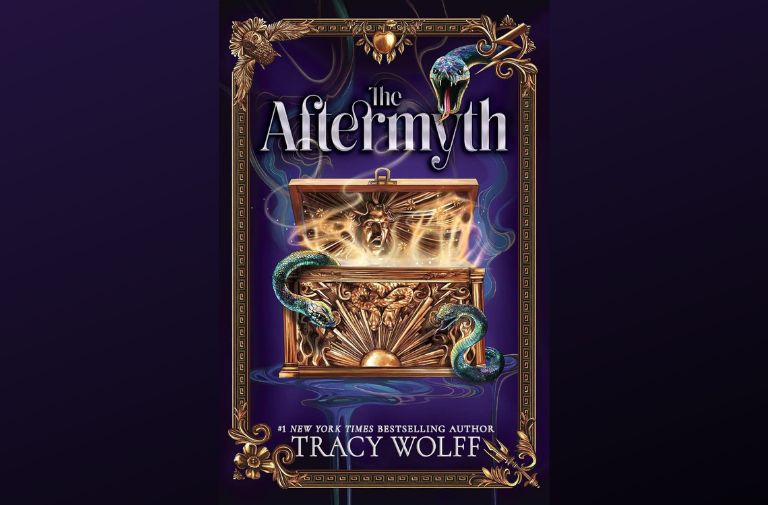
Check out our interview with Tracy Wolff, the author of "The Aftermyth."
What was your inspiration behind "The Aftermyth?"
First of all, I want to say thank you so much for having me. Your site is really wonderful and I am thrilled to be here.
My inspiration for "The Aftermyth" grew out of my lifelong love of Greek mythology — and my frustration with how many of those stories, especially the ones about women and outsiders, have been told and retold in ways that flatten or punish them. Like the Pandora’s Box myth that is central to this story, where Pandora was created by two male gods for the specific purpose of punishing two male titans. She was given the gift of unending curiosity and a jar filled with evil things for the express purpose of opening it, yet she’s been blamed for millennia for doing exactly what she was created to do.
I think that’s why I’ve been drawn to characters like Pandora and Medusa my whole life — because they are remembered for the damage they’ve done and the punishments they’ve received just for being who they are. When I sat down to write "The Aftermyth," I wanted to change this. I wanted to look at the context, coercion, and courage behind their stories. More, I wanted to ask, what happens after the myth ends? Who gets to tell the next version of the story? This book is my attempt to explore those questions through a modern lens — one that showcases agency, found family, and the idea that if the story you’re given doesn’t fit you, you’re allowed to rewrite it. History tends to be written by those in power, and I wanted a chance to show what myth, and life, looks like when people are determined to change that.
What does Reading Rainbow mean to you?
For me, Reading Rainbow means seeing yourself reflected in stories without apology. It means queer readers getting to experience joy, love, adventure, and magic — not just trauma or subtext, but full, complicated lives at the center of the narrative. It’s about claiming space in stories and believing that your identity doesn’t limit the kinds of myths you’re allowed to star in.
As a queer writer, I know how powerful it is to find a book where you recognize yourself — not as a lesson or a side character, but as the hero. That’s why when I was writing the Crave series, I flipped the paradigm of the YA love triangle on its head. The hero of the first book, beloved by people all over the world, doesn’t end up with the heroine. He ends up with his best friend, who just happens to be a dragon prince. Making that choice wasn’t about shock value. It was about honoring emotional truth and giving queer readers a canon love story that felt earned, joyful, and unapologetic. It was my way of saying that queer love doesn’t belong on the sidelines of epic stories — it belongs at the center. Because I believe deeply that when we let characters follow their emotional truth, we make room for readers to see their own lives reflected back with dignity and pride.
Why do you feel representation of a variety of people is so important when it comes to writing books?
Because stories teach us who matters. When readers only ever see one type of person as the hero, the savior, or the love interest, it quietly sends the message that everyone else is secondary. Representation pushes back against that.
More, representation is important, because when readers finally see themselves on the page, it can be life-changing. It tells them, you belong here. Your story is worth telling. I will never forget being in a bookstore with my wife, not long after we first met. We were wandering the YA section, and she pulled a book off the shelf that was about a young, Latinx lesbian living with her family in a small town. My then girlfriend turned to me with tears in her eyes and she didn’t have to say anything for me to understand what it meant for the adult her to finally see the teenage girl she once was in the pages of a book.
She devoured the book on our flight home, and it holds a place of honor on our bookshelves even now.
And finally, representation isn’t just about visibility. It’s about possibility. When readers encounter characters with different identities, backgrounds, and experiences, it expands empathy and imagination for everyone.
Tell us a little more about The Aftermyth and why you decided to write it.
"The Aftermyth" follows Penelope, a girl who enrolls in Anaximander’s Academy, a magical school where ancient myths aren’t just old stories. They’re living, mutable things the students have to not just survive, but to understand. On their first day, each student is divided into one of five halls based on the tenets of different Greek gods—Athena, Aphrodite, Hades, Zeus, and Poseidon. On the first day, everything goes wrong for Penelope. She’s sorted into the wrong hall, the muse she is given to guide her during her six years at Anaximander’s is confused, overworked, and constantly looking for a cup of coffee, and the twelve labors she has to compete before she can graduate are completely inscrutable. As for classes … they’re a little more hands on than the characters are ready for
I wrote this book because I wanted to create a world where kids — especially those who feel different, overlooked, or misunderstood — can see themselves as myth-makers instead of myth-breakers. It’s a story about courage, chosen family, and learning that you don’t have to accept the role the world assigns you.
What can fans expect from your book?
Readers can expect a mix of adventure, humor, emotional depth, and mythic mayhem. There are upside down waterfalls, magic coins that don’t do what they’re supposed to, shifting mosaics, a giant bird named Agatha with a fondness for picking students up by their backpacks, and an underworld unlike any you’ve seen before. There are also gods with agendas and friendships that matter as much, if not more, than the magic itself.
But at its heart, "The Aftermyth" is about hope — the belief that stories can change, people can grow, and that even the most misunderstood figures can reclaim their power.
What's up next for you in the bookish world?
I’m continuing to build the Aftermyth series, which will explore different myths and deepen the characters’ journeys over time. I’m also always juggling a YA fantasy series and an adult romantasy series.
Right now, though, I’m especially excited to share "The Aftermyth" with readers who are hungry for stories where identity, magic, and belonging are all part of the same adventure.