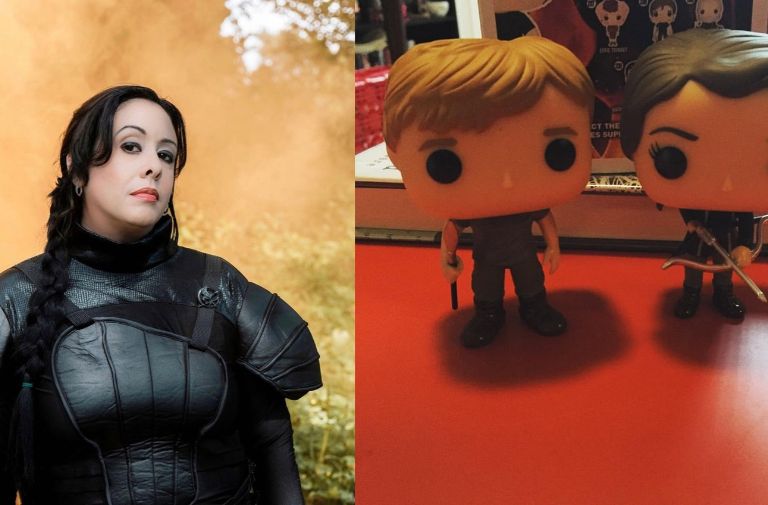
Some stories entertain us, others stay with us, and then there are those rare stories that become part of who we are. For me, The Hunger Games has always belonged in that last category. And yes, I have even dressed up as Katniss Everdeen, complete with the attitude of a girl who has absolutely no intention of letting anyone tell her what she can or cannot do.
With The Hunger Games: Sunrise on the Reaping arriving in theaters this November, I find myself feeling the kind of excitement that only a longtime fan can understand. It is the anticipation of returning to a fictional world that somehow feels familiar, even when that world happens to be Panem, where survival is never guaranteed and the Capitol has a particularly disturbing idea of entertainment.
But my relationship with The Hunger Games began long before the movies, the costumes, and the excitement surrounding each new installment. It began while I was working at The Miami Herald, when my husband, Sebastian, recommended Suzanne Collins' books because he knew I would love them.
And, as he often is when it comes to knowing the kinds of stories that capture my imagination, he was right.
I remember discovering the world of Panem through the pages, becoming invested in its characters, and feeling that wonderful urgency to keep reading because I simply needed to know what happened next. At a time when storytelling was such a significant part of my professional life, it was refreshing to become completely immersed in a story simply because I loved it.
Then came the movie, and another memory that makes this franchise especially meaningful to me: my uncle took me to see it.
That experience became another part of my personal connection to The Hunger Games. There is something special about seeing a book you love come to life on the big screen, especially when you get to share that experience with someone important to you. What began with Sebastian's recommendation had now become a memory I shared with my uncle, too.
And that is one of the beautiful things about books and movies. They become connected to the people who introduce us to them, the people who experience them alongside us, and the moments in our lives when we discover them.
Of course, at the center of my love for the series is Katniss Everdeen.
What has always fascinated me about Katniss is that she is not a traditional heroine. She is stubborn, complicated, occasionally frustrating, fiercely protective, and often uncertain about what she is supposed to do. She does not set out to become a symbol of revolution or a role model for an entire generation. She wants to protect the people she loves, particularly her sister Prim, and she finds herself navigating a world that demands far more from her than anyone should have to give. And that, to me, is where her strength truly lives.
Katniss is brave, but she is also afraid. She makes mistakes, questions herself, and struggles with the consequences of her decisions. Her humanity is what makes her extraordinary. She reminds readers that strength does not always mean having the perfect answer or facing every challenge without hesitation. Sometimes it means standing up again, protecting someone else, or refusing to surrender the parts of yourself that make you human.
As someone who has spent much of her life surrounded by books, journalism, education, and popular culture, I have always appreciated characters who challenge the idea of what a hero should look like. Katniss certainly does that. She is not interested in becoming a celebrity, even when the world insists on turning her into one. Her story raises questions about identity, media manipulation, sacrifice, power, and the responsibility that comes with having a voice.
Those themes are among the reasons I believe The Hunger Games continues to resonate with readers and audiences years after its original publication. Suzanne Collins created a world that is entertaining and terrifying, but she also gave us something to think about long after we closed the books. Behind the action, romance, and elaborate costumes are difficult questions about the stories societies tell, the people they choose to celebrate, and the consequences of treating human suffering as entertainment.
And speaking of costumes, I would be leaving out a very important part of my fandom if I did not mention my own experience cosplaying Katniss.
I have always loved cosplay because it gives fans an opportunity to celebrate the characters who inspire them. There is something wonderfully empowering about stepping into the world of a favorite story, even for a little while. Dressing as Katniss was especially meaningful because I was celebrating a character whose courage, determination, and vulnerability I had admired since first reading the books.
There is also something undeniably fun about channeling the Girl on Fire. After all, who would not want to feel like they could walk into a room with the confidence of Katniss Everdeen?
But cosplay has never been simply about the outfit for me. It is about connection. It is about celebrating stories that have shaped
our imaginations and finding joy in sharing those experiences with others. Whether I am discussing a favorite character with fellow fans, introducing students to the importance of storytelling, or writing about the books and films I love, I am reminded that fandom can create communities where people feel understood.
That sense of connection is exactly why I am so excited about Sunrise on the Reaping.
The upcoming film takes audiences back to the 50th Hunger Games, also known as the Second Quarter Quell, and explores the younger years of Haymitch Abernathy, a character audiences first came to know as Katniss and Peeta's mentor. Set 24 years before Katniss enters the arena, the story offers another opportunity to understand how the world of Panem shaped the people who would eventually become part of her journey.
I have always found Haymitch fascinating because, much like Katniss, he carries the emotional consequences of surviving a system designed to destroy people. Knowing more about his past adds another dimension to the original story, reminding us that even the characters who appear cynical, distant, or difficult have experiences that shape the way they see the world.
And while Katniss is not the central character in this new chapter, her influence remains impossible for me to separate from the franchise. The world she challenged existed long before her name became synonymous with rebellion, and exploring its history makes her eventual choices feel even more significant.
Perhaps that is what I love most about returning to Panem. Each new story encourages us to revisit the ones that came before it, discovering details, relationships, and ideas that we may not have fully appreciated the first time.
As a journalist, educator, writer, and lifelong reader, I believe that great storytelling should do more than provide an escape. It should encourage curiosity, create conversations, and help us understand experiences beyond our own. The Hunger Games accomplishes all of that while still delivering the emotional intensity, unforgettable characters, and dramatic moments that make readers fall in love with a series in the first place.
Yet my excitement about the new movie is also wonderfully personal.
It brings me back to those days working at The Miami Herald, when Sebastian suggested a series he knew I would love. It reminds me of my uncle taking me to see the movie and the joy of experiencing a favorite story on the big screen. It brings back the excitement of discovering Katniss, becoming invested in her journey, and eventually celebrating her through cosplay.
And perhaps most importantly, it reminds me that the books we love become part of our own stories.
We remember where we were when we discovered them, who recommended them, how they made us feel, and the people with whom we shared them. Years later, a new film, a familiar character, or even the sight of a mockingjay can bring those memories rushing back.
So yes, I am absolutely ready to return to Panem this November. I am excited to see how Sunrise on the Reaping brings another chapter of Suzanne Collins' world to life, and I cannot wait to experience the conversations, emotions, and excitement that will come with it.
But somewhere beneath all that anticipation is the memory of a woman working at The Miami Herald, discovering a remarkable series because the person she loves knew she would enjoy it, and later sharing the excitement of its film adaptation with her uncle.
That is the magic of books, the beauty of fandom, and the reason The Hunger Games will always hold a special place in my heart. The Girl on Fire may have started as a fictional character on a page, but the courage, memories, and connections she inspired have stayed with me ever since.
And this November, I am more than ready to feel that spark again.
The Hunger Games: Sunrise on the Reaping arrives in theaters November 20, 2026, so gather your fellow tributes, grab your popcorn, and visit hungergames.movie for the latest updates and ticket information.