

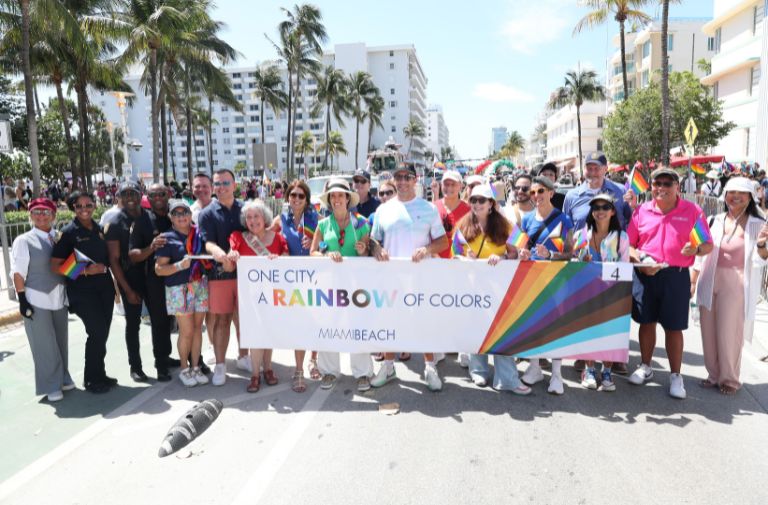
I recently did something that apparently has become radical in American politics: I reached out to people with whom I sometimes disagree and offered to help.
I wrote to Miami Beach Pride because I believe Pride has become an important cultural event in our city. I said plainly that Pride is not going anywhere. I offered to serve in an advisory capacity because I thought my involvement, as a Republican state representative, could demonstrate something Miami Beach desperately needs more of: people with different political views working together.
The response was cordial, but it came with unexpected conditions.
Pride’s chairman wrote that closer collaboration would require “a clear commitment to oppose any legislation that could negatively impact LGBTQ+ individuals or Pride events,” along with advocacy through my office and public platforms.
That exchange raises a larger question about what inclusion actually means.
Miami Beach taxpayers made a substantial investment in Pride this year: up to $250,000 in direct sponsorship, plus approximately $53,000 in waived permitting, police administrative, fire administrative and sanitation fees. Pride describes itself as a major cultural event attracting more than 185,000 attendees.
If taxpayers are partners in an event of that scale, shouldn’t the objective be to make the entire community a partner in its success?
That includes our local businesses.
Pride operates a large festival in Lummus Park with exhibitors, sponsor activations and food vendors. Meanwhile, the restaurants and merchants that pay rent, property taxes and salaries here 365 days a year should not be spectators to an enormous event happening outside their doors.
I would approach it differently.
Give Miami Beach restaurants and merchants an early opportunity to participate in concessions and activations. Build partnerships connecting visitors with neighborhood restaurants, hotels and stores. Measure how much festival spending actually reaches Miami Beach businesses. Make the economic benefit something we can demonstrate, not simply assume.
If public money is being invested partly because an event generates economic activity, asking where that activity goes is responsible governance.
There is an even bigger conversation about inclusion.
Miami Beach can celebrate diversity while confronting the uncomfortable reality that this city has become extraordinarily expensive. LGBTQ residents are not immune from housing costs. Neither are teachers, hospitality workers, young families, police officers or the people who keep this city functioning.
A rainbow banner doesn’t make housing affordable.
If we are serious about inclusion, affordability, small-business survival, public safety and quality of life belong in the conversation too.
And this week, the Miami Beach Commission voted to preserve funding connected to Pride as the January 1 effective date of Florida’s new local-government DEI law approaches. That makes the conversation about public money even more important.
I believe Pride can be supported as a cultural and tourism event that brings people to Miami Beach and contributes to our economy. But then treat it that way. Apply neutral standards. Demonstrate the economic return. Bring our local businesses into the opportunity. Be transparent about where the money goes. And if taxpayers across the political spectrum are helping support it, participation should not come with a political loyalty test.
The new state law does not prohibit private Pride celebrations. It does not prohibit LGBTQ people from organizing, speaking, protesting, celebrating or raising private money. It restricts certain government-funded or government-operated DEI programming while preserving content-neutral permitting and public-safety services.
Reasonable people can disagree about where those boundaries should fall and how the law should be interpreted. Reducing the entire discussion to “Florida banned Pride” avoids the more useful conversation about what government should fund and under what standards.
There is also a financial reality worth discussing. Advocacy has become an industry. Organizations raise money, consultants are paid, political profiles are built and causes can become careers. There is nothing inherently wrong with advocacy or earning a living doing it. But when taxpayers are helping support an institution or event, government has an obligation to ask where community service ends and political advocacy begins.
That standard should have nothing to do with left or right. I would apply it to any organization asking taxpayers to subsidize its activities.
That is why my exchange with Pride bothered me.
I did not approach them demanding that they change their beliefs. I did not ask them to become Republican. I offered to help an important event in the district I represent become stronger, broader and more connected to the community.
In response, I was effectively told that greater involvement would require commitments about how I vote and what I advocate for publicly.
If the only people welcome at the table are the people who already agree, don’t call the table inclusive.
If I were advising Pride, I would focus relentlessly on making the event economically valuable to the local businesses that host it, broadening the coalition supporting it, being transparent about public investment and keeping the doors open to people willing to participate in good faith even when they disagree politically.
Pride was born from people refusing to be told that acceptance depended on conformity. There is a lesson in that history for everyone, including the institutions that now carry its name. You cannot preach inclusion while requiring political obedience as the price of admission.
I offered to help because I believe Miami Beach Pride can be bigger than the politics surrounding it. Put our local businesses first. Welcome people who don’t vote the same way. Spend public money transparently. Measure whether the community actually benefits. Stop confusing disagreement with hostility.
If Pride wants to represent Miami Beach, then open the doors and represent Miami Beach.
The views expressed in this opinion piece are those of the author and do not necessarily reflect the views of OutSFL.
Fabián Basabe is the Republican State Representative for Florida House District 106 and has built bipartisan support across his district and in Tallahassee. His public record on LGBTQ issues includes legislation supporting marriage equality, expanding access to HIV prevention medications including PrEP, and helping secure emergency and longer-term state funding for Florida’s AIDS Drug Assistance Program to protect access to lifesaving HIV medications during the 2026 funding crisis.