
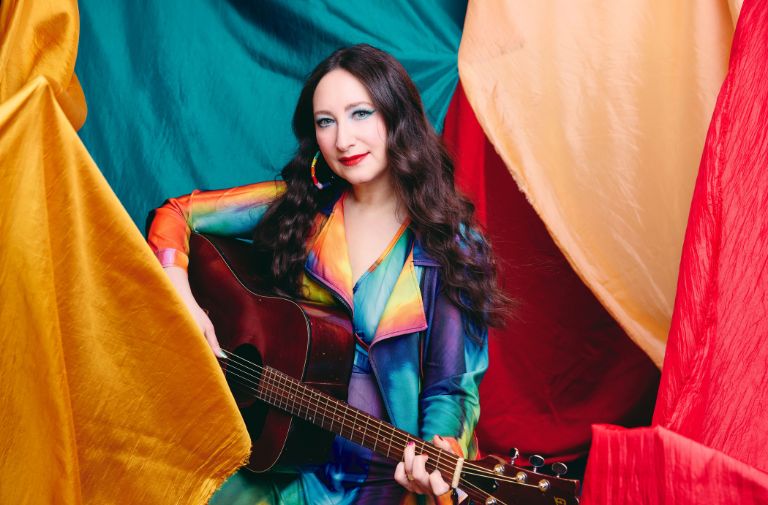
Independent queer singer/songwriter Rachael Sage is nothing if not prolific, considering that she has released nearly 20 full-length albums and multiple EPs over the course of 30 years. In addition to her busy live performance schedule, she runs her own label, MPress Records, which has issued albums by queer acts including Melissa Ferrick and K’s Choice, as well as the solo debut by James Mastro of The Bongos fame, among others.
Sage’s new album, “Canopy” (MPress), credited to Rachael Sage & The Sequins, is a knockout. Available on luscious orange vinyl, and in a CD version with a slipcase and accordion-style layout, the album features more than a dozen songs, including Sage originals alongside two cover tunes. Always a delight, Rachael kindly made time for an interview at the time of the album’s release.
Rachael Sage performs on February 17 at the Helmerich Theater in Key West and on February 18 at Hugh's View Rooftop in Key West.
Rachael, if I did my obsessive research correctly, you’ve been crediting your band The Sequins on your albums since 2008’s “Chandelier.” Your new album, “Canopy,” is the first album officially credited to Rachael Sage & The Sequins on the cover. What brought about the change in branding?
I don’t know that it’s a change in branding so much as an appropriate time and project on which to include them as being featured; no doubt I will still release projects that just have my name but for this one it really was more genuinely collaborative in the studio and much of that is a reflection of how much touring we’ve concertedly done, in recent years. While we haven’t always been playing together as one big group, I’ve done a lot of shows with all these individual players as duos, trios, and occasionally quartet configurations, and when we recorded the album, a lot of the basics included at least three or four members. There was definitely more of a “band feel” to the material itself, and it just felt - especially given the nature of our highly fragmented culture and the themes of inclusivity contained in the album - like the perfect time to honor these wonderful bandmates who also happen to be my best friends.
Speaking of album covers, you have always had a hand in the album artwork. Please tell the readers about your process when it comes to designing the artwork for your records.
I’ve always been very involved in my album artwork. A whole bunch of my records, I did all the design and layout myself, and sometimes that was more challenging when I was also multitasking, running the label, and working with other artists or on tour. Through the years, I’ve come to really enjoy that visual side of things and often incorporated my paintings or collages, and sometimes my handwriting. The last several releases I’ve worked closely with my co-designer Chris Kornmann, whom I actually met when he sent MPress some of his work with Tori Amos! I reached out, and we’ve been working together on many of my releases since then. For this latest album, I had a very clear vision that I wanted the CD to be a kind of coffee table book with hardcovers on each end that folded out like an accordion, and that the color scheme would be bright, bold, and reflective of the Luna Luna pop art exhibition last year in NYC. We incorporated photos by Shervin Lainez and Anna Azarov, along with a bunch of paintings I created specifically for this album and color palette. It’s the most vibrant and ambitious package I’ve ever done by far and was truly a labor of love. The vinyl for this record is also really fun - it’s bright orange and definitely exudes joy!
I’m always intrigued by the songs that songwriters choose to interpret on their recordings. Over the years, you have covered many songs, including Yaz’s “Only You,” Maria McKee’s “Breathe,” Ani DiFranco’s “Both Hands,” Neil Young’s “Ohio” and “Helpless,” Howard Jones’ “No One Is To Blame,” and Melissa Ferrick’s “Anything Anywhere,” among others. What’s involved in your cover song selection process?
I don’t think of myself as covering songs so much as occasionally playing songs I wish I’d written; so maybe that’s my process. I never played in a cover band and if you ask me to randomly cover a song you like I’ll probably struggle with it because while I have a pretty good ear it’s just not something I do much of and I don’t read music. There are songs that are either from my youth, or occasionally I encounter nowadays, that just feel like something I could’ve written or wish I had and it’s a very natural process for me to arrange in my own style. It’s been roughly a dozen (covers) in the scheme of my entire career, which isn’t really that many compared to all these young YouTubers covering songs constantly! Whether it’s the melody or the lyrical content/story, these songs captured me in a unique way, and I hope I’ve done them justice or at least helped bring them to my audiences with the respect and reverence that I have for the material.
“Canopy” is no exception when it comes to covers and features your interpretations of Buddy Holly’s “Everyday” and Irving Berlin’s “God Bless America.” Your choice of the Berlin song feels especially timely, given the current situation in our country, considering the rise in anti-Semitism, and the song having been written by a Jewish immigrant from Russia.
I first performed “God Bless America when the charity Tuesday’s Children asked me to play it at a benefit event in NYC. I had already written an original song for the occasion – “The Tide” – which later appeared on an EP. The event coordinator asked if I would mind also singing “God Bless America,” and, while it was initially intimidating, I thought “wow, this is an opportunity to really do something unique with my cellist and violinist and give a classic patriotic song my own spin”. It was fun to rearrange it in our own style, and vocally, I was surprised how comfortable it felt; that’s not always the case with covers. The day I played it at the benefit, it was very emotional, and the entire room at The Pierre Hotel rose to their feet while we played it, which was a complete surprise. It felt very holy and humbling and was a day I’ll never forget because we were there to honor 9/11 First Responders and fundraise for their families - it was a very high-pressure but beautiful way to first perform the song.
The dedication for the song “Nexus” reads: “For Nex Benedict’s family.” Nex Benedict was a non-binary teenager who committed suicide following relentless bullying at their high school.
When I heard about this story in the news, it cut me to my core. I was able to picture all too vividly how they were brutally beaten and bullied by their peers, especially because I was very badly bullied in grammar school growing up. It got so bad that I eventually refused to go back, but it had already been five solid years of terrible behavior to which no adults at the school were willing to stand up or hold my bullies (or their parents) accountable. I wrote the song in about five minutes, imagining how their parents must feel in a moment not only of such profound loss but also within the context of the LGBTQ+ community protesting around the tragedy and how overwhelming all of that must be when the issue is so personal and private yet becomes a lightning rod for the larger related issues - politically and otherwise. Empathy is the heart of the song, and trying to put ourselves in each others’ shoes in practice - by actually standing together and doing whatever we can to stay united as allies and LGBTQ+ people when God forbid these awful - and highly preventable - things happen and too many people are willing to look away or are willing to ignore because they aren’t personally affected. By the end of the song, it’s a rallying cry to be as present, resolute, and strong as possible as a community and to continue to support and lift one another up with as much conviction and generosity as we can, whatever divisiveness may be at play in our broader culture. In that sense, it goes from tragedy to positivity and hope, which is something I always strive to do rather than just to comment or chronicle.
Your first album, “Morbid Romantic,” was released in 1996. Are there plans to do something to commemorate the 30-year anniversary?
We have a lot of loose plans to commemorate the 30th Anniversary of my founding and running MPress Records, but nothing specifically to mark that album as of yet. In some ways, I thought of it as the first “demo” I made that felt strong enough to share more widely, and at least half of the tracks on it were, indeed, the original demos. Most of it was tracked sort of piece-meal around my existing piano or keyboard parts and in that sense it wasn’t exactly a “live” affair in the studio but it does reflect my sensibility from my early 20’s and where I was at at the end of college an early into my time in the NYC scene, recruiting studio musicians like Shawn Pelton and Mike Visceglia to play on the recordings - co-produced with Andy Zulla. In many ways though I consider the subsequent album, “Smashing The Serene” to be my first proper album because by then I had a real band and we’d been playing local clubs like The Bitter End and Siné - so we can definitely expect a lot more fanfare for that one…especially since it contains “Sistersong” which of course I still play to this day.
Many of your songs have a theatrical quality to them. Do you think you might have a stage musical in you?
You’re definitely not the first person to tell me this and ask that question. I’m not quite sure what to make of it though, on a practical level as I have no experience and really no inclination to write one currently. Never say never, though, and certainly if someone came to me with a compelling story/book or someone like Harvey Fierstein needed a composer and Cyndi Lauper was unavailable [laughs], I would jump at the opportunity! My main challenge would be that I don’t actually read or write music - as in notation - but I imagine if I worked with an experienced Broadway-type arranger that wouldn’t be too big a hurdle. Sarah Bareilles is someone I admire who has made that leap so elegantly as has Anais Mitchell, and I know they worked on these pieces for years and with such impressive results!