

Drip. Drip. Drip.
Rain slipped through the ceiling of the old Pride Center, splashing into buckets arranged around the room. Cheap lamps from Poverello cast a weak glow over folding chairs and a table of snacks. The place, as CEO Robert Boo once put it, “smelled like a urinal.”
“It was grungy,” said Kristofer Fegenbush, who joined The Pride Center nearly two decades ago. “I used duct tape to make X’s on the floor so I wouldn’t interrupt the cool discussion that would be happening when it started raining.”
It was makeshift, but it was where people opened up, changed their lives, and found hope — and where Fegenbush helped build what would become one of South Florida’s most vital LGBTQ institutions.
Now, after two decades — most recently serving as Chief Operating Officer — he’s left for Portland with his husband and son, leaving a legacy woven into nearly every corner of the organization.
The Early Days
In 1993, Fort Lauderdale philanthropist and gay pioneer Alan Schubert envisioned a place where LGBTQ people could gather, organize, and grow — a safe space that would support groups serving the community. What began as the Gay and Lesbian Community Center of South Florida evolved alongside the movement itself.
Fegenbush grew up in rural central Kentucky, in small towns like Burgin and later Danville. That tight-knit upbringing would later echo in the way he built connections at The Pride Center.
Before landing in South Florida, Fegenbush spent nearly four years in Mexico working with a faith-based community development organization across Latin America. The experience shaped his global view of service and taught him fluent Spanish, a skill that proved useful once he arrived in Broward County.
Those experiences informed the way he approached service once he reached South Florida.
As a newly out young man, he spent years traveling between South Beach and Fort Lauderdale to see Robbie, who would later become his husband. One night, on Robbie’s porch, two huge dogs wandered up the steps.
“Oh, Norm’s dogs,” Robbie said. The pair walked them home, and on that doorstep the late Norm Kent learned about Fegenbush’s background, encouraged him to interview at AIDS Project Florida, and within days he was hired. It became his entry point into South Florida’s HIV services world.
When AIDS Project Florida shut down, he brought the PALS Project to The Pride Center, including Choices and the LIFE Program, supporting people living with HIV through education, empowerment, and community.
In those early years, Boo remembers him leading sessions in a converted garage. “During the group, he would, just very casually, pick up a bucket and put it underneath the place where the leak was.”
The space was rough, but what happened inside laid the groundwork for the Center’s future.
“I got to sit through those graduation ceremonies, and it was just always so emotional,” Boo recalled. “Kristofer would be on the opposite side of the room from me, and we were both sitting there going, ‘Oh my god, oh my god, oh my god,’ just tears rolling.”
Boo and Fegenbush’s careers have been intertwined for nearly two decades. Boo started three weeks before Fegenbush, and ever since, he said: “I knew he had my back. He knew I had his.”
A Servant’s Heart
By the mid-2000s, the Center was preparing for a new chapter of its own. In 2005, the Board sold its Andrews Avenue property at the peak of the real estate boom and invested in a five-and-a-half-acre campus in Wilton Manors, the future Equality Park. After a $1 million renovation, the Center reopened in 2009 as The Pride Center at Equality Park, offering more than 30,000 square feet of meeting and office space.
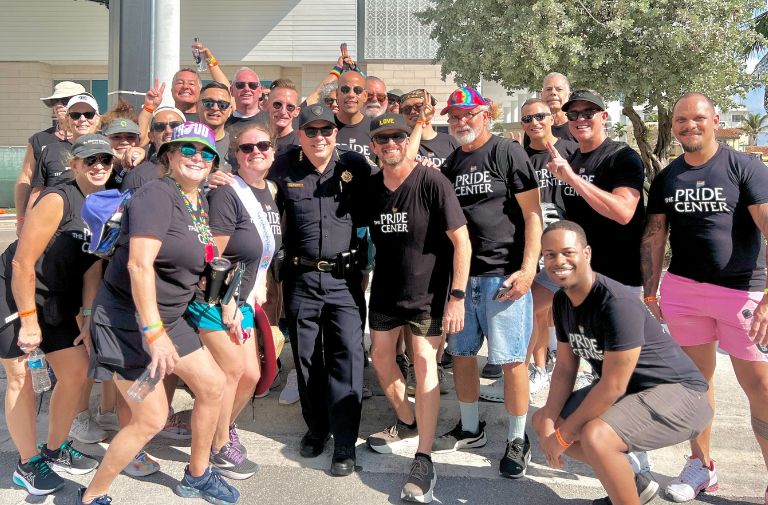
What began as a partnership built on duct tape and determination became a leadership duo that defined the Center’s growth. Together, Boo and Fegenbush steered the organization through hurricanes, budget freezes, and the pandemic, keeping programs running when many others went dark.
Among the moments that defined Fegenbush’s leadership, Boo said one stands out: the night of the Pulse shooting. Boo was out of town, and bringing the community together fell to Fegenbush.
“He was able to pull together the first vigil after Pulse,” Boo said. “We had all of these elected officials and religious leaders, and close to 1,000 people coming together to mourn the attack in our community.”
Boo said the steadiness Fegenbush showed during Pulse reflected the systems he’d been quietly building for years.
“Our community is going to be at a loss from those skills and abilities that he had,” Boo said.
Others in the community echoed that sentiment.
“Kristofer has that amazing ability to balance business with personality,” said Denise Spivak, CEO of CenterLink. “He was generous with his time, his heart, and his talent. That’s the core of his legacy.”
She added that “the team that he and Boo made” was “the secret sauce.”
The PALS and LIFE programs he brought to the Center have since sunset, but their influence remains — in the lives they changed and in the compassionate model of care he helped embed into the Center’s DNA.
His legacy was most visible in the people he supported through crisis.
One afternoon nearly 15 years ago, current Wilton Manors City Commissioner Chris Caputo climbed the stairs of The Pride Center after testing positive for HIV.
“I walked upstairs to his office, and Kris and Robert just took me in,” Caputo said. “They made me feel safe. It wasn’t about being a client or a number – it was like the world stopped, and he was going to help me through it.”
“It’s easy to see how someone in that role could become cold to it,” Caputo said. “But he made me feel completely safe, like I was the center of the universe.”
Caputo later volunteered, joined The Pride Center’s board, and carried forward the lesson he learned that day. “He taught me what it looks like to care about community,” Caputo said. “He could walk into a room and figure out what it would take to empower someone to do their best.”
That instinct to lift others up shaped his leadership style.
Lorenzo Robertson, now executive director of the Ujima Men’s Collective, said Fegenbush changed the course of his career by seeing potential he didn’t yet see in himself.
“I was working with The Pride Center as a contractor,” he said. “He was like, ‘Lorenzo, you're so good at what you're doing.’” Fegenbush encouraged him to apply for a permanent role, telling him he would be “very instrumental” in shaping and implementing the program.
“He didn't have to do that,” Robertson said. “They could have hired somebody else, but he thought that I would be very good to actually implement that program. He saw me in a different capacity.”
Robertson said Fegenbush’s “soothing and welcoming” spirit made him the Center’s quiet backbone.
“So many people don’t realize the impact and the amount of work that he did to promote and to build The Pride Center,” he said. “He was very supportive. He's very honest, transparent. He lives his life authentically.”
Across programs and partnerships, Fegenbush’s influence rippled through South Florida’s LGBTQ and HIV service networks. “He cared about other people more than himself,” said Rev. Leslie Tipton. “He had what we call in Christianity a servant’s heart.”
Faith shaped him early. His father was a preacher, and for part of his childhood the family lived in Kansas City while his father attended seminary. Even after coming out and leaving the church community he grew up in, those values — humility, service, and care for others — stayed with him.
“He always looks for ways to lift people up,” Tipton said. “In a world where many look to put others down to make themselves feel better.”
Goodbye, South Florida
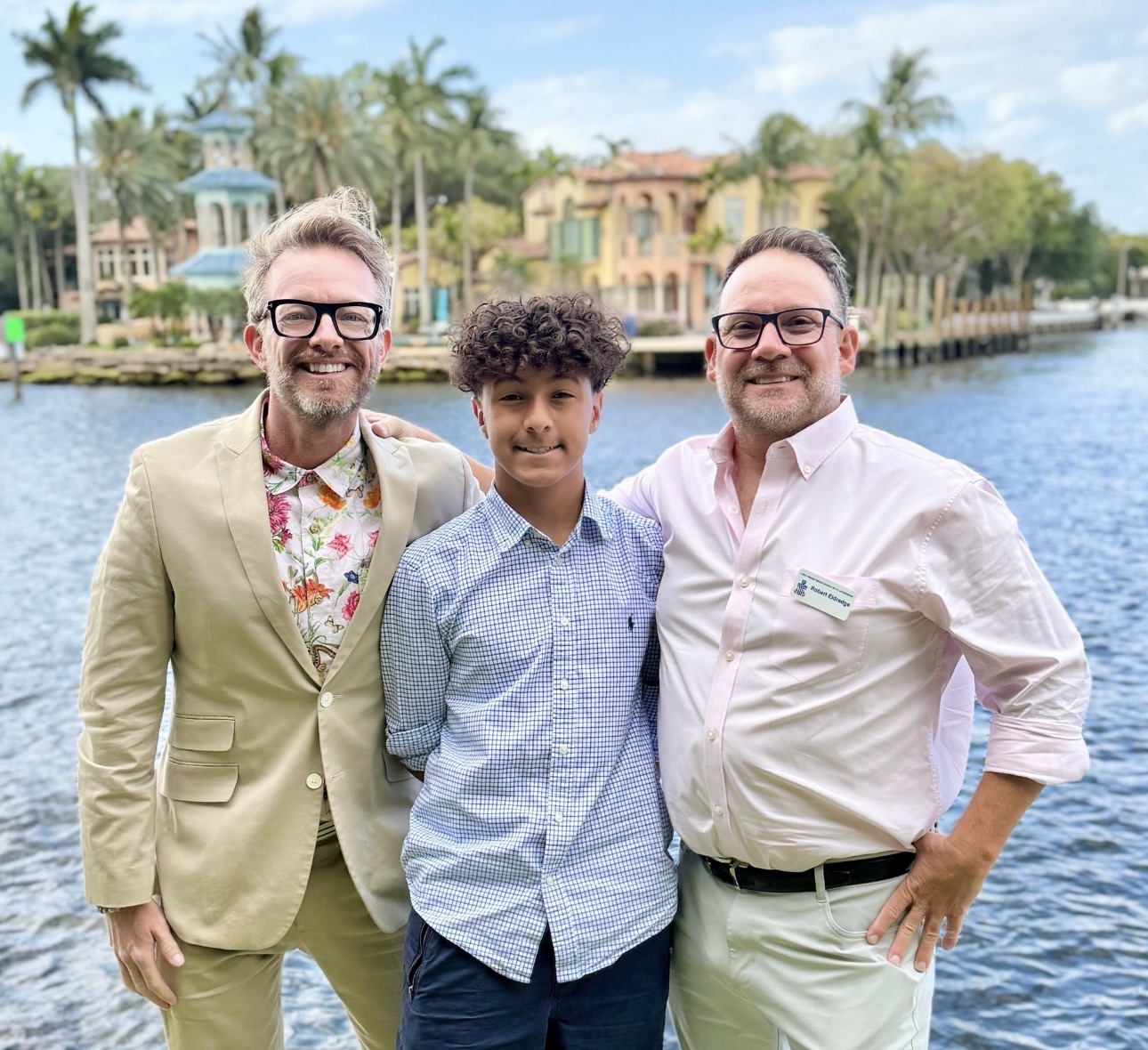
Leaving Florida wasn’t an easy decision, but it was the right one for his son, who has just begun high school. Under the current administration, Florida has taken what Fegenbush calls many steps backward, especially in its assault on diversity, equity, and inclusion. Over the past four years, LGBTQ organizations across Florida have experienced a hostile climate.
“When I walked into his [new] school, there were unapologetically queer posters and Indigenous rights and union rights and environmental justice and all of these posters,” he said. “I think there were educational factors, economic factors, and, without a doubt, political and cultural ones – and what does it mean to have two gay dads and a brown son?”
Family was central to the move.
Still, the decision to leave wasn’t simple. South Florida had been home for two decades.
“Those are deep roots,” he said. “I’ve been very involved in the fight for justice in Florida, and there’s a whole wrestling process that happens, asking, does it feel like we’re abandoning the work?”
In the end, parenting tipped the scale.
“As a social worker, I can make the decision to stay and fight,” he said. “But as a parent, I have to recognize that this is impacting my son in ways that matter.”
Though Fegenbush now calls Portland home, his connection to The Pride Center isn’t over. Since leaving, he’s continued consulting remotely, helping guide transitions and advising on ongoing programs.
Fegenbush’s departure comes as the Center faces the most uncertain funding landscape it has seen in years.
For now, he won’t be replaced. Boo said these are trying times for the organization as it reassesses budgets, grants, and staffing structures.
“With all of the funding cuts, we need to wait and see how the dust settles,” Boo said.
Recently, Boo received word that the Center would not receive any funds from the State of Florida for its HIV testing services, a first in 19 years.
“The loss of the Department of Health grant hurts. It's painful,” Boo said.
Until the organization stabilizes, Fegenbush’s team will report directly to Boo while the Center evaluates its budget and structure.
Although he rarely talked about his own accomplishments, Fegenbush identified three achievements that meant the most to him during his time at The Pride Center.
“I think the campus is a big one,” he said. “I think helping the Center grow into a full campus — that means a lot to me.”
He was also proud of the invisible work, the internal systems and structures that kept programs running smoothly. “I’m really proud of [that],” he said. “Things people don’t even see that make everything work.”
Above all, he pointed to the human impact: “I’m proud of the people. The staff who grew into leaders, the clients who changed their lives, the partners who trusted us. That’s the work that matters.”
Alan Schubert imagined a place that would be South Florida’s premier point of connection for the LGBTQ community. Fegenbush spent two decades turning that vision into something real — a campus alive with community, where seniors are seen, trans people are cared for, and families know they belong.
As Fegenbush settles into Portland, the buckets and duct tape are long gone. But the heart he poured into The Pride Center still holds it all together.