When the lights go down and the first notes of “No One Mourns the Wicked” echo through a theater, something electric happens among queer fans. Glittering pinks, defiant greens, found families in the rows. “Wicked” is not just a blockbuster movie or box office smash. It is a lifeline. A mirror. A political scream wrapped inside a ballad.
“Society is telling you that you’ve got to be a certain way. You have to find an enemy,” said Craig Marasco, a self-described superfan. “And not to get political, but that’s exactly what our government is doing — finding scapegoats within our community.”
Originally a Broadway musical that premiered in 2003, “Wicked” reimagines “The Wizard of Oz” through the eyes of Elphaba, the misunderstood green-skinned witch later known as the Wicked Witch of the West.
Based on Gregory Maguire’s novel, the show became one of the most successful Broadway productions of all time. The recent two-part film adaptation — with “Wicked: For Good” now playing in theaters — has amplified its reach, cementing its place as a cultural phenomenon far beyond the stage.
Marasco, a librarian, remembers the moment he realized the musical wasn’t just another show. He went to Toronto with his mom and a high school friend because it was the closest they could get to Broadway. When the show toured in Rochester, his family went again. Eventually, they splurged for Broadway itself.
“Again, fell in love with it,” he said.
He stood at stage doors with his poster, collecting signatures. The musical became a comfort he could return to through breakups, COVID delays and political turmoil. “It’s become one of my comfort movies, because we all have those.”
Marasco says the story hits home especially hard for LGBTQ people. “You know, being who you are, showing your true colors, not having people get you down. You have a cause that you believe in,” he said.
Comfort as Resistance
For John Alvarez, an elementary school teacher, “Wicked” arrived right after his grandmother died. “She was like my mother,” he said. “I went to the premiere. It comforted me [and] almost my entire family.” Later, when summer grief eased enough for reflection, it hit him. “We see our grandmother in that character,” he said of Elphaba. “Her resilience, her bravery.”
He sees the political allegory clearly. As a Florida educator, the silencing of Dr. Dillamond, a beloved animal professor who is forcibly removed from the classroom for speaking out, felt personal.
“Wicked” shows a world where students are too afraid to speak the truth. Florida feels a little like Shiz University right now, the elite magical school in the movie where fear, conformity and political pressure silence students and teachers alike.
“It’s our responsibility to listen,” he said. “It’s not our responsibility to go ahead and tell their parents that their child came out to us.”
And Alvarez did not hold back on the Wizard.
“There was one line that essentially says that people will believe anything, no matter what,” he said. “And that’s something very Trumpian. People will. And it’s sad.”
For others, the politics of the movie land most powerfully through questions of identity and representation.
Cheyenne Boddie, a sociology graduate student, also sees identity politics coded into every green frame. Watching Cynthia Erivo as Elphaba opposite pop superstar Ariana Grande’s Glinda was profound.
“As a Black person myself, I was decided Black at birth. It was really powerful to me,” they said. To them, a Black Elphaba was a long-overdue choice that sharpened the metaphor. “Having a Black Elphaba, I think, was one of the best choices that they made for this movie.”
Queerness is Built In
The queerness does not stop at interpretation. Several cast members bring their own identities into Oz. Several cast members are openly LGBTQ, including Cynthia Erivo, who plays Elphaba; Marissa Bode, who plays Nessarose; Jonathan Bailey, who portrays Fiyero; and Bowen Yang, a “Saturday Night Live” star who plays Glinda’s friend.
Michael Clarkson, who works in language access in health care, has been a fan for more than 20 years. His first “Wicked” night was a group trip organized by his college LGBTQ student office. “So it was a whole bunch of gays from CSU,” he laughed, recalling the bus ride to Denver’s Buell Theatre.
Since then, he has seen the show five or six times. It was the first soundtrack he learned before seeing a musical. He notices the love story beneath the spellcraft. “There was sort of a queer love connection between Glinda and Elphaba,” he said. And even for viewers who did not ship Gelphaba, queer people know that feeling — that moment, Clarkson says, when “I have a crush on my best friend at school.”
The movie invites it. FayWhat?!, host of the eponymous show and OutSFL’s 2024 Local Person of the Year, felt it immediately. “It felt so LGBTQ integrated,” FayWhat?! said. “We are constantly being labeled ‘other.’ And then the movie turns that being labeled ‘other’ into your power.”
Clarkson sees the metaphor loudly. “It is like a timeless sort of thing that unfortunately in our country has never not been accurate,” he said. “But I think especially now that is acutely pertinent — the active attempts to strip rights from the LGBT community, particularly the trans community.”
Survival, Song by Song
For Esteban Deleón, “Wicked” has been a companion through heartbreak and healing. He read the book first, then saw the first touring production on opening night at the Kennedy Center. He has watched Part One of the film “at least once a week” for a year and even saw Part Two in Brazil on release weekend. With both soundtracks downloaded, the story has become a constant in his life.
After a divorce, the story helped him rebuild. During treatment for cancer, the movie has taken on an even deeper meaning. Deleón said the familiarity of the story has become a source of grounding during scans, appointments and long days of uncertainty.
“It’s a comfort for me,” he said. “The music is uplifting for me when I’m having an off day, when I’m having a down day, when I know I have to go in for treatment, or when I’m nervous.”
For Deleón, predictability matters.
“It’s a familiarity because I know the plays, the books, the movie. I know what’s going to happen,” Deleón said. “So it’s that part of my life right now where I want to control things, if you will, because I can’t control what’s going to happen to me.”
The character that hit him hardest is the green girl who accepts blame that never belonged to her.
“I cried so hard … because I never had somebody say that to me,” he said.
Being forced out of the closet as a kid left scars. The movie gave words to trauma.
“That may be your secret, but that doesn’t make it true,” he said, quoting Glinda. He turns away whenever that scene plays because the tears still come.
The politics aren’t subtle to him, either, especially when it comes to how quickly political power can reverse hard-won progress.
“It took one second to destroy progress,” he said. “And that’s exactly what happened. We made all that great progress under Obama and everything and then all of a sudden just took one person and we’re back to where we are today.”
Marasco sees that same danger in how easily misinformation takes hold.
“People will believe all things that aren’t true … what did Trump say?,” he said. “Oh yeah, ‘I love the uneducated.’”
Where Meaning and Magic Meet
Aurora Dominguez is a journalist, teacher and cosplayer. Her friend dragged her to “Wicked” screenings, and she later interviewed author Gregory Maguire at the Miami Book Fair for OutSFL. The room was nearly empty, which felt wild given the film’s release. That direct insight into why he reimagined Oz made her fall in love.
She sees the characters as two halves of the single human psyche. Elphaba rejects norms. Glinda clings to them for security. “She likes the attention and she feels like that’s going to bring her some sort of joy,” Dominguez said. It is the tension queer people know well: follow the expected path or the truthful one.
“It came at the right time,” she said. Art becomes courage when your home state is hostile. “People need some sort of, not just an escape, but they want to see themselves.”
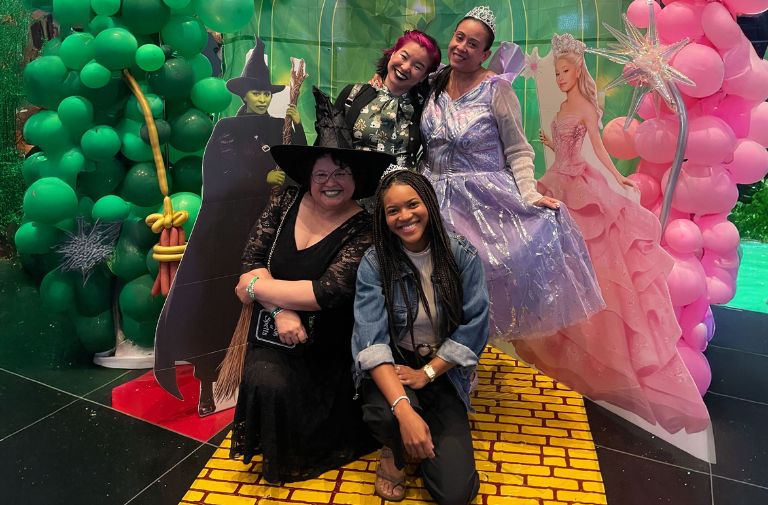
And it brought her friends together. Adults drowning in responsibilities needed a reason to dress in pink and green and remember joy.
Stephen Roland understands the joy part better than most. He went from avoiding the Broadway cast recording entirely to seeing the first movie 15 times in the theater. He and friends made a ritual of Tuesday dinners followed by movie nights, returning again and again for the rush.
“It’s like riding a roller coaster and wanting to ride it over and over and over again,” he said. “You just feel so invigorated.” He sees the menace behind the magic, too. “It’s crazy how relatable it is to today.”
“The wizard is a certain someone,” he continued.
In a world that keeps demanding silence, “Wicked” reminds queer audiences that survival itself can be spectacular — and that sometimes the most radical thing you can do is keep singing.