

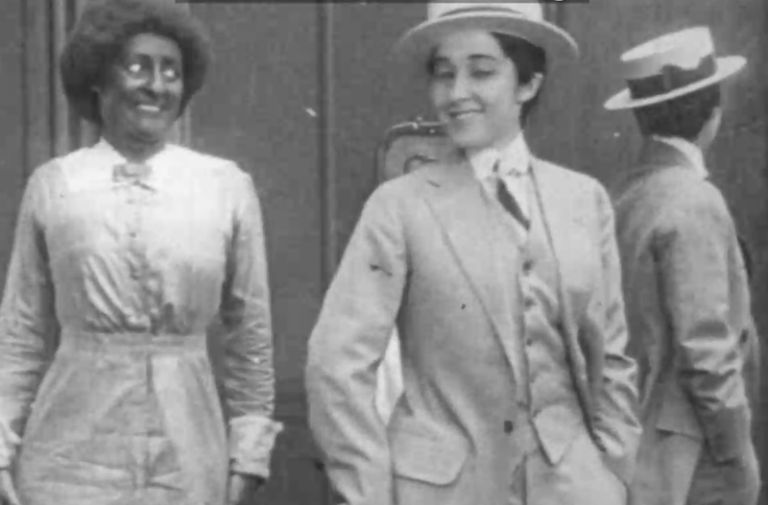
In the 1910s, Americans were still marveling at the new form of entertainment known as the moving picture. Movie houses were springing up in cities and towns across the country, and Florida was no exception. The state’s warm climate, abundant sunshine, and distinctive landscapes also made it an increasingly attractive destination for the fledgling film industry, at a time when filmmakers were heavily dependent upon natural light and favorable weather.
It was in this setting that Marguerite Bertsch and Eugene Mullin adapted “A Florida Enchantment” for the screen.
For early movie makers, Florida offered something more valuable than just scenery. At the time, film cameras depended heavily upon available light as artificial lighting was still primitive compared with what would become standard in later studio filmmaking. Florida’s sunshine and warm climate made it an attractive destination for filmmakers looking for reliable conditions in which to photograph their scenes. The production took advantage of locations in and around St. Augustine, with portions of the movie also filmed in Jacksonville and the St. Petersburg area.
The result was a film that was distinctly Florida in more than name. Florida’s tourist landscape, hotels, and tropical atmosphere became part of the fantasy surrounding the story. The state’s image as an exotic destination for Northern visitors provided an appropriate setting for a story in which the ordinary rules of sex and gender were about to be turned upside down.
The story itself was hardly new at the time. The screenplay was based on Archibald Clavering Gunter’s 1891 novel “A Florida Enchantment,” which had subsequently been adapted into a stage play in 1896. While the novel is still widely available today, the play version is now considered lost, but the story survived long enough to find an entirely new medium in the age of the motion picture.
“A Florida Enchantment” follows Lillian Travers, a young woman who discovers a mysterious set of magical seeds. After eating one, she undergoes a transformation; she becomes Lawrence Talbot, a man who proceeds to flirt with women.
Her transformation does not end there. Her fiancé, Dr. Fred Cassadene, also eats one of the seeds with the opposite result. He becomes feminine and begins likewise attracting the attention of men.
What might sound like the premise of a contemporary queer comedy actually premiered in American cinemas in 1914. Its first South Florida screening took place on December 29, 1914, at Miami’s Dixie Theatre, which was known for its vaudeville-style screenings. The theater was located near what is today 1100 North Miami Avenue, then known as Avenue D, reflecting Miami’s practice of assigning letters to its avenues.
The production of “A Florida Enchantment” was itself a product of the rapidly changing filmmaking industry. Vitagraph, one of the largest American film studios at the time, sent its production company to Florida with Sidney Drew as director and the script in hand. The story was particularly well suited to location shooting. Rather than merely using Florida as a backdrop, the screenplay incorporated the state into the story itself, beginning with Lillian Travers and her fiancé, Dr. Fred Cassadene, at a resort hotel in St. Augustine.
The film presents something that is unmistakably recognizable to a modern LGBTQ audience. For much of the film, the characters cross boundaries of gender and sexuality that would become increasingly difficult to portray openly in American pop culture in the decades that followed.
But the people who made and watched the film did not necessarily understand these events in the same way that we do today. The modern concepts of gay, lesbian, and transgender identity cannot simply be transported backward into 1914. The film instead draws upon an older idea sometimes described as “sexual inversion” or the notion that a person attracted to members of the same sex might possess characteristics associated with the opposite sex, a difficult concept to grasp today, knowing what we do about homosexuality.
This makes “A Florida Enchantment" particularly fascinating to queer historians. It does not present homosexuality as a modern political or social identity. Instead, it reveals a period when Americans were still struggling to understand the relationship between sex, gender, and desire.
Additionally, there is another aspect of “A Florida Enchantment” that cannot be separated from its place in American pop culture: race.
The film contains depictions of blackface and relies upon racial stereotypes that are profoundly offensive to modern audiences. White performers portray Black characters using the conventions of minstrel performance, including makeup and exaggerated behaviors. One of the more prominent characters in the film portrayed this way is identified in contemporary descriptions as Lillian’s “mulatto maid.”
Interestingly, criticism of the racial portrayal was not entirely a product of modern sensibilities. Contemporary reviewers were capable of recognizing and criticizing the use of white performers in Black roles. A 1914 review in the “New York Clipper” specifically objected to Vitagraph’s depiction of Black characters.
Filmed in the 35mm film format in black and white, the film had no recorded dialogue for the audience to hear. The actors communicated through gestures and expressions, as typical in the era of silent films. Often during this era, a pianist or organist would be present in the theater to enhance the experience of watching film. Title cards would also appear between scenes to offer context in the form of a sentence or so about what was happening.
Many films of this era are lost. In fact, according to the Library of Congress, only about 14% of silent-era films survive today. Motion pictures were not originally regarded as permanent historical records. Early films were commercial products, often exhibited for a relatively brief period before being discarded, destroyed, or simply allowed to deteriorate. The fragile nitrate film stock on which many early movies were printed was also highly flammable and subject to decay. As a result, a substantial portion of American film history has disappeared.
“A Florida Enchantment” does not offer a simple story of LGBTQ progress. It was not a gay-rights manifesto, and its treatment of gender, sexuality, and race was shaped by ideas that are now more than a century old.
But perhaps that is exactly why the movie remains worth watching.
It captures a moment when the boundaries of gender, desire, race, and identity were being performed, exaggerated, and tested on a new kind of screen before audiences were even certain what this new medium could become.
And there is another reason the film deserves to be remembered in Florida. Long before the state’s modern battles over LGBTQ rights and decades before Florida would become associated with investigations and bar raids, a film connected to Florida was already placing gender transformation and same-sex desire before American audiences.
Copies of the film, which is in the public domain, can be found online at the Lynn and Louis Wolfson Florida Moving Image Archives at Miami-Dade College, and at the Miami-Dade Public Library System.