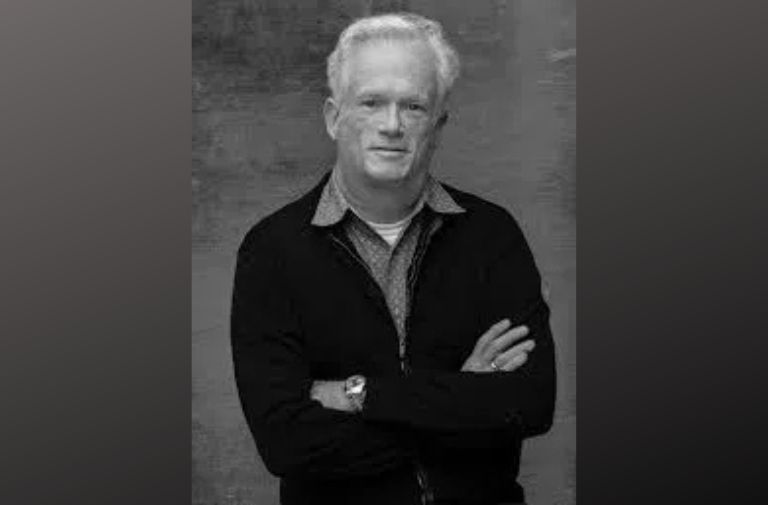
Acclaimed, Baltimore-based gay writer James Magruder’s new book, “No One is Looking at You” (Rattling Good Yarns Press, 2025), a collection of linked short stories, has everything we’ve come to expect from him, including rapier wit combined with the most extraordinary observations on the ever-evolving queer human condition.
Divided into two sections, the first half is sure to inspire nostalgic pangs for readers of a certain age, while possibly stirring up envy in younger readers. The second half, closer to the present day, practically boils with its shared sense of rage during these trying times. Magruder was gracious enough to make time for an interview at the time of the book’s publication.
Your new book, “No One is Looking at You,” is dedicated to two people, about one of whom you wrote, “Gwynn MacDonald, first to suggest short fiction.” “No One is Looking at You” is not your first foray into short fiction.
Gwynn is a theater director pal of many years. Around 2000, I was gaining no traction as a playwright. Gwynn remarked that the final gesture in a play I had written was the perfect capper to a short story — a genre I hadn’t tried since I was an undergraduate. I mulled Gwynn’s suggestion that I try short fiction when I went to MacDowell in August 2001 to write a play. I finished a full draft a week early, and rather than enjoy even more reindeer games with the other residents, I wrote a tiny little story. It felt good. When I got back to Baltimore — literally three days before 9/11 — I wrote some more stories, generally about older men I’d hooked up with in the twenties, and they began to get picked up by literary journals. I consider my second book, a linked collection titled “Let Me See It,” my unofficial MFA — I got so much help from the women in my writing group here in Baltimore.
You previously mentioned to me that there’s a story about the book cover photo of you, taken by Carla Zackson.
Among dozens of preppies in Fair Isle and Laura Ashley, Carla Zackson stood out as the “It Girl” of the 1980-81 Sweet Briar Junior Year in Paris cohort. Asymmetric hair. Leather jackets. Super long scarves. Cropped pants. Bisexual vibes. She’d lend me a multi-striped tube top and apply my eye makeup whenever we went out. Having witnessed my pelvic undulation skills on the dance floor, she decided to cast me in her thesis film (during) our senior year at Cornell. There was no script—I just writhed around an empty rehearsal space in the theater building while she rolled film. It was arty and very of the period. Was I Pan? Was I Eros? Baby Lucifer? I definitely wasn’t Tom Sawyer. I remember having French Lit after the shoot and how my lipstick, and eyeliner, and the leotard under my trench coat completely unnerved my closeted professor. All these years later, neither Carla nor I can agree on what she titled the movie. I say it was Requiem: Grey, but she says it's something else. We’ll have to ask her.
There’s often a fine line between fiction and memoir. For example, “Origin Stories,” the first part of “No One is Looking at You,” is set during the ‘70s and ’80s at Cornell University, at the time when you were a student there. At any point, did these stories begin as a possible memoir?
I don’t do memoir because I can’t/won’t stick to the truth. The six “origin stories” were all scavenged from my first unpublished — and, I see now, unpublishable — novel that I wrote in three months in late 1988, subsequent to my HIV-positive diagnosis. I wanted to write something before I died, as AIDS was a death sentence at the time. I drew its title from one of my favorite Dickinson poems – “Done With the Compass, Done With the Chart.” It covers the first great love affair of my life.
How much of you, if any at all, can be found in the characters Gordon, Kevin, Jason, Marc, Sam, Boyd, Kurt?
They’re all me, with different names and home states. Well, Boyd in “Cufflinks” was my great love, and I’m his desperate antagonist, Kurt. He’s also the repressed Irishman that Maggie dismisses in “Orality.” I don’t stutter like Kevin does in “Tree Surgeon,” but that’s exactly how I lost my gay virginity, from the graffito in the bathroom stall to the chemistry lecture and the “Don’t Touch My Tuts” t-shirt the morning after.
When reading a novel, it’s not uncommon for a reader to have favorite sections of the whole. But when it comes to short stories, with each piece being distinct from the others, choosing a favorite, such as “Faculties,” which is mine from the first section, becomes easier. Do you have favorites from both sections? Which ones, and why?
I’m glad you picked “Faculties” — the long paragraph where Marc (is it Marc?) describes the faculty living room is without a doubt the purplest prose I have ever penned, and I was 27! When I started scavenging the novel in 2016, I kept that section intact. I couldn’t write it that way today. It would embarrass me. On the other hand, the wrap-up to “Faculties,” where Marc meets the daughter of the lover in a toy store, was added twenty-eight years later. As for my favorite in Part One, I might be partial to the yearning and sadness in “Hoo-Whee.”
In “Coil,” the first story of the second section, “Parting Shots,” Roger, the main character of this section, says “I am a middle-aged, tenured smorgasbord of white cis-male privilege, so no one is looking at me,” a line from which the book’s title is derived.
Two thoughts here. “No one is looking at you,” is an Irish-Catholic curse (the other Irish curse) parents put on their children from an early age. Its twin is “Who do you think you are?” Both are designed to promote the idea that you are not special, so don’t try anything to stand out. Stay in your lane, or you will be CUT DOWN by God, a nun, or by me.
The title is also a tongue-in-cheek reference to my “positionality” in today’s culture, which has been in a necessary, overdue state of overcorrection. At least until the Orange Shit-Gibbon in the White House fences Blacks, gays, and Mexicans in their choice of Great Plains States. I am old, white, educated, and of means. In other words, I am a gay elder of privilege who is experienced and successful enough to have lost the crippling (and hilarious) self-consciousness of the young. Don’t get me wrong — straight white men had a good long run, fucking up the planet over millennia in the process, but poor Roger wants to share his wisdom, so different from knowledge.
Since you are an educator, as well as a writer, and you incorporate a variety of theatrical and poetic references in the book, including in “Coil.” Would it be fair to say that, on occasion, you are compelled to educate as well as entertain your readers?
If you mean in the Horatian sense that all art should aspire to a balance of dulce et utile [the sweet and the useful], yes. But not in a high-toned way. “Coil” also reminds (or teaches) the reader that there used to be things called travel agents, and paper plane tickets, and King Charles once said that he wanted to be a tampon inside Camilla Parker-Bowles. And that before 1990, there were virtually no Thai restaurants in this country.
Roger has some intense encounters in the stories of the second section. As I recall, you have spent time on the African continent. Was the story “Service Learning” inspired by that?
Putting the eight puzzle pieces of Roger’s life in “Parting Shots” was something of a chronological nightmare. I lost my hetero virginity in Munich as an undergraduate in 1980, as it were, but I had to move the experience to Sénégal, because Roger needs a job after graduating from Knox College in 1983, when they figured out that AIDS was transmitted through a virus. I spent a year in East Africa in Uganda, where they don’t speak French. I had to find a French-speaking African country where Audrey and Roger could meet up. Of all the Roger Hauf stories, “Service Learning” is the least autobiographical, but the overarching lesson — every woman of quality should have at least one boyfriend in her past who turned out to be gay — is an essential piece of Roger’s wisdom that he (and I) needed to tell. I’m proud of this story because I completely invented the Vistock family. All that is “real” is Audrey, who remains one of my closest friends after 45 years.
Roger also comes face-to-face with a former school bully nemesis in “Sister Essence.” Would you say that there is something cathartic about being able to write about that kind of experience?
Absolutely. It came about because one of my tormentors somehow managed to see “Head Over Heels” (the Tony-nominated musical for which Magruder wrote the book) on Broadway. He has a trans child, and he sought me out. It’s been a fine bromance ever since.
The story “Who Are Your People?”, set in 1985, contains an uncomfortable confrontation about the unhoused. It reminded me of Brian Kilmeade’s recent “just kill ‘em” controversy about the mentally ill homeless. Would you agree that we haven’t really come that far on the subject in almost 40 years?
I do indeed. During that weekend in Bucks County, I discovered I had politics after all. They’ve only become more radical in the ensuing decades.
“Worth Our Breath,” about gay fatherhood, made me think about your own personal experience with a partner who had children prior to the relationship. Additionally, “Amulet,” about cognitive loss, also feels very personal to me.
My husband of 26 years, Steve Bolton, “caught” four of his six children on a commune outside Santa Cruz. He came out in his thirties, and we now have three grandsons. “Worth Our Breath” features E.F., but he’s not the main event. As I was finishing the collection, my writing girlfriends, who all know and adore Steve, thought E.F. should get his own story. Hence, “Amulet,” which manages to demonstrate the infinite marvels of Steve and allows me to exorcise the demon of asking for my own omelet on our trip to Thailand. “Amulet” was written in the month before we sailed on the Queen Mary 2 in June 2024. This January he received a diagnosis of Alzheimer’s disease. My caregiver learning curve has been intense this year, but this role reversal — for Steve’s care had allowed me to flourish as a writer over the decades — reminds me every single day how much I love this man. The boys in “Origin Stories” have no idea of the ways and means of love, but if they are extremely lucky, they will be ready for their E.F.