

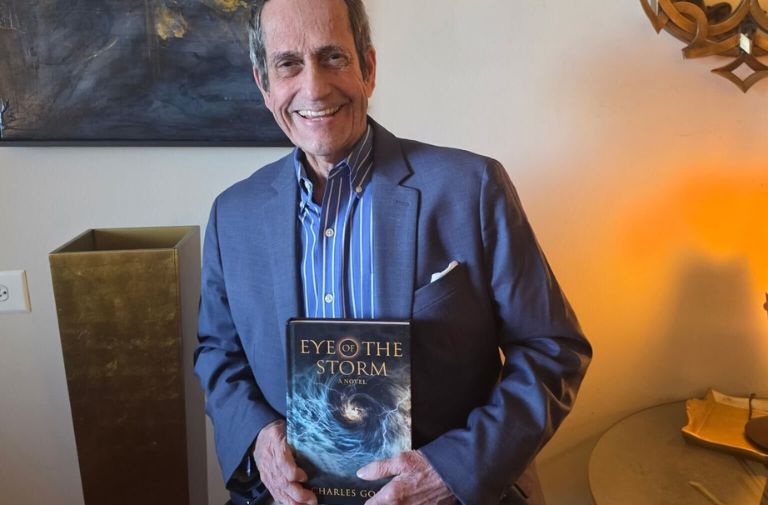
Certain South Florida stories begin long before the first sentence is written — stories shaped by heat, migration, storms, and the gravity of a city where survival often depends on reinvention.
And when Chuck Gomez speaks of his new novel, “Eye of the Storm,” he does so with the unadorned candor of someone who has already faced the worst and come out the other side. The Miami native, former WPLG reporter, and longtime CBS News correspondent has spent his life moving toward the subjects most people try to avoid.
His debut novel arrives after a year in which he nearly ran out of time. Gomez had been living with HIV for decades when sudden heart failure forced him into open-heart surgery.
The prognosis was bleak. “I thought it was over,” he said from his apartment in New York. But it wasn’t. A donor heart came through, and with it, the chance to finish a book, he said, that had been forming in his mind for years.
In “Eye of the Storm,” Gomez does what he has always done — he goes straight to the hard truths. Domestic violence. Child sexual abuse. Elder abuse. Mental illness. “That’s the journalist in me,” he said. “Wanting to confront injustice, wanting the world to be a little fairer.”
It’s familiar ground for the man who grew up in working class Hialeah dreaming of Coral Gables, the place that signaled you had “made it.” He eventually did — first in Miami television, then in Chicago and Los Angeles, and finally at CBS, where he became the first Cuban American correspondent in the network’s history. He won the Edward R. Murrow Award for Excellence in Journalism for going undercover as a homeless man in New York, reporting on the lives the city preferred not to see.
But fiction gives Gomez a different kind of space. His protagonist, Lazarito Lopez, is a gay Cuban American reporter for the fictional Miami Gazette, living with AIDS and navigating a world still shaped by silence and stigma. The parallels to Gomez’s own life are unmistakable, yet the story reaches beyond autobiography.
Inspired by a close friend who survived childhood abuse, the novel is threaded with the spiritual elements of Cuba — Santería, ancestral echoes, and the unseen forces people lean on when the winds pick up. And the winds do pick up. In true Caribbean fashion, the narrative builds toward a hurricane that functions as both plot and metaphor.
As a long-term survivor, Gomez, 72, watched the AIDS epidemic cut down a generation of gay men. When the Trump administration chose not to acknowledge World AIDS Day, the omission felt like an erasure. “Tens of thousands of gay men in their bloom,” he said. “Cut down. Men who never got to give us their gifts.”
Friends describe Gomez as warm, kind, generous, and unmistakably brave. The quality he names, though, is resilience. He remembers being told to get his affairs in order after his AIDS diagnosis, remembers the medications that saved him, remembers the new heart that bought him more time.
“That’s what I wanted for Lopez,” he says. “That sense that you can rise again, even when you don’t expect to.”
Forgiveness anchors the novel as well — particularly the story of a gay son who finds a way to understand and forgive the father who hurt him. “That always stayed with me,” Gomez said. “How someone can evolve toward that kind of grace.”
With “Eye of the Storm,” Gomez returns — at least on the page — to the city that shaped him, where hurricanes and history have always shared the same sky. It is, in the end, a Miami story: a story of survival, reinvention, and the stubborn hope that somehow holds even in the eye of the storm.