

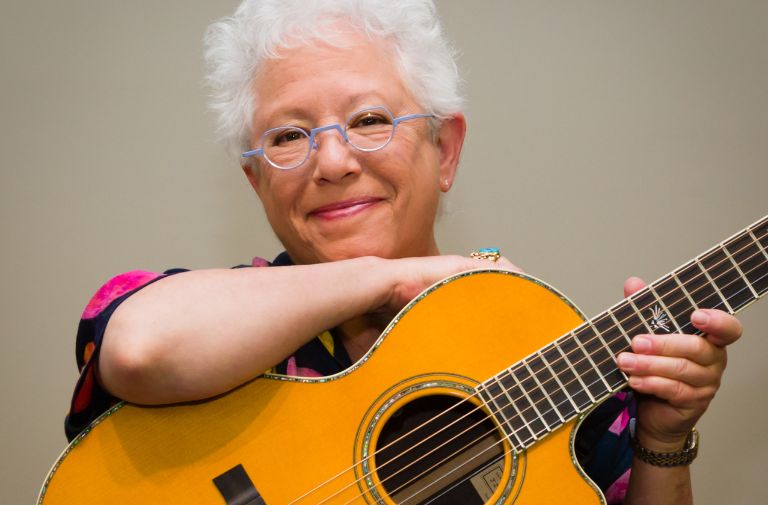
I’m humbled to say that queer Grammy Award-winning singer/songwriter Janis Ian was the first artist I interviewed when I began my journalism.
Since that time, I’ve had the privilege of speaking with her a total of seven times, including the following interview, conducted in early 2026. In addition to priding herself on being a dog lover, especially Porties, Ian has been the subject of a 2024 documentary, as well as her own memoir, reissued in a revised edition in 2025. More importantly, as both a singer and a songwriter, Ian has had an impact that stretches well into the 21st century, and likely beyond. Always a delight with which to converse, Ian graciously (in between puppy training) for an interview in advance of the Stonewall National Museum and Archives’ 2026 Standing on the Shoulders of Giants gala.
If you don’t mind, as one dog person to another, I’d like to begin by asking you to tell us about your new dog?
We’ve had Portuguese Water Dogs for 32 years. We've had three in the past. Two that we raised from puppies. One that we adopted at the breeder’s request when the dog was seven. We lost our last one in April of last year. We thought we’d never get another dog, as you always do. In September, October, we thought, “Wow, the house has a big hole in it.” I have bad allergies. PWDs are a type that I know I will have no problems with. We put the word out that we were looking for a four or five-year-old female that somebody had to give up. People die, people get sick, people can't take care of their dogs. We got a call mid-December that there was a 16-month-old male available. The breeder’s husband had had a series of heart attacks. They had had a litter of 12, and they had placed all of them except two. They were just about to place the female. Did we want the male? We said no at first because we've always had females. Then we looked at each other and said, “Here we are, looking a gift horse in the mouth. The dog needs a home. We need a dog.” So, we got Kobe. We left home on the 2nd of January and we met him on the 3rd in South Carolina and brought him home on the 4th. It's a big adjustment. He's only ever up until now been in the backyard with other dogs or in the car to go to the vet, which meant retraining him about cars being bad, or in the breeders’ home. Everything is brand new to him. It's kind of like having a 55 pound, eight- week-old puppy, which has been pretty exciting. He's big and he's lovable and he's a real sweetheart. Right now, he can't stand that my wife is on the porch and doing laundry downstairs, and I'm inside.
On February 21, 2026, you are being honored at the Stonewall National Museum, Archives, and Library gala in Wilton Manors, Florida. What does such an honor mean to you?
First of all, it means I'm old [laughs]. I reached the age about 10 years ago when people started calling me legendary, which, when I was growing up, was only applied to dead people.
A living legend!
Yeah, that's fine [laughs]. I’ve been honored a fair amount these last two years. I think it's amazing. Especially when it's coming from my own tribe, if that makes any sense. The gay community and I, in the early years, had an on/off relationship, I would say, because I wasn't out to them in the ‘70s, and I think there was some resentment among some of the women who were out, and paid a price for it. But I really didn't want to be known as a gay writer. I wanted to be known as a writer. That was really important to me. It's not like everybody in the business, and my family and friends, didn't know. The press knew! But they were good to me. I think it all started turning around with AIDS. I was one of the first performers to come out and say I'm doing AIDS benefits, and I don't care what you think. I did the first AIDS benefit in Manhattan and the first pediatric AIDS benefit in the country, the first AIDS benefit in Nashville. I pretty much went wherever people felt I could do some good. And then I wrote a column for “The Advocate.” I was hired to be what Judy Wieder, who was then my editor, said was “it’s a male ship, and we need a female on it, and we need some humor. I want you to be our resident iconoclast, poke fun at everything.” I wrote articles like, “Heather has two mommies, but she should have had a dad” or what's the most the one that got me in trouble? Oh, “Lesbian chic, a contradiction in terms.” Things like that. Just really making fun, but also sometimes hitting on stuff like mammograms or the treatment of the elderly by the gay community. I think it changed then. Over the years, as I got older, when I came out so publicly and loudly with (the album) “Breaking Silence” in ’92, it changed again. So, the gay community since then has been, I would say, supportive and good to me. In return, I've tried to be supportive and good to the gay community.
Have you ever crossed paths with fellow 2026 honorees Barney Frank or Jon Stryker?
No. I am extremely excited to shake Barney Frank's hand. He has been a hero of mine forever. I heard about him from friends in Massachusetts who worked on his early campaigns in the early or mid-1980s. I mean, talk about a leader. I think he's amazing.
Both you and Barney have written memoirs. Have you been to the Stonewall National Museum, Archives, and Library in Fort Lauderdale to see your book on the shelf?
I have not. We are actually going in two days early. My wife (Pat) is coming, which is unusual, and we're going in early so that we can have a tour of the museum.
It's so wonderful. You're going to love it.
I love the pictures online!
A new Roberta Flack box set, titled “With Her Song,” includes the “Killing Me Softly” album on which she performed your song “Jesse.” Would you please say a few words about Roberta, who passed in 2025?
In the great scheme of everything comes full circle, when my wife and I met, she was telling me how much she loved this artist Roberta Flack, especially a song called “Jesse.” I said, “Oh, I wrote that.” Pat immediately said, “No you didn't. Roberta Flack wrote it. I said, “No, I wrote it, really wrote it,” and we argued. I had to actually find a copy of the album, which was in storage, and show her the writer’s credit. I never got to meet Roberta, but our paths crossed in 100 different ways. Pat met her because she used to go see her in Washington, DC at a little nightclub…
Mr. Henry’s!
Yes! There you go! Then it turned out we shared the same publicist. So, I was able to send her a letter during the last year of her life and talk to her on the phone when she couldn't speak. She really jump-started my career again. She gave me credibility as a writer when a lot of the world had only known me from “Society's Child.” There were even rumors that my parents had written it. That no 14-year-old could have written that. She made me credible to the industry. I can't tell you how much that meant. It was like the kiss of God.
On Facebook, you recently mentioned Dusty Springfield’s cover of “In The Winter.” Do you have other favorite cover versions of your songs?
Sure! I thought that Céline Dion did an amazing job on “At 17.” She made it her own. Shirley Bassey's cover of “Jesse” was completely different from mine, as was Roberta's. Those two are favorites. Vanilla Fudge did “Society's Child,” and blew me away. I think that was like Bob Dylan hearing “Mr. Tambourine Man” from The Byrds. It had never occurred to me that the song could be done like that. I had one of those “Oh my God” moments when I was watching “Oz” one day years ago, and Rita Moreno sang a song called “Days Like These.” I was like, “That's Rita Moreno! Holy cow!”
What a great list that is.
Yes, it’s amazing. I can't say that I love all of them but I think when it's somebody like Bette Midler or Glen Campbell or John Mellencamp or Mel Torme, who literally listened to hundreds of songs before they would choose the 10 or 11 for an album, when people like that record your song that's the pinnacle. I was talking about this with Pat yesterday. I said, “I was a good singer. I was even, maybe sometimes, a very good singer, and I'm sometimes a very good guitarist, but I feel like I became a great writer. That was my goal from the time I was 16, to be able to feel like my work could stand next to…I don't mean to inflate myself but, next to Richard Rodgers and Oscar Hammerstein, or next to Stephen Sondheim, or next to Leonard Cohen. The people of my generation tried to hit that mark.
A new, revised version of your 2008 memoir, “Society’s Child: My Autobiography,” was released in 2025. What was added to the book?
It was less a question of addition, although there is an ending to the book now. Between when the book came out and when we did the revised edition, I lost my ability to sing. That was major. I lost all of my equipment [laughs], and stage stuff in the floods from the hurricanes in 2024; it's kind of God's final coda there. We got married legally and the world changed a lot. I wanted to touch on all of that. Also, Random House gave me back the rights which meant that they were no longer gonna publish it. There's enough in sales every year that it's worth putting out. The movie came out, and I thought it was important to highlight that. When I wrote the original book, I overwrote because I figured they would edit it. But [laughs] I had an editor who wasn't interested in doing much. Literally, there was no editing done except for factual. I really felt that there was stuff in there that didn't need to be in there, that was actually kind of boring. It took four or five months, and I went through it line by line, chapter by chapter, and then my agent and a couple of friends went through it again and fine-tuned it. I guess it was like reissuing (the album) “Between The Lines” when brooks Arthur and I did it with Steve Berkowitz. We went through it and said, “Let's make this as though we had all of this stuff we now have available.” Computers have changed a lot, Word has changed a lot, and publishing has changed enormously. But let's stick to the original ethos. That's what I tried to do with the book, as well.